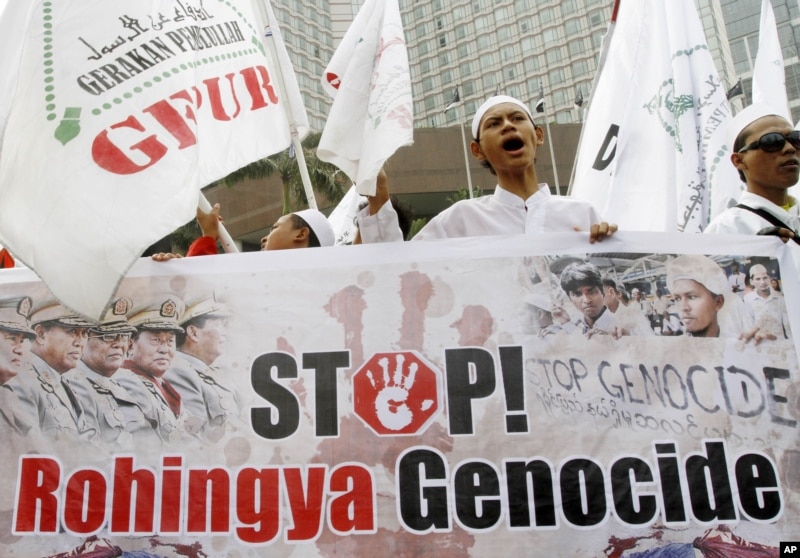
Thursday, 9 August 2012

"MASS GRAVES" FOR MYANMAR ROHINGYAS.

Aljazera, 8 Aug 2012
Exclusive report from Rakihne state exposes an entire region divided by religious and racial discrimination.
A recent journey to western Myanmar has revealed a provincial capital divided by hatred and thousands of its Muslim residents terrorised by what they say is a state-sponsored campaign to segregate the population along ethno-sectarian lines.

Decades-old tension between ethnic Rakhine Buddhists and Rohingya Muslims in coastal Rakhine state exploded with new ferocity in June, leaving at least 78 people dead and tens of thousands homeless.

Exclusive reporting conducted last week in the highly restricted region suggests that the long-term fallout from recent violence could be even more damaging than the bloodshed.

The United Nations has estimated that 80,000 people are still displaced around the cities of Sittwe and Maungdaw, and international rights groups continue to denounced Myanmar for its role in the conflict.

As it stands, any thought of reconciliation between local Buddhists and Muslims appears a distant dream.

Many Rohingya have fled the polarised region, fearing revenge attacks and increasing discrimination. Their status has sparked international concern and disagreement.

Rights groups have condemned the violence. The Myanmar government has denied any wrongdoing, while neighbouring Bangladesh has rejected an influx of refugees and slashed access to aid.

For those Rohingya caught up in the dispute, the day-to-day situation is rapidly slipping from desperate to dire.


Social 'non-engagement'

In Sittwe, the capital of Rakhine state, the scars of recent conflict were everywhere.

Burned homes, shops and entire markets dot the Buddhist-majority city of nearly 200,000 people. Traditionally Muslim neighbourhoods, such as Shwe Pyar, Nazi Konetan and Mawlike, were deserted, locked up, or living in deep secrecy.

Prominent mosques and buildings bear signs from the municipality reading, "No one is allowed to enter." Locals told Al Jazeera the properties have been taken over by the state. In some areas of Sittwe, the devastation from the violence that peaked in June is comparable to Cyclone Nargis, which struck Myanmar in 2008.

Most striking was the almost completely absence of the Rohingya population that once made up nearly one-third of the city's residents, and the largest portion of its working class.

The impact of that loss was obvious. The Rohingya who worked as the city's ever-present ricksaw drivers and porters at the jetty and markets are now gone. There are no signs of Muslims at the airport, the boat shuttles that ferry passengers to outlying islands, or even the local busses that run Buthidaung to Maungdaw, two Rohingya-majority states.

Local Hindus, and residents who appear to be of Indian descent, have taken to applying bindis to their foreheads to avoid being mistaken for Rohingya.

A range of interviews found that Buddhist Rakhines had collectively decided to practice a policy of "non-engagement" with the Rohingya. In practical terms, this meant a ban on businesses, as well as controlling access to food, medicine, travel and communication.

According to local sources, Rohingya are no longer allowed to enter the city's largest market or to travel from town to town.


'Facing starvation'

Outside Sittwe, where the fleeing Rohingya had gathered, the situation was worse. The village of Bhumei, a few kilometres to the west, was overrun by thousands of refugees who said they were forced from the city, first by mobs, then by security troops.

By local accounts, this camp is the biggest of the camps that have sprung up to shelter the displaced city dwellers.

The refugees endured the current monsoon rains in mud-floored tents, living mostly on bags of rice provided by the UN's World Food Programme. There is no clinic, proper bathroom or clean water, as witnessed by Al Jazeera.

 The tream - The plight of the Rohingya
The camp is surrounded by all hours by security troops. Many wonder if the soldiers are there to protect them from attacks from the Rakhine, or keep them under guard.

"Many of the refugees who fled from inside the city are manual labourers and daily wagers. We are having great difficulties just surviving each day. We fear what will happen to us if we go back to the town. We can't go there yet. Those who risked going back to their homes and shops were prevented by authorities on security grounds," said U Shwe Maung, a Rohingya refugee in Bhumei.

"We are sharing food with each other. We are now facing starvation. Even though we are provided food by the WFP, that is not enough for such a huge number of people like this," he added.

The Rohingya now forced to live in the Bhumei camp appeared desperate. One woman was crying in the street with her rain-soaked children on her lap. She said they were sick and there was clinic to look after them or food to eat.

"We want to go back to our homes if the officials provide security for us," said Mahmud Shiko, a Rohingya in Bhumei.

"The police told me I'd find nothing back there if I return, but I still want to go back."


Military accused

The wave of violence in June was sparked by the alleged rape and murder of a Buddhist woman by three Muslim men in a Rakhine village.

Both ethnic communities attacked rival villages and neighborhoods in the days that followed, destroying and torching homes, businesses and holy sites, according to a Human Rights Watch (HRW) report released last week.

The HRW report denounced both sides for the cycle of reprisal attacks, estimating that the death toll was far higher than the Myanmar government total of 78.

HRW also blasted Myanmar's security forces, sent in by the government, for standing down while the Rakhine and Rohingya groups battled each other. As the attacks escalated and thousands of Rohingya rioted, the report said that police and paramilitary trooped fired on Rohingya protesters.

In an outlying area, according to the report, soldiers shot at Rohingya villagers as they tried to escape and looted food and valuables from their emptied homes.

Benjamin Zawacki, a Bangkok-based researcher for Amnesty International, described the violence as "primarily one-sided, with Muslims generally and Rohingya specifically the targets and victims".

HRW says hundreds of men and boys were rounded up in mass arrests, their whereabouts still unknown. Informal Rohingya estimates put the number of missing and arrested in the thousands.

On the hushed streets of Sittwe and in the tent city outside Bhumei, Rohinyga speak of the brutality of the Rakhine and the Myanmar forces, and of the many loved ones still missing from the conflict.


Animosity abounds

The alleged victims are not the only combatants talking about the violence.

In a series of interviews with off-duty security officers at bars and restaurants in Sittwe, a picture emerged of what some Myanmar military and police think about the Rohingya.

An ethnic Rakhine soldier from the 352 Light Infantry Battalion claimed he and his comrades killed "300 Rohingya" from Myothugyi village near the area of Three Mile between Buthidaung and Maundaw townships on the night of June 8.

The soldier, whose name has been withheld, explained that the killings took place when hundreds of Muslims blocked and tried to overwhelm the truck carrying his unit. The victims were unaware the truck, a civilian vehicle used for road construction, was carrying soldiers.

"I put the butt of my gun here at [the right side of] my waist and shot down many Muslims while keeping my left hand on magazines so that I could quickly fill up my bullets," said the soldier, now stationed at a village outside Maungdaw.

"There were so many dead bodies that we even had to call in a bulldozer to make a mass grave."
Another ethnic Rakhine soldier boasted that he and his troops killed an uncountable number of Rohingya in the village of Nyaung Chaung in the countryside around Maungdaw during the early June crackdown.

"We have even still kept this from our [commanding] officers," he said.

It was impossible to verify these claims. Even so, the uncaring nature of the statements shows the animosity that some who wield power have for the Rohingya.
Such anger is easily apparent on the streets.

An educated Rakhine woman, visiting Maungdaw from the US where she has lived for 20 years, spoke bitterly when asked if the human rights she enjoys should be granted to Rohingya to ease tension between the communities.

"Human rights are for human being only. Are Rohingya humans?" she told Al Jazeera.

"We are the house owners and they are the guests. When the guests attempt to drive out the homeowners, human rights are no longer meant for them."


Government 'solution'

The Myanmar government has strongly denied accusations of abuse from rights groups.
"The government has exercised maximum restraint in order to restore law and order in those particular places," read a statement released on Monday.
The government also denounced "attempts by some quarters to politicise and internationalise this situation as a religious issue", a sidelong reference to the criticism emerging from Muslim countries, such as Indonesia and Saudi Arabia, over the assaults on Rohingya.
Then again, the government has, over the years, denied the entire existence of a "Rohingya problem", and even the Rohingya themselves.

  Rohingya: The world's most forgotten people
Myanmar's formerly military government and its state-run media have strictly avoided the word "Rohingya", referring to the group instead as "Bengali Muslims", implying that the people are not indigenous and have migrated to Myanmar recently a few several decades ago. The Myanmar immigration minister has repeatedly said that there are no Rohingyas in Myanmar.

Last month, in his last month meeting with a UN High Commissioner for Refugees delegation, President Thein Sein said refugee camps or deportation was the only answer for nearly the country estimate 800,000 to a million Rohingya Muslims.

"We will take responsibility for our ethnic people but it is impossible to accept the illegally entered Rohingyas, who are not our ethnicity," he told UNHCR cheif Antonio Guterres, according to the president's official website.

The former general said the "only solution" was to send the Rohingyas to refugee camps run by UNHCR.

"We will send them away if any third country would accept them. This is what we are thinking is the solution to the issue."
 

Uncertain future

The government, when it does discuss the issue, blames the resentment and fear that the Rakhine have for the Rohingya on a potential population explosion that would see the group seize power.

Outside its capital city, Rakhine state is nearly two-thirds Rohingya. The adjacent states of Maungdaw and Buthidaung are already majority Rohingya, according to official figures.
The population fears, possibly stemming from cultural stereotypes, are an issue that 72-year-old Rohingya elder Sayyad Abdullah can appreciate. He has four wives, 28 children and, in his words, "lots" of grandchildren.

Last week, authorities cited Abdullah's family and quoted him in press briefings about the so-called population explosion. Abdullah rejected any desire for an autonomous state and said he was open to government measure to curb Rohingya families to one wife and two children, but not at the expense of dignity.

"We just desire equal rights like the Rakhine and the Burmese, and we want nothing more than a normal life," he told Al Jazeera.

Other Rohingya leaders say the perception of their community is wrong, and racist. The majority are impoverished farmers and labourers, but some Rohingya hold university degrees and own many businesses in Sittwe and Yangon.

Thein Zaw and Kyaw Hla, who are now overseeing the distribution of food aid at the Bhumei refugee camp, belong to the wealthiest class of Sittwe. They claim their forefathers have lived in Rakhine state for 350 years.

As it stands, the vast majority of Rohingya are denied Myanmar citizenship, cannot own businesses, marry or relocate. The president's proposal to relegate the Rohingya population to UNHCR-run camps seems unsustainable and humiliating.

Whether this long-simmering dispute is founded in race, religion or population, matters little to the Rohingya stuck in camps such as Bhumei. Nor to the Rakhine who live in majority Rohingya areas and claim to live in constant fear of attack.

Some scholars, such as Myanmar expert Bertil Linter, claim the animosity between Rakhine and Rohingya began during the Second World War, when Buddhist backed the Japanese and Muslims the British. Other experts say the rift began centuries before.

In either case, unless the government or international bodies intervene, the violence and discrimination seem destined to continue.

A freelance reporter contributed this report to Al Jazeera from Myanmar. He is not being named for his own safety.

Wednesday, 8 August 2012

GENOCIDAL ATTACKS CONTINUE .

 The muslim people of Arakan are continue to face starvation and instant attacks in all over Arakan particularly for homeless people those in the isolated regions of Kyauktaw, Rambre, Pauktaw, Rathedaung and Rambre towns.

Rakhine gangs involving a few monks begin crossing into Aungmingala village and shouting to leave the remaining muslim from their homes in good time.
Lawyer Kyaw Hla Aung, the nominee MP of 1990 for Sittwe who is also a senior staff of MSF, is not yet released despite the government replied during Quintana visit that he has been released along with some political prisoners including Phyo Wai Aung who was sentenced to death.


Myebon town

In Myebon town, the muslims live in only two villages known as Alay Baine Quarter in central area and Taungbaw Rwa (mountain village) and most of them are Kamans and Rakhine muslims.
Four muslim houses in  Alay Baine Quarter have been destructed by a group of Rakhine on 7 Aug.

From the beginning, the local Rakhine village head and its secretary are trying to prevent any attacks against muslims. It was uncontrollable in some points after some outsider Rakhine people came from different areas are organizing local Rakhine people to launch attacks from 5 Aug.


Kyauktaw town

Yesterday on 7 Aug, the shelter-less Rohingya villagers of Ambari have been surrounded and attacked by Rakhine people after heard of foods supply coming for shelter-less Rohingya villagers.
Foeyda village and PaiketayYat (Fishing village) have been surrounded by Rakhines from 5 Aug and subsequent attacks taking place.


Unreported news of Pauktaw town
(Rohingya live in 18 villages)
From the beginning of violence, Rohingyas in all villages have been under attacks. Of them, five Rohingya villages have been heavily attacked and totally destructed by fires. They are PaiketayYat (Fishing village), Rwa Thit (Noaya Fara), Seysudaine, Quarter-4 (Furun Fara), and Quarter-3. The shelter-less Rohingyas plus Kamans and Rakhine muslims in these regions do not received any food or aid. Their situation was not even reported.

The sources confirmed that there were at least 1 to 3 Rohingyas died in other villages which are still under attacks and surrounded by Rakhine and local police forces. The death toll for the Pauktaw town estimates around a thousand comprising the Rohingya, Kamans and Rakhine muslims.

More details about the five villages which were heavily attacked and all the houses were totally burnt down, are;-
PaiketayYat (Fishing village) and Rwa Thit (Noaya Fara), were firstly attacked from 8 June and all Rohingya houses about 100 were totally burnt down. Despite the survivor villagers estimate the death toll at least 30 Rohingyas, half of the villagers missing are never found.

There were about 120 Rohingya houses in Saysudaine village and estimated about 700 people. The villagers have been attacked similarly from 8 June. At least 100 people died in the attacks and most of the rest escaped from the village were recaptured by Rakhine people. Additionally on 10 July, police forces jointly with Rakhine people selectively chose out the 32 Rohingya elders from where they are temporarily gathered and brutally beaten to death in front the villgers. In this manner, now only around 100 villagers left and all of the rest are believed to be killed.

The Quarter(4) @ Furun Fara, estimated about 2,500 Rohingyas, had been attacked by Rakhine people on 10 June and 5 Rohingyas dead.

The Quarter(3) consisted about 50 Rohingya houses, had been attacked by Rakhine people on 23 July. A few of those died in the attacks were escalated as; the two brother- Dil Mohamad-35 and Sultan Amin-25 s/o Chicha Alam, Nor Mohamed-25 s/o Sultan Ahmed, and Karlarya-15 s/o Abdul Sidik.

Maungdaw town
7 Aug (KPN): Police and Nasaka personnel raided Ward number-2 (Fayazi para) at night without informing to the villagers to check the family lists yesterday night at about 10:00pm. When the Police and Nasaka personnel entered to the village, all the male are run away from the village and the security forces loot the Rohingyas’ house, according to a villager. “The security forces also toke the family list when they didn’t get all the family members.”

Yesterday at night, a group of police accompanied by Rakhine youths led by police officer U Kyaw Than went to Bhumu Para and seized some of family lists and asked the villagers to choose it after paying money, the next day. When the police went to the village, male villagers ran away for fear of arrest leaving their women. Taking this advantage, the police assaulted the women. Police become hero in Maungdaw town as government lets them to commit any crimes against the Rohingya community. Every day, police hareaaas, loot Rohingya people who go to market to buy somewhere else.
Moreover, yesterday, at about 3:00 pm, the Nasaka personnel of Nasaka area No.(6) arrested two Rohingya youths –Abdullah-25 s/o Kamal  Hussain and Zubair-21 s/o Mohamed Hussain while they were walking on the road. They are still detained in the camp.
In addition, Maulana Mohamed-60 and Mohamed Alam-32, both are from Paung Zaar village, were arrested by Nasaka personnel of Nasaka area No.(6), yesterday, at about 4:30 pm, from Darga Bazar only for extorting money.

Abul Hussein-25 s/o Mohamed Hussain, hailed from Dura bill village of Nasaka area No.(6) under the Maungdaw Township was killed on July 25, in the Maungdaw police custody.  He was arrested by Nasaka (Burma’s border security force) on July 10, without any fault and brought to the local Nasaka camp where he was severely tortured.  Before one week of his death, the Nasaka offered to the victim’s father to pay Kyat 2.5 million for his release. When the father met his son Abul Hussain, he asked his father not to pay money as he will die soon, not misuse the money. The next day, he was sent to Maungdaw police station, where he was dead after three days later. Being informed, father went to the police station and asked to hand over the dead body, so he was ruthlessly kicked by the police.

Tuesday, 7 August 2012

GENOCIDIAL ATTACK IN KYAUKTAW AFTER UN HUMAN RIGHTS EXPERT'S DEPARTURE.

The genocidal attacks against unarmed defenseless Rohingya civilians have been resumed in Arakan. The military government that quietened the 60 millions population for five decades, wisely pretends to be uncontrollable the situation while local media are still trying to neglect the ongoing violences by repeating a fabricated murder case of individual.
UN and International communities must take workable decisive action to immediately end the ongoing genocidal attacks against unarmed defenseless Rohingya community. It is the government sponsor an ethnic cleansing pogrom like the previous occasions. Allowing Independent Inquiry and ceasing violence are its irregular activities. Therefore, UN must immediately deploy international peacekeeping forces and save the very vulnerable victims of genocide.
 
 
Kyauktaw township: 
Today morning around 10:00am, Rohingya houses of Ambari village (known as mango filed), were set fire and all about 200 houses plus 2 mosques and a joined governmental school, were completely burnt down. It is the poorest Rohingya village and has been attacked from the evening of 5 Aug. It is the last Rohingya village of southern Kyauktaw and situated on the plane farming lands between two Rakhine villages call Dokkanchaung and Boseingya villages.
The sources said that the terrorist Rakhine gangs involving some monks explored successful attacks over the Rohingya villagers after the military and police forces surrounded the village. A few members of the gangs or the forces with civil dresses torched fires house to house with the flame-throwers.
The villagers' cattle, fishing nets, goods, boats and canoes were also took away during the attacks.
The Rohingyas have been unable to defend for their lives as result of the government armed forces' involvement like similar occasions of June and July. At lest 2 Rohingya villager dead in the attacks.
A Rohingya of Kyauktaw said that the attacks have been swiftly resumed after a week of  the military general who was in-charge in providing protection for Rohingyas has been replaced with another new general. He added, "it is being worse than in the war, in the war both sides attacking each against other with arms, surrenderers were not shot, but here is different and attacking one side".

2 Rohingya villagers of Shwe Hlaing (Maelifaung @ Sadargyi) who were hospitalized with the bullet wounds, have been died in the hospital of Kyauktaw and the authority demands 500,000 Kyat to choose the bodies. They were shot by local police forces during their village consisting about 135 houses were set fires and villgers were attacked by Rakhine people on 5 Aug. The remaining villagers estimated about 930 people are still gathered around the mosque. The death toll for this village reached at total 16 persons involved a month old baby.

The Rohingya village, Paiketay Yat (Fishing village) has been also attacked from the evening of 5 Aug. Finally, the Rakhine gang set fire a Rakhine own Rice-mill because the mill is situated within Rohingya village and secretly selling rice for Rohingya villagers.
 
Ponnagyuan town
Setting fire of Rohingya houses in Taedak Kadi (Sidikul Fara) village have been stop somehow after military forces arrived there. However, the military led by Major Myint Zaw gathered all the villagers on the ground and selectively beat every elder and then  took away 6 religious leaders. They were brutally pounded by guns and steaks. But none of the aggressive Rakhine people has been arrested. The six Rohingya victims are;
1) Mv Abu Ahmad-25 whose leg was beaten to broke down,
2) Mv Abdu Khalik-25, whose hand was beaten to broke down
3) Mv Mojiburahman-35 whose one side of eyeball was took off,
4) Hf Amin Sharif-24,
5) Hf Dil Mohamed-20, and
6) Hf Abdu Zolil-70.
 
Maungdaw and Buthidaung towns 6 Aug (Kaladan Press), Kamal Husson-32 s/o Abul Husson  hailed from Durabil village of Zapinenya village tract  was killed by the authority in Buthidaung jail who was arrested during period of riot in Maungdaw. He left  3 young children and his wife. 
Besides, Abdul Rahim s/o Abdul Kurdus Haild from Bagona village was severely beat by Moghs from Ward (4), in front of Maungdaw general Hospital today in the afternoon while he was going to the market. Despite he struggled to escape, he was died in the Myoma 

Kyayoungdan village due to unable to admit at local hospital run by Rakhine people.


4 Aug: About 100 cattle from Nurula villagers of Maungdaw, were took away by Rakhine people. The Rakhine people said it is democracy rule and the villagers can report at visiting UN officials if they don't satisfy.
source- Habib
 

Sunday, 5 August 2012

FRESH ATTACKS IN THREE TWONSIP AFTER UN ENVOY LEFT.

From today afternoon of 5 Aug, Rakhine people begin freshly attackings of Rohingyas in Kyauktaw, Ponnagyuan and Rathedaung towns. Despite the villagers informed the military on the time of Rakhine people approaching their villages, the military did  not respond.

Several sources came from villagers and members of ERCA confirmed that the Rakhine people use poisonous arrows and lethal knives in the present of bystander local police forces.

Rohingyas in these regions are very minority and no foreign diplomat or UN staff has been accessed to visit. During June and July;
In Kyauktaw town, about 100 Rohingya died and more than 160 Rohingya houses plus 4 mosques were burnt down in the five Rohingya villages.
In Rathedaung town, about 200 Rohingya died and more than 650 Rohingya houses plus 5 mosques were burnt down in the five Rohingya villages.

There are yet to escalate more brutal crimes while no appropriate action has been taken by the UN.


Kyauktaw town
15:00pm: Around 90 Rohingya houses of Guvitaung (Gu Taung Bazzar) village and about 50 Rohingya houses of Maelibaung (Sadargyi) village, were set fire by Rakhine people.

16:00pm: Remaining nearly 100 Rohingya houses of Apoukwa (Aa-fok) village, were set fire and only about 10 houses left unburnt after raining began.
3 Rohingya  men and a woman were died in the attack, are Ms Fushuni d/o Anamulhoq, Karla, Lala and Abdu Hussein.

The Rohingya villages of Ambari, Foeda, Khaungdok Alay Kyun (Barua Fara), have been surrounded by Rakhine people and the information is yet to be received.

Ponnagyuan town
Evening: Only one Rohingya village known as Taedak Kadi (Sidikul Fara) village in Ponnagyuan town, was attacked and all the houses around a hundred were burnt down.
The sources said that the Rakhine people have been attacking this village since five days ago and the dead bodies of 2 Rohingyas who were taken away were thrown at the village on 4 Aug.


Additionally, the information also received about the Aine Fara (opposite site of Aa-fok) of Kyauktaw town and Rohingya villages of Rathedaung town have been under attacked. However, it was unable to confirm due to disconnected communication.

Saturday, 4 August 2012

Statement of the Special Rapporteur on the Situation of Human Rights in Myanmar By Tomás Ojea Quintana, 4 August 2012, Yangon International Airport, Myanmar


I have just concluded my six-day mission to Myanmar - my sixth visit to the country since I was appointed Special Rapporteur in March 2008.  I would like to express my appreciation to the Government of Myanmar for its invitation, and for the cooperation and flexibility shown during my visit, in particular for my visit to Rakhine State.

In Nay Pyi Taw, I met with the Minister of Home Affairs, the Minister of Social Welfare, Relief and Resettlement (also the Minister of Labour), the Minister of Immigration and Population, the Deputy Minister of Health, the Deputy Minister of Education, the Attorney General, the Chief Justice of the Supreme Court, the Vice-Speaker of the Pyithu Hluttaw and members of several parliamentary committees. 

In Yangon, I met with the Minister of Foreign Affairs, the Minister of Border Affairs, as well as members of the National Human Rights Commission, members of the 88 Generation Students Group, and representatives of civil society organizations.
 I discussed a broad range of human rights issues with Daw Aung San Suu Kyi.  Also, in Yangon, I met with three prisoners of conscience in Insein Prison, including a staff member of the United Nations who has been detained in connection with the events in Rakhine State, as well as a prisoner in Insein Hospital, Phyo Wai Aung, who was granted amnesty yesterday and released.

 And, I met with members of the United Nations Country Team and briefed the diplomatic community.  I would like to thank the Resident Coordinator and the Country Team for the support provided to me during my mission.

In Rakhine State, I accompanied a visit organized by the Government for members of the diplomatic community and the United Nations Country Team.  In Maungdaw, I met with state and local authorities, and members of the Muslim community.  I visited burned Rakhine villages and observed the construction of new shelters.

   In addition, my team and I visited camps for internally displaced persons for both Rakhine Buddhist and Muslim communities in Sittwe and Maungdaw.  I also interviewed five United Nations staff in Buthidaung Prison who have been detained in connection with the events in Rakhine State, and met a lawyer who was considering representing one of the staff. 

 I would like to thank the Government for the access granted to my team and myself to areas where tensions remain high.
My mission took place against the backdrop of continuing change and transition in Myanmar, which have had a dramatic impact on the country and its people.   I welcome recent achievements, such as the adoption of a joint strategy with the International Labour Organization for the elimination of all forms of forced labour by 2015 and the signing of an action plan with the United Nations to prevent the recruitment and use of children by Myanmar’s armed forces.

 I am encouraged to see the increasing engagement of civil society, political parties and other stakeholders in the reform process.  During my mission, there was greater openness in discussing human rights issues and more critical debate and analysis on the direction, pace and scope of reforms, in particular on the challenges and risks.  State and national institutions that have important roles in furthering democratic transition and ensuring respect for human rights, such as Parliament and the National Human Rights Commission, have continued to develop.  In this respect, I see that the National Human Rights Commission has continued to undertake important activities, such as the review of complaints and the conduct of missions to investigate allegations of human rights violations, including most recently to Kachin State.  While there is a long way to go before this body is fully compliant with the Paris Principles and independent, it seems to have embraced its important role in promoting and protecting human rights and is trying to address its shortcomings in order to enhance its credibility and effectiveness.

I also acknowledge efforts towards building a society based on the rule of law.   Central to this is the continuing review and reform of legislation and the adoption of new laws.  I am encouraged that relevant stakeholders, such as civil society and international organizations, are being consulted on some of the draft laws being prepared.  More time should be given to enable broader consultation and proper consideration of draft laws.  I am also encouraged that draft laws are now being published in the media prior to their consideration by Parliament.  At the same time, given the scope and pace of the legislative reforms, it is vital that equal attention be paid to implementation as well as to raising awareness of new laws amongst the general public.  Additionally, greater coordination, priority-setting and clarity in the timetable for legislative reform is needed, particularly with respect to the laws that I have previously identified as not being in full compliance with international human rights standards, such as the State Protection Law, the Electronic Transactions Law and the Unlawful Associations Act.
Central to upholding the rule of law is an independent, impartial and effective judiciary.  I was encouraged to see that the Supreme Court has engaged with and sought capacity-building and technical assistance from the international community, which goes some way towards addressing my previous recommendations on this issue.

Despite these positive developments, Myanmar continues to grapple with serious human rights challenges which, as the events in Rakhine State demonstrate,  need to be addressed for democratic transition and national reconciliation to properly take hold.

The human rights situation in Rakhine state is serious.  I witnessed the widespread suffering of people who have lost their homes and livelihoods as a result of the violence and express my sympathy to the victims from both communities.

I note the actions taken by the Government to restore law and order, including the deployment of additional security forces to the area, and the establishment of a commission to investigate the incidents that sparked the communal violence.  I am concerned, however, at the allegations I have received of serious human rights violations committed as part of measures to restore law and order.  These include the excessive use of force by security and police personnel, arbitrary arrest and detention, killings, the denial of due process guarantees and the use of torture in places of detention.

  While I am in no position to be able to verify these allegations at this point in time, they are of grave concern.  It is therefore of fundamental importance to clearly establish what has happened in Rakhine State and to ensure accountability.  Reconciliation will not be possible without this, and exaggerations and distortions will fill the vacuum to further fuel distrust and tensions between communities.  Therefore, I join the calls of others for an independent and credible investigation into these allegations of human rights violations as a matter of urgency.  And I offer my assistance in this regard.

I welcome the actions taken by the Government and international organizations to attend to the immediate needs of the displaced and provide humanitarian assistance.  But the situation still requires urgent attention to address concerns of access to food, water, sanitation and health care for those displaced, particularly in the larger camps.  I therefore encourage the international community to respond to the Myanmar authorities’ appeal for increased humanitarian assistance.  I am also concerned at the sentiments against the United Nations and international non-governmental organizations, particularly regarding perceptions amongst the Rakhine Buddhist community that humanitarian assistance is not being provided according to the principles of impartiality and neutrality.  I encourage the international organizations involved to work jointly with the Government authorities to counter these perceptions.

 Further, while the Government is clearly trying to respond to the immediate humanitarian needs and has a medium-term plan for the resettlement for those displaced, attention must be paid to the development of a longer-term strategy for rehabilitation and reconciliation – one that is based on integration and not separation of the two communities.  This strategy should be anchored in ensuring that the fundamental rights of all are respected and address the underlying causes of the violence.  I am extremely concerned about the deep-seated animosity and distrust which exists between the communities in Rakhine State.  The situation will only further deteriorate unless brave steps are taken by the Government. 
In this respect, I have, throughout my mandate, consistently highlighted concerns regarding systematic discrimination against the Rohingya community.  Such concerns include the denial of citizenship or legal status to Rohingyas, restrictions on their freedom of movement, marriage restrictions, and other discriminatory policies.  I hope that steps will be taken to address these issues, including a review of the 1982 Citizenship Act to ensure that it is in line with international human rights standards.

  The international community also has a role to play in helping to identify durable solutions, premised on human rights principles, to the statelessness of the Rohingyas.   I urge Myanmar’s neighbours and States across the region to recognize that they have an obligation under international law to protect the human rights of all persons within their borders regardless of whether or not they are recognized as citizens of that country and to guarantee respect for the international principle of non-refoulement.
During my mission, I interviewed six United Nations staff members, in Insein and Buthidaung prisons, who have been detained in connection with the events in Rakhine State.  I have also received information that a number of staff of international non-governmental organizations have been similarly detained.  Based on my interviews, I have serious concerns about the treatment of these individuals during detention.  I am of the view that the charges against them are unfounded and that their due process rights have been denied.  This is reminiscent of the experiences of prisoners of conscience whom I interviewed in Insein Prison.   I therefore call for the immediate release of these individuals and a review of their cases. I have also received information that the lawyer I met has received threats to deter him from representing one of the United Nations staff.   I call on the authorities to guarantee that the individuals I met do not face reprisals and to ensure their protection and that of their families at this time.

I also met with other prisoners of conscience at Insein Prison.  While I commend the President for the recent release of an additional number of prisoners last month, I am concerned that there are remaining prisoners of conscience being held not only in Insein but also in other prisons; information which was also conveyed during my mission.  I must therefore once again call for the release of all remaining prisoners of conscience without conditions or delay.   National reconciliation and democratic transition cannot move forward without this necessary step.  And the international community needs to remain engaged on this issue.

In this respect, while I am aware of continuing efforts to address discrepancies in the numbers of remaining prisoners of conscience from different sources, I believe that a comprehensive and thorough investigation is still needed to clarify records and determine accurate numbers. This must be done urgently and in consultation with relevant stakeholders, such as former prisoners of conscience and civil society.   Regardless of these efforts, there are prisoners whose identities and cases are known and there is no reason why their release should be further delayed.
In Insein Hospital, I also met with Phyo Wai Aung, whom I had met on my two previous missions.  I was informed yesterday that Phyo Wai Aung had been granted amnesty and was released.  I welcome this news and commend the President and the Government for taking this positive step.

During my mission, I discussed developments and progress made in addressing the ongoing tensions and conflict with armed ethnic groups in border areas, particularly in Kachin State.  I welcome the ceasefire agreements reached with 10 ethnic armed groups thus far and am aware of efforts to attend to post-ceasefire needs,   dialogue with ethnic groups and progress ceasefire agreements into peace agreements.  Efforts towards finding a durable political solution to the conflict should be accelerated and should address long-standing grievances and deep-rooted concerns amongst ethnic groups.
Yet, as a result of ongoing conflict, particularly in Kachin State, I continue to receive allegations of serious human rights violations committed, including attacks against civilian populations, extrajudicial killings, sexual violence, internal displacement, and torture.  Furthermore, I received allegations of the use of landmines, the recruitment of child soldiers, as well as forced labour and portering committed by all parties to the conflict.  I must therefore reiterate that it is vital for these allegations to be addressed as a matter of priority.  The Government and all armed groups must do more to ensure the protection of civilians during armed conflict.  International human rights and humanitarian law must be respected.

I must also emphasize that the needs of those displaced and affected by the conflict, including in non-Government controlled areas, must be addressed as a matter of priority.  The United Nations and its humanitarian partners must have regular, independent and predictable access to all individuals in need, regardless of whether they are in Government or non-Government controlled areas. 
Finally, I remain of the opinion that addressing grievances from decades of human rights violations is crucial for democratic transition and national reconciliation.  Acknowledging the suffering of victims and allowing them to heal will help to prevent future violations from occurring.

In this regard, I have discussed with different stakeholders, including ethnic groups, political party leaders, and members of Parliament, the establishment of a truth commission.  I believe that Parliament, as the only multi-party and multi-ethnic public institution, is the most appropriate body for the creation of such a commission and for this difficult but necessary task.  As a first step, there should be a process of consultation with all relevant stakeholders, including victims of human rights violations, in order to get their advice and views on how this truth commission should be shaped.  Lessons should be learned from other countries that have experience in these processes.   Assistance may be provided by the United Nations and other international organizations.
To conclude, as reforms deepen in Myanmar, my mandate can help to highlight the importance of placing human rights standards and principles at the very heart of this process.  Take, for instance, the flood of foreign investment that is beginning to enter the country.  Adopting a human rights-based approach ensures that the principles of participation, non-discrimination, transparency, accountability and the rule of law guide this process.  With this guiding framework of human rights, investments will serve to create a more fair and just society, in which the human rights of the people of Myanmar are fulfilled.   The time to firmly embed a human rights-based approach in economic and social development is now. 

More generally, I believe that human rights should not fall off the agenda, and human rights concepts and principles need to be at the forefront of the entire reform process, driving it forward and keeping it focused on addressing the needs and aspirations of the people of Myanmar.  It is my responsibility, as Special Rapporteur, to continue to emphasize this point. 
I want to again thank the Government of Myanmar for its invitation and cooperation.  I look forward to another visit to the country before my next report to the Human Rights Council in 2013.  And I reaffirm my willingness to work constructively and cooperatively with Myanmar to improve the human rights situation of its people.
ENDS


Statement of the Special Rapporteur on the Situation of Human Rights in Myanmar
By Tomás Ojea Quintana, 4 August 2012, Yangon International Airport, Myanmar
I have just concluded my six-day mission to Myanmar - my sixth visit to the country since I was appointed Special Rapporteur in March 2008.  I would like to express my appreciation to the Government of Myanmar for its invitation, and for the cooperation and flexibility shown during my visit, in particular for my visit to Rakhine State.
In Nay Pyi Taw, I met with the Minister of Home Affairs, the Minister of Social Welfare, Relief and Resettlement (also the Minister of Labour), the Minister of Immigration and Population, the Deputy Minister of Health, the Deputy Minister of Education, the Attorney General, the Chief Justice of the Supreme Court, the Vice-Speaker of the Pyithu Hluttaw and members of several parliamentary committees. 
In Yangon, I met with the Minister of Foreign Affairs, the Minister of Border Affairs, as well as members of the National Human Rights Commission, members of the 88 Generation Students Group, and representatives of civil society organizations. I discussed a broad range of human rights issues with Daw Aung San Suu Kyi.  Also, in Yangon, I met with three prisoners of conscience in Insein Prison, including a staff member of the United Nations who has been detained in connection with the events in Rakhine State, as well as a prisoner in Insein Hospital, Phyo Wai Aung, who was granted amnesty yesterday and released.  And, I met with members of the United Nations Country Team and briefed the diplomatic community.  I would like to thank the Resident Coordinator and the Country Team for the support provided to me during my mission.

In Rakhine State, I accompanied a visit organized by the Government for members of the diplomatic community and the United Nations Country Team.  In Maungdaw, I met with state and local authorities, and members of the Muslim community.  I visited burned Rakhine villages and observed the construction of new shelters.   In addition, my team and I visited camps for internally displaced persons for both Rakhine Buddhist and Muslim communities in Sittwe and Maungdaw.  I also interviewed five United Nations staff in Buthidaung Prison who have been detained in connection with the events in Rakhine State, and met a lawyer who was considering representing one of the staff.   I would like to thank the Government for the access granted to my team and myself to areas where tensions remain high.

My mission took place against the backdrop of continuing change and transition in Myanmar, which have had a dramatic impact on the country and its people.   I welcome recent achievements, such as the adoption of a joint strategy with the International Labour Organization for the elimination of all forms of forced labour by 2015 and the signing of an action plan with the United Nations to prevent the recruitment and use of children by Myanmar’s armed forces.  I am encouraged to see the increasing engagement of civil society, political parties and other stakeholders in the reform process.  During my mission, there was greater openness in discussing human rights issues and more critical debate and analysis on the direction, pace and scope of reforms, in particular on the challenges and risks.  State and national institutions that have important roles in furthering democratic transition and ensuring respect for human rights, such as Parliament and the National Human Rights Commission, have continued to develop.  In this respect, I see that the National Human Rights Commission has continued to undertake important activities, such as the review of complaints and the conduct of missions to investigate allegations of human rights violations, including most recently to Kachin State.  While there is a long way to go before this body is fully compliant with the Paris Principles and independent, it seems to have embraced its important role in promoting and protecting human rights and is trying to address its shortcomings in order to enhance its credibility and effectiveness.
I also acknowledge efforts towards building a society based on the rule of law.   Central to this is the continuing review and reform of legislation and the adoption of new laws.  I am encouraged that relevant stakeholders, such as civil society and international organizations, are being consulted on some of the draft laws being prepared.  More time should be given to enable broader consultation and proper consideration of draft laws.  I am also encouraged that draft laws are now being published in the media prior to their consideration by Parliament.  At the same time, given the scope and pace of the legislative reforms, it is vital that equal attention be paid to implementation as well as to raising awareness of new laws amongst the general public.  Additionally, greater coordination, priority-setting and clarity in the timetable for legislative reform is needed, particularly with respect to the laws that I have previously identified as not being in full compliance with international human rights standards, such as the State Protection Law, the Electronic Transactions Law and the Unlawful Associations Act.

Central to upholding the rule of law is an independent, impartial and effective judiciary.  I was encouraged to see that the Supreme Court has engaged with and sought capacity-building and technical assistance from the international community, which goes some way towards addressing my previous recommendations on this issue.
Despite these positive developments, Myanmar continues to grapple with serious human rights challenges which, as the events in Rakhine State demonstrate,  need to be addressed for democratic transition and national reconciliation to properly take hold.

The human rights situation in Rakhine state is serious.  I witnessed the widespread suffering of people who have lost their homes and livelihoods as a result of the violence and express my sympathy to the victims from both communities. I note the actions taken by the Government to restore law and order, including the deployment of additional security forces to the area, and the establishment of a commission to investigate the incidents that sparked the communal violence.  I am concerned, however, at the allegations I have received of serious human rights violations committed as part of measures to restore law and order.  These include the excessive use of force by security and police personnel, arbitrary arrest and detention, killings, the denial of due process guarantees and the use of torture in places of detention.  While I am in no position to be able to verify these allegations at this point in time, they are of grave concern.  It is therefore of fundamental importance to clearly establish what has happened in Rakhine State and to ensure accountability.  Reconciliation will not be possible without this, and exaggerations and distortions will fill the vacuum to further fuel distrust and tensions between communities.  Therefore, I join the calls of others for an independent and credible investigation into these allegations of human rights violations as a matter of urgency.  And I offer my assistance in this regard.
I welcome the actions taken by the Government and international organizations to attend to the immediate needs of the displaced and provide humanitarian assistance.  But the situation still requires urgent attention to address concerns of access to food, water, sanitation and health care for those displaced, particularly in the larger camps.  I therefore encourage the international community to respond to the Myanmar authorities’ appeal for increased humanitarian assistance.  I am also concerned at the sentiments against the United Nations and international non-governmental organizations, particularly regarding perceptions amongst the Rakhine Buddhist community that humanitarian assistance is not being provided according to the principles of impartiality and neutrality.  I encourage the international organizations involved to work jointly with the Government authorities to counter these perceptions.

 Further, while the Government is clearly trying to respond to the immediate humanitarian needs and has a medium-term plan for the resettlement for those displaced, attention must be paid to the development of a longer-term strategy for rehabilitation and reconciliation – one that is based on integration and not separation of the two communities.  This strategy should be anchored in ensuring that the fundamental rights of all are respected and address the underlying causes of the violence.  I am extremely concerned about the deep-seated animosity and distrust which exists between the communities in Rakhine State.  The situation will only further deteriorate unless brave steps are taken by the Government. 
In this respect, I have, throughout my mandate, consistently highlighted concerns regarding systematic discrimination against the Rohingya community.  Such concerns include the denial of citizenship or legal status to Rohingyas, restrictions on their freedom of movement, marriage restrictions, and other discriminatory policies.  I hope that steps will be taken to address these issues, including a review of the 1982 Citizenship Act to ensure that it is in line with international human rights standards.

  The international community also has a role to play in helping to identify durable solutions, premised on human rights principles, to the statelessness of the Rohingyas.   I urge Myanmar’s neighbours and States across the region to recognize that they have an obligation under international law to protect the human rights of all persons within their borders regardless of whether or not they are recognized as citizens of that country and to guarantee respect for the international principle of non-refoulement.
During my mission, I interviewed six United Nations staff members, in Insein and Buthidaung prisons, who have been detained in connection with the events in Rakhine State.  I have also received information that a number of staff of international non-governmental organizations have been similarly detained.  Based on my interviews, I have serious concerns about the treatment of these individuals during detention.  I am of the view that the charges against them are unfounded and that their due process rights have been denied.  This is reminiscent of the experiences of prisoners of conscience whom I interviewed in Insein Prison.   I therefore call for the immediate release of these individuals and a review of their cases. I have also received information that the lawyer I met has received threats to deter him from representing one of the United Nations staff.   I call on the authorities to guarantee that the individuals I met do not face reprisals and to ensure their protection and that of their families at this time.

I also met with other prisoners of conscience at Insein Prison.  While I commend the President for the recent release of an additional number of prisoners last month, I am concerned that there are remaining prisoners of conscience being held not only in Insein but also in other prisons; information which was also conveyed during my mission.  I must therefore once again call for the release of all remaining prisoners of conscience without conditions or delay.   National reconciliation and democratic transition cannot move forward without this necessary step.  And the international community needs to remain engaged on this issue.

In this respect, while I am aware of continuing efforts to address discrepancies in the numbers of remaining prisoners of conscience from different sources, I believe that a comprehensive and thorough investigation is still needed to clarify records and determine accurate numbers. This must be done urgently and in consultation with relevant stakeholders, such as former prisoners of conscience and civil society.   Regardless of these efforts, there are prisoners whose identities and cases are known and there is no reason why their release should be further delayed.

In Insein Hospital, I also met with Phyo Wai Aung, whom I had met on my two previous missions.  I was informed yesterday that Phyo Wai Aung had been granted amnesty and was released.  I welcome this news and commend the President and the Government for taking this positive step.

During my mission, I discussed developments and progress made in addressing the ongoing tensions and conflict with armed ethnic groups in border areas, particularly in Kachin State.  I welcome the ceasefire agreements reached with 10 ethnic armed groups thus far and am aware of efforts to attend to post-ceasefire needs,   dialogue with ethnic groups and progress ceasefire agreements into peace agreements.  Efforts towards finding a durable political solution to the conflict should be accelerated and should address long-standing grievances and deep-rooted concerns amongst ethnic groups.

Yet, as a result of ongoing conflict, particularly in Kachin State, I continue to receive allegations of serious human rights violations committed, including attacks against civilian populations, extrajudicial killings, sexual violence, internal displacement, and torture.  Furthermore, I received allegations of the use of landmines, the recruitment of child soldiers, as well as forced labour and portering committed by all parties to the conflict.  I must therefore reiterate that it is vital for these allegations to be addressed as a matter of priority.  The Government and all armed groups must do more to ensure the protection of civilians during armed conflict.  International human rights and humanitarian law must be respected.

I must also emphasize that the needs of those displaced and affected by the conflict, including in non-Government controlled areas, must be addressed as a matter of priority.  The United Nations and its humanitarian partners must have regular, independent and predictable access to all individuals in need, regardless of whether they are in Government or non-Government controlled areas. 

Finally, I remain of the opinion that addressing grievances from decades of human rights violations is crucial for democratic transition and national reconciliation.  Acknowledging the suffering of victims and allowing them to heal will help to prevent future violations from occurring.

In this regard, I have discussed with different stakeholders, including ethnic groups, political party leaders, and members of Parliament, the establishment of a truth commission.  I believe that Parliament, as the only multi-party and multi-ethnic public institution, is the most appropriate body for the creation of such a commission and for this difficult but necessary task.  As a first step, there should be a process of consultation with all relevant stakeholders, including victims of human rights violations, in order to get their advice and views on how this truth commission should be shaped.  Lessons should be learned from other countries that have experience in these processes.   Assistance may be provided by the United Nations and other international organizations.

To conclude, as reforms deepen in Myanmar, my mandate can help to highlight the importance of placing human rights standards and principles at the very heart of this process.  Take, for instance, the flood of foreign investment that is beginning to enter the country.  Adopting a human rights-based approach ensures that the principles of participation, non-discrimination, transparency, accountability and the rule of law guide this process.  With this guiding framework of human rights, investments will serve to create a more fair and just society, in which the human rights of the people of Myanmar are fulfilled.   The time to firmly embed a human rights-based approach in economic and social development is now. 

More generally, I believe that human rights should not fall off the agenda, and human rights concepts and principles need to be at the forefront of the entire reform process, driving it forward and keeping it focused on addressing the needs and aspirations of the people of Myanmar.  It is my responsibility, as Special Rapporteur, to continue to emphasize this point. 

I want to again thank the Government of Myanmar for its invitation and cooperation.  I look forward to another visit to the country before my next report to the Human Rights Council in 2013.  And I reaffirm my willingness to work constructively and cooperatively with Myanmar to improve the human rights situation of its people.
Source:UN Office ,Yangon.

1000 Rohingya dying in the deep jungal

About 1000 Rohingyas including men, women and children from Rathedaung Township of Arakan state in Burma fled their villages one week ago and tried to cross to Maungdaw Township through a mountain pass east of Andang village ( Innding in Burmese) in Maungdaw. But they were blocked by the security forces inside deep forest, not allowing to come out to either side of the mountain pass. They are now in critical situation as there is not enough food, medicine and lack of protection from monsoon rain. Urgent attention is needed for those dying people. 

Most of the above-mentioned people are from the Anauk Pyin Village of Rathedaung Township. The village is surrounded by Rakhine villages. They are the most suffered people from the Rathedaung Township.  Over one hundred young boys and men were detained, severely tortured by both security forces and Rakhine gang and put in prison. Many of the villagers fled from their homes.

Later, some security forces were assigned to guard and harass the villagers. They are now systematically looting and raping the villagers. The villagers are not allowed to possess knives, lighters or even matches. Every night about 10 to 15 girls are picked up from their houses and gang raped by both security forces and Rakhine gangsters in a school.

International monitors and independent media are urgently needed to uncover the ongoing atrocities and prevent such thing in the future.

Source: From the ground

Rohingya: Sharing Responsibility

By Priscilla Clapp

2012-08-03
The root causes of Rohingya statelessness have not been addressed and it is high time to do so.
RFA
Rohingyas in a refugee camp in Bangladesh.
Since the dramatic outbreak of violence a couple of months ago between Rakhine Buddhists and Rohingya Muslims living in Burma’s Rakhine State, a great deal of international attention has been devoted to this problem.

This is entirely appropriate, because the Rohingya are among the world’s most deprived and forgotten people, consigned to stateless status wherever they live and treated by their host countries with utter contempt.

This is not a new problem.

The Rohingya have been living this way for generations, if not centuries, in Bengal and Bangladesh, in Burma, and more recently in other Southeast Asian and Persian Gulf countries, where they have fled to escape poverty and persecution.

In response to an outbreak of violence that sent a large number of Rohingya from Burma into Bangladesh in the early 1990’s, the Burmese government eventually allowed the UNHCR to return the majority of them to their homes in Maungdaw and Buthidaung.

With generous funding from the United States and other donor governments, UNHCR has continued to assist and protect the returnees in Burma for the past twenty years, as well as the approximately 200,000 Rohingya who remain in refugee status in Bangladesh.

Root causes

The root causes of Rohingya statelessness, however, have not been addressed and it is high time to do so.

Somewhat unfairly, much of the international concern for the Rohingya in recent months has been leveled at Burma and its political leaders, as if to suggest that after generations of ethnic animosity against the Rohingya in Burma, they can simply wave a wand, articulate a just policy, and make the animosity disappear.

Yet we know that life doesn’t work this way.

Burma is in the midst of a dramatic political transition from decades of autocratic military government to a modern democracy and the international community clearly wishes above all to contribute to the success of this process.

With international support, the new government has already undertaken an ambitious program to make peace with its many minority nationalities, even though it does not yet have the institutions to implement agreements that are likely to come out of the peace process.

After generations of harsh repression, Burma’s population has almost no experience in mediating and resolving social and political differences, because military leaders saw cooperative efforts among different minority groups as a threat to their authority and control.

Thus the government preferred to keep them at odds with each other.  As a result, even many Burmese who have devoted their lives to the cause of democracy and human rights seem to have no tolerance for the Rohingya.

And the worst kind of prejudices have been allowed to govern the behavior of the country’s military and security forces.

Inconsistent

There is no question that Burma must take its share of the responsibility for the Rohingya living in Burma, and President Thein Sein’s suggestion to the UN that they should be resettled in other countries is certainly not the answer. It is totally inconsistent with the spirit of the democratic reforms he is promoting.

A central part of the solution will be for Burma to undertake a comprehensive program leading to normalization of the status of the 800,000 or so Rohingya living in the Rakhine State and making it possible for them to prosper in a peaceful environment.

Right now, however, the absence of institutions and experience to manage social mediation and interethnic harmony make this very difficult, if not impossible, without an international framework and the support of an international authority mandated to take a holistic approach to the problem.

In other words, a just solution to the plight of the Rohingya living in Burma should be part of a wider international effort to normalize the status of Rohingya in all those countries where they currently reside.

In the overall scheme of things, the Rohingya are not a large population: probably not many more than one million people. No matter how large a country’s population, the Rohingya can easily be accommodated.

Normalize status

The United Nations and its agencies have wide experience with various solutions for much larger refugee problems and, with support from key donors, should be able to help governments design and implement programs to normalize the status and living conditions of Rohingya.

In the final analysis, international leaders—including governments, non-governmental organizations, and media—are not serving the long term interests of the Rohingya by pointing the finger only at Burma’s political leaders and, in the process, oversimplifying and misrepresenting the facts of this highly complex and deep-rooted tragedy.

Well-meaning international observers should instead be helping to develop a constructive, humane, and workable international framework for providing a lasting solution to Rohingya statelessness and the affected governments should be cooperating in this effort.

Priscilla Clapp was a former U.S. chargé d'affaires to Burma (1999 to 2002) and deputy assistant secretary of state for refugee programs (1989 to 1993).

Friday, 3 August 2012

THE LIST OF CAUSALITIES AND DESTRUCTION IN ARAKAN


I would like to resend the list of causalities and destructions but the detail about Maungdaw is yet to be escalated and the rest are much corrected. The death toll could be confused but destructions were correct. If you could reach via your contact, please check them again village to village and do not hesitate to share the feed back..
 
Presently, Rohingya people of Sittwe estimate the death toll more than 20,000 becasue those gone to missing have been now more than 50 days and they could not be turn alive and even their bodies will not be found.
.................
 
The following contribution from the beginning are very clear parts of the government's involvement despite the government trying to cover-up by highlighting an individual matter of suspect murder case;
1) Curfew and Order are imposed on only Rohingya while Rakhine people are freely allowed to carry out various attacks, looting goods and cash even harden woods and pillars and finally torching fires.
2) Security forces have been permitted to shot the Rohingyas,
3)  Seizing lands of Rohingyas which were burnt down and disposing them into refugee camps.
4) Blocking foods and compelling them to die with starvation.
5) Denying their rights and handing over to relocate at a third country. 
 
According to the information we received, the death toll of Rohingyan exceeds 10,000 from Sittwe township alone and a few thousands covering from Maungdaw, Rathedaung and Kyauktaw townships. Most of them were shot dead, brutally beaten to death, burnt alive and killings of thousands of the rest of those taken away by security forces into hidden areas.  About 20,000 of Rohingya, Kaman and Rakhine muslim houses from (55) villages and at least (48) mosques from seven different towns of Sittwe, Maungdaw, Rathedaung, Kyauktaw, Rambre, Myebon and Pauktaw townships were burnt down and more than (100,000) Rohingyas are displaced and shelter- less in these regions.
 
Additionally, the worst are those homeless Rohingyas, Kamans and Rakhine muslims from Pauktaw, Kyauktaw, Rambre, Rathedaung townships where aid couldn't be reached nor intl communities could see them. Daily, there are at least 3 to 7 Rohingyas dying additionally from starvation and lack of medication.
 
List of causalities in Arakan.pdfList of causalities in Arakan.pdf
45K   View   Download   

Credit:Habib

Muslim Groups Increasingly Worried About Fate of Burma's Rohingyas

News / Asia


A Muslim Indonesian holds a banner during a protest in front of the Burma Embassy in Jakarta, Indonesia, July 13, 2012.
 
Muslim groups worldwide are increasing pressure on the Burmese government to stop human rights abuses committed against ethnic Rohingya Muslims.

The plight of the technically stateless group in Burma's western Rakhine state has long been a concern of the global Muslim community. But attention has intensified in recent weeks after longstanding tensions erupted between the Rohingya and ethnic Rakhine Buddhists, leaving dozens dead and tens of thousands displaced.
Rights groups such as Amnesty International say Rohingyas are the victims of state-sanctioned violence and discrimination in a country that has a long history of mistreating ethnic minorities.

But others, including the government of Iran, have gone much further, calling the conflict a religiously inspired "genocide" and spreading what observers say are doctored photos and fabricated stories of the conflict.

Several extremist groups have also joined the conversation, including the Pakistani Taliban, which on Thursday threatened to attack Burma to avenge the abuses against the Rohingya population.

Outside pressure may not help

Increased attention from Muslims globally could help pressure Burma's government to give more rights to Rohingyas, says Jim Della-Giacoma of the International Crisis Group. But he adds that it could also make the situation worse.

"This is an issue around which Burmese or ethnically Burman nationals rally around, and that is part of the problem," says Della-Giacoma. "So any sort of threats from outside groups would only enforce or harden that nationalism and definitely not help the problem."

Rohingyas reject Taliban threats

Maung Kyaw Nu, a former political prisoner turned activist who works with Burmese Rohingya Association of Thailand, says he not only doubts the threat of an attack should be taken seriously, but the message runs counter to his group's goal of a peaceful solution.

"Even we don't like it," he says. "You know my political attitude toward Burma is to restore the peace and the rule of law so that we don't like this kind of group, and we condemn them, you know, not only regarding Burma, regarding any area particular area in the world."

Despite the rejection from some prominent Rohingyas, Chris Lewa of the Arakan Project, an NGO that monitors Rohingya issues, says there may already be repercussions from the outside threats. Lewa said that Burma's military reportedly arrested 38 Muslim religious leaders in northern Rakhine state Thursday following the terror threat by the Taliban.

"It appears that [the Burmese military] has responded in arresting a number of imams and mullahs from Maungdaw and Buthidaung along the border with Bangladesh," says Lewa, who says a number of other religious leaders have been arrested recently in a crackdown seemingly aimed at preventing protests during the religiously important month of Ramadan.

The violence and discrimination against Rohingyas is not genocide according to Lewa, who says such exaggerations are partly the result of recent statements from Burmese President Thein Sein. The president said earlier this month that deportation or refugee camps were the only solutions for the Rohingyas, who are denied citizenship in both Burma and neighboring Bangladesh.

Not just about religion

Benjamin Zawacki, a Burma researcher at Amnesty International, insists that it would be a mistake to view the conflict through only religious lenses, saying it should be viewed in the wider context of Burma's struggles with ethnic minority groups.

"I think that religion is clearly a part, but my assessment is that it is more secondary than it is primary in terms of why these violations and this discrimination takes place," says Zawacki.

Not only do Rohingya have a clearly different physical appearance from the majority of Burmese, says Zawacki, they have also adopted what some consider to be a "foreign" or "minority" religion.

But he says the widespread prejudice and discrimination against Rohingyas in Burmese society is partly the offspring of government policies that limit the rights of the minority group.

"If you look at the sort of discrimination that Rohingyas have faced for decades, it's very much part of the institution," says Zawacki. "The restrictions on marriage, the restriction on education, the restriction on movement - these are all systems within Myanmar [Burma] society."

Zawacki says these kinds of policies have the effect of making Burmese citizens feel they are justified in treating Rohingyas differently from other groups. Rights groups such as Amnesty International say the crisis can begin to be resolved when Burma amends its 1982 citizenship law that says Rohingyas are not citizens.

Many were encouraged that democracy leader Aung San Suu Kyi this week called for laws to protect the rights of ethnic minorities. But Zawacki said she should go a step further, and clearly state that Rohingyas should receive the same rights as all other Burmese citizens.

Thursday, 2 August 2012

Update Report of Arakan Crisis

Source from NDPHR(exile),
The number of shelterless Rohingyas living along the refugee camps are more than those living in the tents of all the five refugee camps of Darpaine (Daebaine), Taechaung (Gwaladil), Chicha Fara, Bawdupa (Baduadil), Thankaybyin (Sakki Fara). Most of those shelterless Rohingyas lifted to Ongdawgyi (Bariza Fara or known as Coconut Field) a day before UN Envoy Quintana visit, have been placed without foods and shelter. The number estimate at least 10,000 persons.
 
After obvious contribution to the recent violence by the quasi-government, its forces and radical nationalists, they are trying to deceive international communities by misquoting that the mater is not racial nor religious. While some also described the matter as the historic nature, internal politics or social matters and internationally politicising. 
In deed, they could not explain about the previous Massacres against Rohingya took place in 1942, 1949, and the major Expulsion Operation of 1978 and 1991. the other reason is that the Arakan ethnic groups known as tribal people {Sak, Dinet/Chakma, Mro/Khami} whose physical appearances and language are similar to Rohingya have never been persecuted because their belief dissimilarity to Rohingya.
Most of anti-Rohingya news agencies both local and exile sided with the military government's ideology that undermines the logistical and historical facts of Arakan and Rohingya by referring Rohingyas as migrants from East Bengal during British Era in 1886 continued until 1948.
The nature of Burmese government's falsehood is well known to the world. Some of it was even found in foreign. For example, the Burmese Counselor U Tun Ngwe at Japan who reported he had found a bomb on 13 Nov 1989, was quickly flew back to Burma after investigation confirmed no other persons could have entered the embassy compound from outside. There were many other creations to impose Martial Law by placing explosive devices in Yangon and some where else.  
Sittwe Crisis
One of the survivors who were shot by Nasaka at the Tambi village (Tambi Fara or new Chicha Fara) on 31 July, has been died from wound on 1st Aug.
The Nasaka troops have been raiding the village during nights from the night of 31 July. All the villagers were laid on the ground after pulled out from their houses and abused them therefore a few villagers have been reportedly escaped.
One more Rohingya of 176 persons who are mostly from Rathedaung town and detained at military base camp during the violence, was died with tortures since a week ago. The rest 174 persons were transferred to Sittwe Prison. Of them, 2 Religious leaders are palced in the execution cell,  22 persons in a separate cell and the rest are in a different block.
A boat load of about 50 Rohingyas involving women and children, was sank near the mouth of Sittwe Bay on 2 Aug. They were heading to Sittwe from Pauktaw town after they been stucked more than 50 days without foods and shelter.
One of the twin babies was died as a result of the Red Cross staffs ran away from the refugee camp of Bawdupa (Badwadil) after a threaten phone call received from a Rakhine during they were treating the baby.
Kyauktaw township:
According to ERCA member Rofiq, 3 Rohingyas of Paiketay Yat (Fishing village), went for fishing were attacked by a gang of Rakhine patrolling by boat in the Kaladan River at around 2:00pm of 2 Aug. The two persons suffered minor injuries and the other one, Lalu s/o Zawbor was largely cut at many parts of the body and less condition to survive. 
Tandwe township:
4 muslims believe to be Kaman ethnic, have been arrested with false charges on 31 July and detained in police lock-up..
The source also confirmed that the Rakhines jointly with monks are timely inciting across the town and also for their victory over Kalars.

Wednesday, 1 August 2012

Burma govt's failed to prevent Arakan violece:HRW


By HANNA HINDSTROM

Published: 1 August 2012
New-AFP-riot-story
Policemen carry their weapons during fighting between Arakanese and Rohingya communities in Sittwe, Arakan state. (Reuters)
 
The Burmese government could have prevented the recent sectarian violence in Arakan state, which killed at least 78 people and displaced 100,000, but instead stood by and watched abuses perpetrated against both Arakanese and Rohingya communities, according to Human Rights Watch (HRW).

A new report, based on 57 interviews with Arakanese and Rohingya witnesses in Burma and Bangladesh, accuses the government of failing to stop the escalating conflict, and later playing a direct role in targeting the stateless minority group.

“Witness after witness described to Human Rights Watch how the Burmese authorities failed to provide protection to either side in the early days of the violence and that Arakan and local security forces colluded in acts of arson and violence against Rohingya,” said the report.

Tensions flared in the western state after the rape and murder of an Arakanese girl in late May, allegedly by three Muslims, led to a brutal revenge attack on ten Muslim pilgrims. Locals from both Rohingya and Arakanese communities complained that authorities failed to foresee and preempt the crisis, despite rising hostilities fanned by local nationalists and biased media coverage.

“Even with regard to the initial June 3 attack on Muslim travelers by an Arakan mob in Toungop, police and army soldiers witnessed the killings but did not intervene. A witness told Human Rights Watch that the authorities took action only to collect the dead bodies.”
As mass riots then engulfed the region and systematically became more organised, regional police and security forces remained indifferent. One witness was reportedly told by a police officer that they could not intervene because they had “not been given any order to take action”.

A 40-year-old Arakan man in Sittwe told HRW, “The government didn’t help us. We had no food, no shelter, and no security [when we fled], but we protected ourselves using sticks and knives.”

It was only after a state of emergency was declared on 10 June that security forces took action, by teaming up with locals to target the Rohingya in a wave of arbitrary violence, mass arrests and forced displacement.

“Burmese security forces failed to protect the Arakan and Rohingya from each other and then unleashed a campaign of violence and mass roundups against the Rohingya,” said Brad Adams, Asia director at Human Rights Watch.

“The government claims it is committed to ending ethnic strife and abuse, but recent events in Arakan State demonstrate that state-sponsored persecution and discrimination persist.”
More than 50,000 displaced Rohingya are estimated to be living in squalid, makeshift camps segregated from the Arakanese population, where foreign journalists and human rights researchers are denied access.

The report accuses local authorities of deliberately interfering with the distribution of humanitarian aid during the aftermath of the deadly clashes. International aid agencies have been forced to cut back their operations over security concerns, and ten aid workers were arrested in early July for dubious reasons.

The research also highlights the devastating role played by nationalists groups in fuelling distrust against the Rohingya community and international aid agencies through the distribution of incendiary leaflets. One pamphlet says that anyone working for the Rohingya will be considered a “traitor and thereby our enemy” and called on locals to attack UN agencies.

A number of regional monks associations have also instigated a campaign to boycott Rohingyas, which HRW says has exacerbated their ability to access food and basic services. Witnesses told the rights group that Burmese army soldiers who would previously go to the local market on their behalf to buy rice and other supplies would no longer do so.
“Most of the Arakan are now refusing to sell food to the Muslims,” said a 42-year old displaced Rohingya.

Analysts say the recent crisis is symptomatic of the government’s policy of discrimination against the stateless group, which was officially stripped of citizenship by former military dictator Ne Win in 1982. On Tuesday, Immigration Minister Khin Yi reiterated the government’s view that Rohingyas are “illegal Bengali immigrants” and cannot be considered Burmese citizens.

“The Burmese government needs to urgently amend its citizenship law to end official discrimination against the Rohingya,” Adams said. “President Thein Sein cannot credibly claim to be promoting human rights while calling for the expulsion of people because of their ethnicity and religion.”

The government has so far rejected calls for an inquiry into the violence, but recently granted access to UN Special Rapporteur for Human Rights in Burma, Tomas Quintana, who is visiting the region this week.

source:DVB.

Govt Failed to Stem Arakan Strife: HRW


Print This Post

A Rohingya mother and child in front of their makeshift home in an unregistered refugee camp in Teknaf, Cox’s Bazar. (Photo: Reuters)

BANGKOK — Welcoming the ongoing visit by UN human rights envoy Tomas Ojea Quintana to Burma, US-based Human Rights Watch said on Wednesday that the Naypyidaw government failed to do enough to prevent June mob fighting between Buddhists and Muslims in troubled Arakan State.
“We heard the same quote, the government could have stopped this, from different people, on different days, one Rohingya, one Arakanese,” said HRW Deputy Asia Director Phil Robertson speaking at the Bangkok launch of a report based on interviews and field research in Burma and Bangladesh.

The document outlines that while the Burmese armed forces stepped in to keep an uneasy peace between the two sides, elements of the security forces, such as local police and the NaSaKa—the border security force—either allowed attacks on Muslims or participated in violence.

Echoing assessments heard by The Irrawaddy during a June visit to the state capital Sittwe, HRW said that not only Rohingya Muslims were targets of Arakanese violence, but that other Muslim groups in the area were affected as well.
“Marauding mobs from both Arakan and Rohingya communities stormed unsuspecting villages and neighborhoods, brutally killed residents and destroyed and burned homes, shops and houses of worship,” read one section of the report.
“With little to no government security present to stop the violence, people armed themselves with swords, spears, sticks, iron rods, knives and other basic weaponry. Inflammatory anti-Muslim media accounts and local propaganda fanned the violence.”

The situation on the ground in Arakan State remains peaceful but tense, according to Chris Lewa, director of the Arakan Project NGO. “I am concerned, however, that the authorities are trying to create a show of calm in the region for the visit of the UN envoy,” she added.
Critics say anxiety on the ground is being fanned by exaggerated or unverifiable accounts of the extent of the violence and by mutual demonization.

“Some Rohingya and others overseas are claiming figures in excess of 20,000 dead and claiming genocide,” said Robertson. “We have found no evidence for these claims.”
Robertson said, however, that the government figure of 78 dead is likely to be an underestimate. “Four of the 57 interviews we carried out pointed to over 90 dead, just in those four cases,” he added.

While welcoming envoy Quintana’s visit to Arakan State, Robertson commented that the Burmese government has “so far prevented any independent international investigation.”
The visit of Mr. Quintana is a start, but it is clear from statements in recent days that the government is somewhat in denial,” said Robertson. A July 30 press release by the Burmese government on the Arakan violence said that “Myanmar is a multi-racial and multi-religious country where people of different faiths have lived together in peace and harmony.”

The release was forwarded to international media by the secretariat of the Association of Southeast Asian Nations, the 10 country regional bloc which Burma is due to chair in 2014.
However, Burma was designated a “country of particular concern” by the latest US State Department international religious freedom report, along with China, Eritrea, Iran, North Korea, Saudi Arabia, Sudan and Uzbekistan.
The report cited Burma’s refusal to grant citizenship rights to the Rohingya, who number around 800,000 and are deemed illegal Bengali immigrants by the government and many ordinary people.

“The Burmese government needs to urgently amend its citizenship law to end official discrimination against the Rohingya,” said Brad Adams, HRW Asia section director. “President Thein Sein cannot credibly claim to be promoting human rights while calling for the expulsion of people because of their ethnicity and religion.”

The Arakan violence does not appear to be denting international enthusiasm for Burma’s reforms, however. At the height of the June violence, President Barak Obama announced that US firms could invest in Burma after suspending sanctions.
US Under Secretary of State Robert Hormats told the Washington International Trade Association on Tuesday that “I do think from the conversations I’ve have had [with Myanmar leaders] that there is a general understanding if they were really to retreat from this, there would be a lot of social pressure against them.

Source-The Irrawaddy News.

Right group:International Community "in denial" over Rohingya


Rights group: International community "in denial" over Rohingya


Government security personnel failed to stop Buddhist Rakhine people from attacking Rohingya communities in June in the westcoast’s Rakhine State and participated in some of the atrocities, the New York-based human rights group said.


"Security forces were responsible for the killing of numerous Rohingya in June," it said in a report about the stateless ethnic minority.


The report was based on interviews with 57 Rakhine and Rohingya witnesses to the sectarian violence, set off after three Rohinyas were accused in the rape and killing of a Rakhine woman on May 28.


The incident sparked the worst sectarian violence witnessed in Myanmar since President Thein Sein came to power in March 2011, ushering in political and economic reforms that have prompted Western democracies to ease sanctions on the former pariah state and encourage investments in the country, which is also known as Burma.


"At the height of the violence in Arakan (Rakhine), President Barack Obama was announcing regulations authorizing US companies to invest in Burma," said Phil Robertson, deputy director of the rights group’s Asia division.


"The international community seems to be blinded by a romantic narrative of sweeping change in Burma, signing new trade deals and lifting sanctions even while the atrocities continue," Robertson said.//DPA