Saturday, 17 November 2012

ASEAN ‘cannot’ press Burma on Rohingya citizenship

By HANNA

HINDSTROM


Published: 17 November 2012
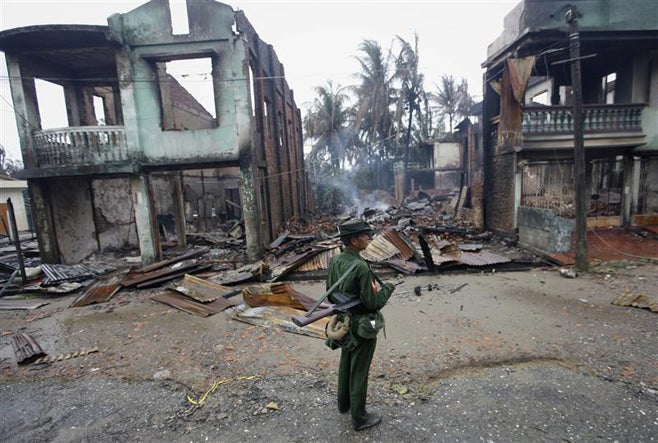
Muslim people pass the time at their house in Paik Thay, the site of recent violence between Muslim Rohingyas and Buddhist Rakhine people
Muslim people pass the time at their house in Paik Thay (Reuters)

The Association of Southeast Asian Nations (ASEAN) cannot pressure Burma on the issue of Rohingya citizenship, but should step up humanitarian assistance to Arakan state or risk regional instability, Secretary-General Surin Pitsuwan said on Friday.

Speaking ahead of the 21st ASEAN summit in Phnom Penh, he stressed that it was not the organisation’s role to meddle in a member state’s internal legal affairs.

“If a government says these people are not citizens, it is not for the ASEAN to say change your laws, change your constitution and accept these people,” he said.

But he warned that unless the ASEAN community steps up their humanitarian assistance to the conflict-torn region, the stateless Muslim minority could easily be radicalized.

“I think the elements are rather ripe, if not for terrorism then for radicalization or extremism, and that is the precursor for more violent actions later on.”

The conflict was raised at the meeting of ASEAN Foreign Ministers on Saturday, with participants voicing concerns over its impact on Burma’s nascent reconciliation process. Pitsuwan added that additional bilateral discussions are likely to be held behind the scenes during the summit.

On Friday, President Thein Sein told the UN in a letter that he is willing to consider new rights for the Rohingya minority, including citizenship, work permits and freedom of movement, but stopped short of making any commitments.

While the UN called the letter “a step in the right direction”, it is likely to fuel concern that Thein Sein is paying lip service to human rights issues ahead of US President Barack Obama’s landmark visit to the country. Earlier this week, activists slammed the government’s latest mass amnesty — which included no political prisoners — as a cynical political ploy to curry the west’s favour.
On Monday, Obama will become the first US president to visit Burma, where he is set to meet with President Thein Sein and opposition leader Aung San Suu Kyi.

The Burmese government has come under fire for its treatment of the Muslim Rohingya, since violence flared between them and Arakanese Buddhists in early June and again last month, resulting in the deaths of over 150 people. Human rights activists have accused the Burmese regime of siding with the Buddhist majority.

Pitsuwan warned that the entire region’s security could be endangered if a resolution is not sought.

“If these people feel hopeless, or that nobody cares, then we will have to take care of ourselves, the safety and security of the Malacca straits themselves could be affected,” he said, echoing comments made to reporters in Jakarta earlier this month.


He warned of a fresh exodus of Rohingya Muslims from northern Arakan state through the Malacca straits – a region that is key to Southeast Asia’s economic interests.

Between 65-75,000 ships pass through the Malacca straits each year, he said, with 80-85% of East Asia’s energy resources coming from the Middle East or Southeast Asia.

“Any instability in this region will have implications for the energy security of those countries too.”

The UN estimates that some 800,000 Rohingya live in Burma, where they are considered illegal Bengali immigrants and denied citizenship, although many have lived there for generations

OIC: Save Myanmar Muslims from 'genocide'

OIC: Save Myanmar Muslims from 'genocide'


Agence France Presse
Saturday 17 November 2012


DJIBOUTI: The world’s top Islamic body urged US President Barack Obama to look into the plight of Muslims in Myanmar’s unrest-hit Rakhine state as he makes a landmark trip to the Southeast Asian country. “We expect the United States to convey a strong message to the government of Burma (Myanmar) so they protect that minority, what is going on there is a genocide,” said Djibouti’s Foreign Minister Mahmoud Ali Youssouf, who is the acting chairman of the Organization of Islamic Cooperation. “We are telling things how they are, we believe that the United States and other ... countries ... should act quickly to save that minority which is submitted to an oppressive policy and a genocide,” he said at the end of an OIC foreign ministers’ meeting in Djibouti.

Obama on Saturday began a three-country visit in Southeast Asia, making stops in Thailand and Cambodia before a historic trip to Myanmar, a former pariah state. The White House hopes his visit will push the country to lock in democratic reforms.
Two major outbreaks of violence in Rakhine since June between Muslim and Buddhist communities have left 180 dead and more than 110,000, most of them the Muslim Rohingya, crammed into makeshift camps.

Security forces are also accused of abuse against the minority.
OIC Secretary-General Ekmeleddin Ihsanoglu of Turkey also urged a stop to what he called “ethnic cleansing” of the Rohingya, considered among the most persecuted groups in the world by the United Nations. “We would like the international community to act immediately to stop the ethnic cleansing,” he said.

The 57-member OIC decided at an August summit in  Makkah to take the issue before the UN General Assembly.
Obama on Monday will become the first sitting US president to visit Myanmar — formerly known as Burma — in a short but hugely symbolic trip that he hopes will spur greater reform in the once isolated country and highlight a rare success for his policy of engaging pariah regimes.

Ahead of the visit, Myanmar President Thein Sein said Saturday that the communal unrest was hampering the country’s reforms and causing it “to lose face” on the world stage.
In October, Thein Sein blocked the OIC from opening an office in the country, following rallies against the organization’s efforts to help Rakhine’s Muslims.
The some 800,000 Rohingya in Myanmar, who speak a language similar to that spoken in southeastern Bangladesh, are considered illegal immigrants by the government and many ethnic Burmese.

Myanmar’s reformist government is under pressure to give them a legal status as it comes under international scrutiny with warnings that the conflict threatens its democratic transition

False Muslims representatives and leader recruited by Myanmar government to mislead President Barak Obama regarding persecutions on Myanmar Muslims.


Is Pres.Obama  going to meet pets of liar Thien Sein ?? These puppets are worse than racist Moughs and Thien Sein Regime.These non sense BROKERS should be isolated from the community.

By

Maung Kyaw Nu.


Myanmar Muslim News News ♦♦♦ 16 November 2012

Since the news of US President Barak Obama to visit Myanmar has confirmed, Rights group have been urging President Obama to pressure on Myanmar quasi-Military government for the series of Human Rights abuses. Many experts have speculated that Rohingya crisis could be one of the top agenda among the topics at the meeting between two leaders.
According to the President Thein Sein’s Office spokesperson stated on his Facebook account that the President has invited some Muslim leaders and Buddhist monks to discuss Rakhine issues. The truth is that these Muslims who were invited do not represent Myanmar Muslims at all. The President does not invite anyone who belongs to five major Myanmar Muslim organisations and neither invited any Muslims politician nor activist who lead and represent Myanmar Muslims. The President has picked collectively who would only nod their head. Besides, half of them are retired army officers.

The agenda of the meeting was to discuss Arakan crisis but it is too late to talk. While the crisis broke out second time in Arakan on 21st October, Myanmar government only admitted after the release of satellite pictures from US based HRW, which was few days later. It clearly echoed the lack of sincerity of Myanmar government over Arakan issues. Moreover, there is not a single action have taken against anti-Muslims organisations and Rakhine extremist who have been instigating against Muslims publically and who have committed terrorist attacks on Muslims in Arakan. President has ordered to form inquiry commissions one after another but none of them could investigate successfully and could not achieve any concrete evidence or prove while ten Myanmar Muslims pilgrims were beaten to death brutally by hundreds of Rakhines at the security check-point in Taung Gouk Township, in Arakan. It is one of the reason why Myanmar Muslims have lost their confidence on the government.

Myanmar government has proficiency in using sprinkles to garnish in order to hide their ugly sinister. The plans to fool international community have been executed by lobbyist while President Barak Obama visit is a pressure on the country half century long religious persecutions and racial discriminations. Myanmar Muslims have fed up with empty promises of Thein Sein government and its members; unfortunately, the genocide of Rohingya and Kaman Muslims has hidden under the so called Democratic reforms. International community should not rush to reward any pseudo Democratic reforms policy of Myanmar military generals who dominating the power ultimately.  The military is still powerful and dominating most of the affairs of the country; the genuine Democracy could be achieved only after 2015 general election if pro-Democracy parties win it.

The simplest prove is that, President Thein Sein has stated earlier this year to send Rohingya Muslims to third country, how come a Democratic reformist President does not aware of Human Rights. His statement highlighted serious issues of xenophobic bigotry that exist inside Myanmar Military.

Current Myanmar government as well as their predecessor Military regime have consistently favoured cronies and puppets to execute their policy and plans; now they have invited collectively who do not represent Myanmar Muslims at all to misled President Barak Obama that Muslims in Myanmar have pleasant and perfect condition. Myanmar government intend to impress to President Barak Obama that President Thein Sein is unlikely to his predecessors. If Thein Sein government were sincere, the genocide in Arakan would not repeat second time.

The government has consistently neglected all the credible information which proving the outbreak of bloodshed in Arakan again, in spite of Myanmar Muslims leaders have informed to the Arakan state government and Central government regarding the lawlessness and extremism of Rakhines in Arakan state and the lack of security presence to protect armless Muslims in Arakan. Is this their negligence or they have underestimated the crisis; those who have neglected and failed to fulfil their responsibility to protect minorities in Myanmar and let the innocent people killed in the hands of terrorist, could not be Democratic reformers.

Myanmar could be a bonanza of opportunity or could be a strategic key allay for US in future; a world respected leader, US President Barak Obama should not compromise with Myanmar President Thein Sein the lives of Myanmar Muslims, especially Rohginyas and Kaman Muslims in Arakan who have hugely counted on him for their liberty.

Burma: Obama Visit Underscores Rights Challenges

Political Prisoners, Ethnic Violence, Abusive Laws Remain Concerns
November 16, 2012
Obama’s trip to Burma risks providing an undeserved seal of approval to the military-dominated government that is still violating human rights. Obama’s success in securing tangible commitments on human rights, not his mere presence in the country, is crucial for promoting genuine and lasting reform.

Brad Adams, Asia director
(Bangkok) – United States President Barack Obama’s visit to Burma will be a success only if it generates concrete and lasting steps toward improving human rights in the country, Human Rights Watch said today. On November 19, 2012, Obama will visit Rangoon and hold meetings with President Thein Sein and the opposition leader, Aung San Suu Kyi, in the first visit to Burma by a sitting US president.

Obama should press for the release of all political prisoners and an end to abuses by state security forces in ethnic minority areas, Human Rights Watch said. Obama should also publicly call for legal and constitutional reform in Burma, including ending military authority to dismiss the government, dropping the military’s 25 percent quota of parliamentary seats, and revising laws limiting basic rights to freedom of expression, association, and assembly. All those responsible for serious abuses should be held to account, Human Rights Watch said.

“Obama’s trip to Burma risks providing an undeserved seal of approval to the military-dominated government that is still violating human rights,” said Brad Adams, Asia director at Human Rights Watch. “Obama’s success in securing tangible commitments on human rights, not his mere presence in the country, is crucial for promoting genuine and lasting reform.”

Thein Sein reportedly included no political prisoners among the 452 prisoners released in a November 15 amnesty just prior to Obama’s visit, Human Rights Watch said. In four amnesties in the past year, the government has released at least 300 political prisoners, leaving an undetermined number behind bars. Human Rights Watch and others have called for independent international monitors to be given unfettered access to Burma’s prisons to provide an accounting of all remaining political prisoners. Many released political prisoners face travel and other restrictions.

Obama should publicly address the deadly sectarian violence between ethnic Arakan Buddhists and ethnic Rohingya Muslims and non-Rohingya Muslims that erupted in June in Arakan State. State security forces failed at the outset to protect either community from violence and then increasingly targeted Rohingya in killings, beatings, and mass arrests.

State security forces committed further abuses in October when deadly violence erupted again, partly as a result of the government’s failure to provide adequate security and pursue accountability for earlier crimes, Human Rights Watch said.

Over 110,000 people, mostly Rohingya, have been displaced by the violence in Arakan State. Government restrictions on humanitarian access to displaced Muslim communities in Arakan State have left many in dire need of food, adequate shelter, and medical care. The authorities also indefinitely suspended nearly all pre-crisis humanitarian aid programs to the Rohingya, affecting hundreds of thousands who remain in their homes.

“Obama should press Thein Sein to end discrimination and violence against the Rohingya and grant them citizenship on par with other ethnic nationalities,” Adams said. “He should stress the urgent need to allow international aid to reach the Rohingya and for security conditions that would allow them to return to their homes.”

Obama should also raise concerns about continuing abuses and unmet humanitarian needs in Burma’s Kachin State, where conflict continues between the Burmese army and the Kachin Independence Army (KIA).  The Burmese military has attacked villages and committed extrajudicial killings, forced labor, torture, rape, and pillage. Both sides have used anti-personnel landmines.

The number of internally displaced people in Kachin State has reached an estimated 90,000 this year. The government has largely denied humanitarian access to displaced people in KIA-held territory.

The fundamental right to peaceful assembly remains tightly restricted in Burma, Human Rights Watch said. Thirteen activists who led over 1,000 protesters in a September 21 march in Rangoon calling for peace in Kachin State and elsewhere were subsequently summoned to local police stations. Nine protesters now face prison terms on charges of violating the purportedly reformist 2011 Peaceful Assembly Law.

Obama’s visit is the most visible gesture of praise by the US government toward Burma.
In May, the Obama administration named the first US ambassador to Burma in 22 years and in July lifted longstanding sanctions against Burma, permitting American companies to invest in every sector of the country’s economy. Human Rights Watch and others have expressed concern that it was premature for the US to open up across-the-board investment in Burma and had sought much stronger preconditions, including an updated sanctions list and binding prohibitions on investment in Burma’s problematic oil and gas industries.

US officials, including National Security Adviser Thomas Donilon, have said that the purpose of Obama’s visit is to “lock in” reforms. Human Rights Watch urged Obama to be cautious and realistic when assessing the changes that have taken place in Burma thus far.

“While genuine progress in Burma should be encouraged, Obama should be careful not to overstate the changes that have occurred,” Adams said. “The still-suffering Burmese people will be better served by a US president who is committed to seeing long-term reform in their country than one who expresses overeager praise.”

Friday, 16 November 2012

US has given too much leverage to Burma - rights group | Asia Pacific

Updated 16 November 2012, 21:45 AEST


On the eve of US President Barack Obama's much-awaited Southeast Asia tour, advocacy groups are urging him to get tough on repressive governments.

US has given too much leverage to Burma - rights group (Credit: ABC)
Mr Obama begins his trip in Bangkok tomorrow and he'll go on to meet with Asia's top leaders at a summit in Cambodia next week.
The US leader will also hold talks with Burma's President Thein Sein.

And while Burma has made tentative steps towards democracy, human rights groups say it has been rewarded much too soon.
They say the US now lacks leverage to get Burma to introduce more reforms.

Burma last night released over 450 prisoners, but rights groups called it a cynical move, ahead of the US leader's visit.
Presenter: Sen Lam

Speaker: Mark Farmaner, Director at Burma Campaign UK

FARMANER: From the information we've received so far, it seems that there're no political prisoners included in this release. It's abit of a mystery why they'd do that, to build up expectations, to knock it down. We're starting to see this pattern, where before every significant international events, whether it's Obama visiting now, or before the UN General Assembly, when Thein Sein visited New York, you get a small number of political prisoners being released. So, Thein Sein seems to have decided after releasing several hundred political prisoners a few months ago, to keep a few hundred in prison and use them as some kind of political pawns, to be able to get some political capital every now and then, when he's got an important international event.

LAM: So are you saying that the Burmese government is being cynical, and indeed, manipulative in these staggered prisoner releases?

FARMANER: It's a very cynical way in which the Burmese government has made these political releases. They're saying they're committed to reform and democracy, and yet they've decided to keep hundres of political prisoners in jail. They're getting credit from the international community everytime they make these releases. Most international leaders now barely mention political prisoners, so it seems that it's been quite a successful strategy for the government of Burma. They'd release a few hundred political prisoners, left many more behind in jail and then release them tactically, when they need abit of good publicity.

LAM: So do we know who this latest batch of 450 prisoners are? If they're not prisoners of conscience, what does your information tell you?

FARMANER: We haven't received any reliable information yet on who these prisoners are, I'm afraidd. Our contacts focussed on those in jail for political reasons. One thing we are concerned about is, while you may have 700 or 800 political prisoners who'd been released in the past year and a half, there seems to be alot of arrests taking place in some of the ethnic states. So, where the Burmese army has resumed conflict in the northern Kachin state, you have many innocent Kachin farmers who were being arrested, jailed and tortured and accused of the being part of the Kachin Independence Army, who're fighting the Burmese Army.
And you also have in Rakhine state, where you've had the communal violence and now systematic attacks against the Rohingya muslim minority. The government itself has admitted that there're around a thousand people it's arrested and the majority of them are Rohingyas. Many of them were probably involved in the violence, but we've also had reports that many political and community leaders Rohingya political leaders were arrested as well, perhaps to stop them from talking to the international community about what's taking place. And we have no way of assessing the proper number of political prisoners in the country. We can't trust the government - they've made no serious measures to deal with this problem. We have this 'drip drip' series of tactical political prisoner releases. We have consistent reports of more people being arrested, more people being jailed and I think it's time the international community moved on from this current process. And we've said to the government of Burma, we need now to establish a proper Commission in Burma, which has international support, with UN exertise, which can properly assess how many political prisoners are in Burma's jails and ensure that they are released. So that we deal with this issue once and for all, because we can't continue with this years-long process of political prisoners being kept in jail, relased at a time when the government needs good publicity, more people still being arrested and jailed - especially at a time when the international community seems much more concerned about trade now, than human rights in Burma. A Commission like this, which is going to be keeping a focus on political prisoners, making sure that they are released - it's very important.

LAM: And so when the US President Barack Obama meets with his Burmese counterpart Thein Sein on Monday, do you expect that he might raise these issues of human rights and indeed, that of the sectarian violence and the ethnic minority issues in Burma?

FARMANER: We certainly expect President Obama to raise all of the key, important human rights issue with President Thein Sein. The problem we have now, is what leverage has the US got left, to persuade Thein Sein to go further? People in Burma tell us that most of these reforms are 'top-down', all decided by the President, not part of a negotiated process and they're skin-deep.
You've had some political prisoner releases but not all released. And all the laws that put them in jail are still in the books. That Thein Sein has not introduced one democratic reform that actually makes Burma closer to being a proper democracy. There're no laws being passed that reduce the power of the military or the government. The problem that Obama is going to have is that he can raise all the issues about human rights and the political prisoner situation, and Rakhine and Kachin states, but what leverage does he have, when he has already lifted most of the sanctions against Burma? When he's now visiting Burma, which is an enormous reward for President Thein Sein. He's thrown away the sticks, now he's given away almost all the carrots, so what leverage has he got left, to actually make sure that Thein Sein really delivers on releasing all the political prisoners, ending the violence against ethnic minorities and introducing real democratic reforms?

ROHINGYA DEMAND PRESDENT OBAMA TO HALT BURMA VISIT.

The US Authority ,

On behalf of entire Rohingyas and Muslim population of Arakan state of Burma, we strongly demand President Obama to cancel the scheduled Burma visit as show of support and solidarity to suffering humanity,the Rohingya people and Muslims of Arakan as Obama is known as the the symbol anti-Genocide and champion of humanity .

It is not a right time for Obama to visit the Burma where tens of thousands of innocent Rohingyas were killed ,hundreds of Rohingya girls/women were forcibly  raped, ,tens of thousands of house were burned down and around 50 thousands Rohingyas  flee Arakan. More than 50 thousands people are still missing and many uprooted Rohingyas are still floating in the rivers and sea. Dead bodies are seen along the sea side from Arakan to Australia.The controlled  Genocide on Rohingya is non stop going.This is a fearful human deserter in this era.This is a dangerous humanitarian crisis in this millennium.There is no rule of law in Arakan. Arakan is a killing field and a concentration camps for Rohingyas.

  Burma's quasi- civilian government have been overstated. “President Thein Sein is a liar. He is not implementing a genuine change that alters the military role in the country. Instead he's killing innocent Rohingya people.His strategy is to make Rohingya free Arakan''.


         We the entire Rohingya demand   to deploy UN peace keeping forces in Arakan to protect remaining Rohingyas.The Rohingyas deserve international protection.We have been staging protest asking for protection since June.2012.

          We are very much concerned that the response from the United States and the international community to the anti-Rohingfya  violence against the Rohingya and Muslims of Arakan  has been wholly inadequate. The conditions that led to two major outbreaks of mass killings are getting worse. Greater loss of life and displacement are a certainty without a change of course
      By visiting Burma by the great President of America and meeting with Thein Sein who is a  human-rights abuser and the criminal of crimes against humanity the American value of Respect to human rights and US Governments commitment to protect and prevent genocide against the unarmed civilian from brutal regime will be tarnished in the world.


      Moreover, the Burmese Government led by Thein Sein will become embolden to implement his announcement to deport entire Rohingya people to third countries or
exterminate the whole Rohingya nation from the soil of Arakan through ethnic cleansing.
Furthermore, if the President persist and decide to visit Burma disregarding world public opinion and the Rohingyas humble demand,then, we would have no alternative but to sincerely urge the President to help the Rohingya victims of controlled genocide as following-


1.Please tell Thein Sein Led Burmese Govt clearly that US Govt. will never accept
    a. the continuation of  human rights abuses and genocide on Rohinga,
    b.the war criminals go without book for trail at international tribunals including ICC.
    c.the fact finding committee consist of racist Rakhine Dr.Aye Maung led RNDP and govt ally members.
    d.the bloc of humanitarian assistance and international helping agency and media groups.
    e.the sheltering  national Rohingyas in Refugee camps instead of rehabilitation at their ancentrail housing plots.
    d.the blocking of Rohingyas call for deployment of UN peacekeeping forces.
    g.the continous attack to Rohingyas by Dr.Aye Maung led RNDP and Khine Soe Naing ,Mra Raza Lunn led ALP       ceasefire armed groups.
    h.the continue rape women/girls and maltreatment to children,women ang old people.
    i. the census to Rohingyas to start third time genocidal Rohingya cleansing .
2.we would like to appeal President Obama as following,
   a. To give an opportunity meeting with Burmese Rohingya Association in Thailand , BRAT deligation  in Bangkok.
   b.To pay visit to concentration camp of Rohingyas in Arakan.
   c.To meet and discuss with elites of Rohingyas in Burma.(Not Govt sponsor one.)
   d.To release all Rohingyas arrested during 2012 genocide on Rohingyas.
   e.To deploy US Navy from Bangladesh to Australia water to rescue the floating Rohingyas where half of them always sank.

We therefore ask international protection immediately.We also look forward a meeting with President Obama in Bangkok.

Thank you.

Sincerely,


Maung Kyaw Nu,

President,
Burmese Rohingya Association in Thailand(BRAT).
email- brat.headoffice@gmail.com.
website-http://rohingyathai.blogspot.com
phone-(+66)085 369 0442

Thursday, 15 November 2012

OBAMA SHOULD NOT VISIT BURMA.

President Obama should reconsider his upcoming trip to Myanmar. While the ruling junta appears to be making reforms, there is less there than meets the eye.
President Thein Sein's government has opened up the political process, freeing longtime political prisoner Nobel laureate Aung San Suu Kyi and even allowing her and dozens of her fellow party members to serve in Parliament. He has also loosened up some of the state control of the economy.

As a result, he has erased the country's international pariah status and half a century of isolation, both self-imposed and externally maintained. The military has ruled since 1962. But despite their firm grip on power, the generals have always felt they are riding on the back of angry and wounded tiger.

"We do not want to end up like the Arab dictators," Shwe Mann, once the third most powerful general in the junta, told reporters last December after meeting Secretary of State Hillary Clinton. "One day, they were very powerful. The next day, they died ignoble deaths."
But don't be fooled: The ex-military officers and their active-duty brethren retain complete monopoly control over all aspects of reforms. In the new era of "democratic transition," these men continue to hold all levers of state power. And it is these "men on horseback," not collaborating dissidents or developmental technocrats, who determine the reforms' nature, scope, priorities and pace.

Still today, the Burmese army brutally represses ethnic minorities, and army-owned mining and commercial agricultural companies boot ordinary farmers off their ancestral lands. It is the ethnic minority regions that are being designated as the sites of virtually all mega-development initiatives, resource extractions, special economic zones and industrial agricultural schemes worth billions of dollars.

But we don't hear about any of that in Washington, where the emphasis is on the new strategy of "pivoting" back to Asia. This pivot has made it possible for the generals to come out of their bunkers. The Americans want the Burmese to walk away from Beijing's embrace. The Burmese, for their part, are grateful to Washington in helping wean them off of China's international protection in exchange for dropping the U.S. demand for regime change in Myanmar (the name that the ruling clique has given to the country historically known as Burma). This is a classic geostrategic symbiosis that is looking increasingly promising for the junta and the Pentagon.

The generals are pursuing reforms largely for the wrong reasons - for their own long-term survival, politically and economically. Motives do matter. As a direct consequence, they remain wholly unprepared to do what is necessary to promote public welfare and advance the cause of freedom, human rights and democracy. So, the generals talk the talk of peace, but do not walk the walk.

Myanmar's reforms are, upon closer look, more about the interests and longevity of the country's military rests than about interethnic peace, public welfare or democracy.
These are reasons enough for Obama to stay away.

ABOUT THE WRITER
Maung Zarni (http://maungzarni.com) is a visiting fellow at the London School of Economics and founding director of the Free Burma Coalition (1995-2004). Readers may write to the author at: Progressive Media Project, 409 East Main Street, Madison, Wis. 53703; email: pmproj@progressive.org; Web site: www.progressive.org. For information on PMP's funding, please visit http://www.progressive.org/pmpabout.html#anchorsupport.
This article was prepared for The Progressive Media Project and is available to MCT subscribers. McClatchy-Tribune did not subsidize the writing of this column; the opinions are those of the writer and do not necessarily represent the views of McClatchy-Tribune or its editors.

2012, Maung Zarni

Wednesday, 14 November 2012

Pres. Obama Risks Undermining Human Rights Progress If Unable to Deliver Strong Message in Myanmar/Burma

Press Release
November 13, 2012

Pres. Obama Risks Undermining Human Rights Progress If Unable to Deliver Strong Message in Myanmar/Burma

Amnesty Reps Urge Action in Meetings with White House Senior Advisors
Contact: Carol Gregory, cgregory@aiusa.org, 202-675-8759
Washington, D.C. – Amnesty International USA today called on President Obama to deliver an unequivocal message on human rights during an upcoming trip to Myanmar (Burma), or risk undermining human rights progress. Amnesty International will use the opportunity of a White House meeting on Myanmar on Tuesday, November 13 to spell out key elements that are necessary to ensure the President’s visit does not undercut the reform process. In order to avoid giving Myanmar authorities a free pass on grave human rights abuses still underway in the country, the President must take the following three actions:
  • Call on the government of Myanmar to release all remaining prisoners of conscience;
  • Reinforce the call of UN High Commissioner for Human Rights Navi Pillay on the Myanmar government to ensure that all Rohingyas have equal access to citizenship, end abuses of their human rights and take decisive measures to address ethnic strife in Rakhine state and ensure respect for the rights of all ethnic minorities;
  • Demand that U.S. corporations entering Burma put human rights before profits and abide by best practices on corporate social responsibility, as outlined in Amnesty International USA’s advice to U.S. businesses, including the United Nations Guiding Principles on Business and Human Rights (the so-called "Ruggie Principles").
"If President Obama doesn’t put his full weight behind further urgent reforms in Myanmar, this trip risks being an ill-timed Presidential pat on the back for a regime that has looked the other way as violence rages, destroying villages and communities just in the last few weeks," said Suzanne Nossel, executive director, Amnesty International USA. "President Obama cannot treat this trip as a goodwill tour when political prisoners continue to be unjustly jailed, and 200 people have died and more than 100,000 were forced to flee over the last few months due to ethnic strife in Rakhine state. Myanmar is emerging from more than five decades of repressive military regimes, and we need the U.S. to be vigilant in its demand for freedom and justice, and not side-step human rights in its quest for new allies in the region."

Amnesty International is a Nobel Peace Prize-winning grassroots activist organization with more than 3 million supporters, activists and volunteers in more than 150 countries campaigning for human rights worldwide. The organization investigates and exposes abuses, educates and mobilizes the public, and works to protect people wherever justice, freedom, truth and dignity are denied.

Tuesday, 13 November 2012

Arakan Strife Could Spread Across Burma: I


Arakan Strife Could Spread Across Burma: ICG

A young boy looks through burnt remains of a house in Pauktaw Township, Arakan State. (Photo: JPaing / The Irrawaddy)
Recent sectarian violence in Arakan (Rakhine) State threatens national stability and could spread into wider religious conflict unless tackled through decisive moral leadership, claims the International Crisis Group (ICG) in a new report.
Myanmar: Storm Clouds on the Horizon indicates there is a real risk that the localized Arakan State conflict could take on a more general Buddhists-versus-Muslims dimension and spread to other parts of the multi-religious and multi-ethnic country.
“Social tensions are rising as more freedom allows local conflicts to resurface,” says Paul Quinn-Judge, ICG’s acting Asia program director. “Moral leadership is required now to calm tensions and new compromises will be needed if divisive confrontation is to be avoided.”
The Brussels-based group tracks the broad changes that have continued to move Burma away from authoritarianism despite the recent and serious backward step of communal violence in the country’s west.

“The Myanmar government and legislature have demonstrated that they possess the vision and leadership to shift the country decisively away from its authoritarian past,” says Jim Della-Giacoma, ICG’s Southeast Asia project director.
“But they will inevitably face major challenges, including containing and resolving the intercommunal conflict that has engulfed Rakhine State and reaching a ceasefire in Kachin State.”

In May 2012, the rape and murder of a Buddhist woman allegedly by three Muslim men ignited long-simmering tensions between the Buddhist Arakanese and Muslim Rohingya communities. Since June, rioting has led to more than 100 people killed, thousands of homes burnt down and tens of thousands made homeless, according to official figures.
While the local authorities have been seen to take the Arakanese side in the conflict, international aid agencies including the United Nations and Doctors Without Borders have faced threats and intimidation from the Buddhist majority for supposedly siding with the Muslims.

The ICG sees the recent unrest as taking place in the context of President Thein Sein introducing more democratic policies and consolidating power among reformers. Political prisoners have been released, protests permitted, censorship reduced and cabinet reshuffled to remove or sideline ministers who were seen as too conservative or ineffective.
The ICG report, released on Monday, also points at the difficulty in reaching a ceasefire in Kachin State as underlining the complexity of forging a sustainable peace with ethnic armed groups. There are also rising grassroots tensions over land grabs, environmental and social concerns regarding foreign-backed infrastructure and mining projects as well as widespread human rights violations committed by government troops.
A report by the Free Burma Rangers humanitarian group released on Oct. 23 provides independent verification of the continuing abuses that threaten national conciliation in Kachin State.

“On July 8, soldiers from Light Infantry Battalion 321, Infantry Battalion (IB) 28 and IB 37 raped a 58-year-old woman [name withheld for victim’s protection] from Hpa Re Village in the Pang Wa area. She is married with one child. Burma Army soldiers also raped a 39-year-old who is a widowed mother of 12,” reported the group.

“Kachin villagers have also been subject to unlawful capture and torture. On June 1, [Border Guard Force] Battalion 1001 arrived at Tang Gaw Village and captured 34-year-old Tang Gaw Ting Sau, a Kachin pastor, with two sons and a wife.
“His wife recounted how Burma Army soldiers covered his eyes and beat him after they captured him. He was imprisoned for his alleged association with the [Kachin Independence Army]. As of the latest report, Burma Army soldiers are still holding him captive.”
David Mathieson, senior researcher on Burma for Human Rights Watch, told The Irrawaddy on Tuesday that the broader ceasefire pattern was more worrying for the overall prospects of nationwide peace than the current situation in western Burma.

“Ongoing conflict in Kachin and the possibility that the ceasefires in Burma could breakdown probably represents more of a threat to the reform process than anything else,” he said. “The peace process in the east, while looking good from the outside, is going through a very fragile time and it needs to have a lot more effort given to cementing those ceasefires and ending the conflict in Kachin State.”

Mathieson explained that the lack of progress with ethnic groups that have an established military and political apparatus was more troubling than the “murky elements” on all sides of the communal conflict in Arakan State, but that separating the two communities would only lead to future strife.

“I think segregation is the recipe for further intercommunal violence in the future,” he added. “Slow integration and legal acceptance for minorities with education and religious tolerance should be the way forward. Segregation is a short-term security solution rather than a long-term peace-building solution.”

 The ICG report says a major test for the government’s security forces will be maintaining law and order without rekindling memories of the recent authoritarian past. Furthermore, competition between Thein Sein’s reformist administration and opposition leader Aung San Suu Kyi’s National League for Democracy leading up to the 2015 general election could lead to more confrontational social movements unless handled carefully.

Rohingya Refuse to Register as ‘Bengali’


Rohingya Refuse to Register as ‘Bengali’

Rohingya Muslim family in Pawtauk Township, Arakan State. (Photo: JPaing / The Irrawaddy)
Thousands of Rohingya Muslims in Pauktaw Township, Arakan (Rakhine) State, have refused to sign government-issued registration forms in order to push for recognition as an official minority.
Chris Lewa, the director of the Arakan Project humanitarian group which works for Rohingya rights, told The Irrawaddy that local people are not happy that the authorities erased the term “Rohingya” from completed forms and instead replaced it with “Bengali.”
Almost all members of the Muslim Rohingya minority in Pauktaw Township have since refused to cooperate with the fortnight-old registration process which was ostensibly initiated to get accurate numbers for the different communities present there.
Local people feared that they would be declared illegal migrants and deported if they registered under the loaded term “Bengali,” which used by many Burmese in the belief that the Rohingya are illegal immigrants from neighboring Bangladesh. This claim is vehemently denied by the Rohinyga who highlight that many of their community have lived in Burma for generations.
Border authorities, Burmese soldiers, immigration officials, police and Arakanese politicians from the Rakhine Nationalities Development Party (RNDP) have been attempting a house-to-house registration procedure to check personal details.
A field report from the Arakan Project revealed that from the very first day those who refused to use the term “Bengali” were removed from the survey.
On Saturday, Rohingya in Set Kyi Pyin Village informed the local authorities that they would only sign the forms if United Nations and Association of Southeast Asian Nations representatives were present as witnesses, according to the Arakan Project.
Meanwhile, Thet Tun, a MP for the RNDP in the Arakan State Parliament, told The Irrawaddy on Tuesday that the term “Rohingya” was invented. “They are Bengali, but they do not accept it any more now and they only accepted the term Rohingya,” he said.
Thet Tun added that around 1,800 displaced people at a refugee camp In Nget Chaung Village refused to cooperate with the authorities and register unless they were allowed to be called Rohingya.
The Arakan Project accused the local authorities of forcing people to sign the registration form by threatening that they otherwise would not receive clothes for their children or help rebuilding burned houses.
The Arakan State government formed a committee last month to register every township in its boundaries. From this body, 15 separate groups attempted the village-to-village registration process in Pauktaw Township.
Individuals being surveyed were presented with a four-page form. The first details name, age, village, occupation, education, marital status, race and possessed documents. The second has ancestral details, grandparents, great-grandparents and immigration information. The third includes criminal convictions or proceedings, while the final page is for a signature or fingerprint.
There are 135 official ethnic groups in Burma according to the widely-condemned 1982 citizenship law enacted by former dictator Gen Ne Win. The Rohingya are not included amongst this number and have faced restrictions on travel, marriage and reproduction as a consequence.

UNHCR calls for open borders as the Rohingya flee on boats


UNHCR calls for open borders as the Rohingya flee on boats
Print all
http://www.unhcr.org/50a2366efc9.html


UNHCR calls for open borders as the Rohingya flee on boats

Briefing Notes, 13 November 2012
This is a summary of what was said by UNHCR spokesperson Melissa Fleming to whom quoted text may be attributed at the press briefing, on 13 November 2012, at the Palais des Nations in Geneva.

UNHCR is seriously concerned at recent boat tragedies in the Bay of Bengal involving people fleeing feeling insecurity and violence in Myanmar. We are calling on countries in the region to strengthen burden-sharing in the face of this growing humanitarian emergency.

In the last two weeks, there have been reports of two boats sinking in the Bay of Bengal with an estimated 240 people, among them Rohingyas from Myanmar's Rakhine state. UNHCR cannot confirm the figures as we have no presence near the wreck sites, but available information is that more than 40 people have been rescued from the two boats. There were reports of bodies seen floating in the water.

These two incidents mark an alarming start to the traditional sailing season in the Bay of Bengal, when a mix of asylum seekers and irregular migrants risk their lives on fishing boats in the hope of finding safety and a better life in South-East Asia. An estimated 7,000 to 8,000 people left from the Bay of Bengal during the previous sailing season from October 2011 to March 2012. There are fears many more could follow in the coming weeks, driven by desperation and hopelessness.

UNHCR is urging the government of Myanmar to take urgent action to address some of the main push-factors especially issues connected with the problem of citizenship and statelessness in relation to the Rohingyas. The already precarious situation in Rakhine state was exacerbated in June and most recently again in October this year when inter-communal violence broke out, killing dozens of people, destroying thousands of homes and displacing more than 110,000 people.

A fragile calm has returned but tensions remain high. In addition to providing urgent humanitarian assistance to both affected communities, the root causes need to be resolved for the Rohingyas so that they can lead normal lives where they are.
In the meantime, UNHCR is calling on governments in the region to keep their borders open to people seeking asylum and international protection from Myanmar. We stand ready to support states in assisting and protecting these individuals.

UNHCR is alarmed by reports of countries either pushing back boats from their shores or helping them on to another country. We are appealing to these governments to uphold their long tradition of providing humanitarian aid to refugees instead of shifting the responsibility to another state.
For more information on this topic, please contact:
  • In Bangkok: Vivian Tan, mobile +66 818 270 280
  • In Geneva: Babar Baloch on mobile +41 79 557 9106

ROHINGYA'S DEMONSTRATION ASKING FOR UN PEACE KEEPING FORCES.

This is for your kind information.Please voice out one - To deploy UN peace keeping forces to protect remaining Rohingyas in Arakan.We  fight for protection .Thanks to all who call for UN Peace Keeping Forces World wide.

I sincerely look forwards your kind recommendation and solidarity with us.

Best Regards,
Maung Kyaw Nu;
    President,
Burmese Rohingya Association in Thailand ,(BRAT)

 
BRAT.


Demonstration at UN ,Bangkok.

http://www.facebook.com/photo.php?fbid=371865936233236&set=a.371858379567325.90356.100002294987787&type=1&theater

http://www.facebook.com/photo.php?fbid=370667036353126&set=a.370664063020090.90034.100002294987787&type=1&theater

http://www.facebook.com/photo.php?fbid=370670383019458&set=a.370669453019551.90037.100002294987787&type=1&theater

http://www.facebook.com/photo.php?fbid=370671273019369&set=a.370669453019551.90037.100002294987787&type=1&theater

http://www.facebook.com/photo.php?fbid=370706099682553&set=a.370704203016076.90056.100002294987787&type=1&theater

http://www.facebook.com/photo.php?fbid=370706099682553&set=a.370704203016076.90056.100002294987787&type=1&theaterhttp://www.facebook.com/photo.php?fbid=370706099682553&set=a.370704203016076.90056.100002294987787&type=1&theater


http://www.facebook.com/photo.php?fbid=371782759574887&set=a.371780349575128.90339.100002294987787&type=1&theater

http://www.facebook.com/photo.php?fbid=371037199649443&set=a.371023736317456.90160.100002294987787&type=1&theater

http://www.facebook.com/photo.php?fbid=371842676235562&set=a.371842629568900.90353.100002294987787&type=1&theater

http://www.facebook.com/photo.php?fbid=370732333013263&set=a.370729366346893.90068.100002294987787&type=1&theater

http://www.facebook.com/photo.php?fbid=370675413018955&set=a.370673179685845.90038.100002294987787&type=1&theater

http://www.facebook.com/photo.php?fbid=371808726238957&set=a.371806392905857.90349.100002294987787&type=1&theater

http://www.facebook.com/photo.php?fbid=370653453021151&set=a.293348590751638.69989.100002294987787&type=1&theater
http://www.facebook.com/photo.php?fbid=370655496354280&set=a.370654959687667.90027.100002294987787&type=1&theater


Burmese Rohingya Association Thailand [BRAT]
Bangkok, Thailand
November 5, 2012
Honorable Ban Ki-Moon
The Secretary General of the United Nations

Subject: Fervent Request for Sending UN Peace Keeping Force to Arakan State to Save the Remaining Rohingya

Dear Ban Ki-Moon,
As you are fully aware, the situation of Rohingyas and Muslims in Arakan State of Burma is in a CRITICAL stage. Men, woman and children are dying from attacks, hunger, in need of medical and shelter.  Thousands of people are wondering in the high sea seeking for shelter while hundreds of them have drown and feared dead. Corps are seen floating at the mouth of Naf and Kaladan rivers.
We, the Rohingya Diaspora, addressed the seriousness of the issue to your good office at the beginning of June, when the Junta in collaboration of racist Rakhine started killing, but your good office and the international community did not pay attention to our cries which caused to the death of several hundreds and displaced hundreds of thousands more in the repeated follow-up attacks.
Burmese junta will not stop killing us until there is a strong enough barrier. Soon, the junta would attack our people again and kill many more thousands. Rohingya in concentration camps are also dying every hour of everyday.
Therefore, the only way to save these people is by sending a team of UN Peace Keeping Force. Please consider our cries before it is too late.
Please rest assured that our protest will remain peaceful and we will obey the law and order of our current residing country, Thailand. However, we will remain firm and stage protest demanding your good office to fulfill our urgent need. We will not go back until our demands are met. 

Sincerely,

Maung Kyaw Nu
Coordinator of Demonstration Committee
(President )
(Burmese Rohingya Association of Thailand)BRAT.
email; brat.headoffice.com

ROHINGYA MARATRON DEMO IN BANGKOK-STRATS 29/IO/2012

To/

                                                                                                                                                                                                     Date:October 29,2612 ,Bangkok.

The Honorable Banki-moon,

The Secretary­ General of the United Nations ,

Subject: Asking for UN peace keeping farces wìthin 72 hours.

We the overseas Rohìngyas sincerely would like to ask your urgent good offìce to send UN peace
keeping forces in Arkan within 72 hours .You are well aware that tens of thousands of unarmed
 Rohìngyas were kìlled,Rohingya subjects were burnt down and thousands were compelled to jumb in
to the rivers. Every days, shooting, killing, rape the womenand burning houes are seem every where in Arakan. Tens of
thousands of Rohìngyas have beng floating in the sea or rivers with small boats without engines and
rudders since June 2012.

We, Therefore,are staging demonstration day and night at UN Office ,Bangkok to ask your urgent good office to deploy UN peace keeping forces in Arakan with out delay.

We are not going back, since our demand is met.

We also assure you that our demonstration is peaceful and obey the law and regutatìon of residing
country (Kingdom of Thailand

Sincerely,

Maung Kyaw Nu

Coordinator of Demonstatìon Committee .

President
Burmese Rohingya Association of Thailand. (BRAT)

PRESS RELEASE.

DON'T TRUST TO RACISTS. GENOCIDE ON ROHINGYAS MUST BE STOPPED!

On 8 November,we went with demonstration to Burmese ,US and UK Embassies in Bangkok. Everywhere we used to give speeches asking and gaining support to immediately deploy the U
N PEACE KEEPING FORCES which is the only option to save dying Rohingyas.

I was invited inside the US and UK Embassies and had a discussion there. I also handed over a letter for Mr.Ban Ki Moon and asking their strong recommendation to arrange emergency security Council meeting regarding UN peace keeping forces deployment.

I'd also like every Embassy of Rangoon to work on Rohingya's global call to urgently deploy UN peace keeping forces in Arakan to protect the remaining Rohingyas .We require their respective countries' support .We ,the Burmese Rohingya Association in Thailand ,have been staging at UN and some Embassies in Bangkok in this regards since 29 October 2012 .

However we welcome the recent visiting to some seriously affected areas of southern Araakan by US,UK and Australian Embassies .In one word ,I'd like to ask for working to PROTECT the Rohingyas under the UN the UN forces .
I'd also like to say every non Burmese including Obama that not to fell in to the trap of killer Military regime who are cheaters and pet dogs of former dictator Ne Win.Thien Sein Regime is very difficult to be understood.
Offering more olive branches to dictator means giving much more killing tickets to them.
Best,
Maung Kyaw Nu,
B.R.A.T

Joint statement by the undersigned Embassies
November 9, 2012We are deeply saddened by the recent violence and displacement in Rakhine State. The latestresurgence of violence has led to the loss of life and property of thousands of innocent men,women, and children in Rakhine State. We urge all parties to work together to bring animmediate end to the violence.We support the Government in its efforts to restore security and stability according tointernational standards, and to hold those behind the violence fully accountable under just andtransparent procedures according to the rule of law. We welcome the establishment of anInvestigative Commission for the violence in Rakhine State, and urge that the Governmentauthorize a full, transparent and independent investigation of the latest violence to determine itsroots and to prevent its recurrence.We further encourage the Government to enable safe, timely, and unhindered humanitarianaccess across Rakhine State to all persons in need. The international community stands ready tohelp with humanitarian aid and longer-term development assistance in Rakhine State, and iscommitted to doing so through coordinated efforts to ensure maximum effectiveness andefficiency.
We strongly support the Myanmar people’s deep desire for a peaceful, prosperous, just and
democratic country operating under the rule of law that respects the rights of all people. Westand ready to assist the country toward that goal, in Rakhine State and throughout the country.The Embassy of AustraliaThe Embassy of EgyptThe Embassy of FranceThe Embassy of GermanyThe Embassy of JapanThe Embassy of Saudi ArabiaThe Embassy of TurkeyThe Embassy of the United KingdomThe Embassy of the United States of America


Joint statement by the undersigned Embassies
November 9, 2012We are deeply saddened by the recent violence and displacement in Rakhine State. The latestresurgence of violence has led to the loss of life and property of thousands of innocent men,women, and children in Rakhine State. We urge all parties to work together to bring animmediate end to the violence.We support the Government in its efforts to restore security and stability according tointernational standards, and to hold those behind the violence fully accountable under just andtransparent procedures according to the rule of law. We welcome the establishment of anInvestigative Commission for the violence in Rakhine State, and urge that the Governmentauthorize a full, transparent and independent investigation of the latest violence to determine itsroots and to prevent its recurrence.We further encourage the Government to enable safe, timely, and unhindered humanitarianaccess across Rakhine State to all persons in need. The international community stands ready tohelp with humanitarian aid and longer-term development assistance in Rakhine State, and iscommitted to doing so through coordinated efforts to ensure maximum effectiveness andefficiency.
We strongly support the Myanmar people’s deep desire for a peaceful, prosperous, just and
democratic country operating under the rule of law that respects the rights of all people. We stand ready to assist the country toward that goal, in Rakhine State and throughout the country.

The Embassy of Australia
The Embassy of Egypt
The Embassy of France
The Embassy of Germany
The Embassy of Japan
The Embassy of Saudi Arabia
The Embassy of Turkey
The Embassy of the United Kingdom
The Embassy of the United States of America

Monday, 12 November 2012

JOINT STATEMENT OF ROHINGYA ORANISATIONS ON GLOBALDAY OF ACTION .

Global Day for Action.

Joint statement

Date: 8th November 2012

Urgent international Actions to Protect Rohingya People


We the undersigned thank all organizations, NGOs, media and individuals for joining today’s “Global Day of Action” event in solidarity with the Rohingya people.

Despite international outcries the Burmese government is trying to use the world’s most oppressive “Burma Citizenship Law of 1982” on the homeless and traumatized Rohingya people whilst most of their documents were burned down in the violence. This is another design of the government to hoodwink the international community.

Since June 2012:

· Many thousands of Rohingya have been killed.

· Thousands of Rohingya are missing.

· Thousands of homes have been destroyed.

· Hundreds of women have been raped.

· More than 100,000 people have been forced to flee their homes.

· Hundreds and thousands of Rohingya have been living under siege while most of them suffering from starvation and diseases.

· Rohingya refugees and internally displaced are blocked from receiving adequate food, shelters, medical treatment and other humanitarian aids.

· A new system of apartheid against Rohingya is being introduced and practised.

Burmese government has not only manifestly failed to protect the Rohingya population but it has also been a primary force behind the persecution and destruction of them. Thus the “responsibility to protect Rohingya” lies with the international community. We, therefore, urge upon the international community, UN, OIC, EU, ASEAN, UK, US and all Burma’s neighbours for the followings:


1. Put pressure on the Burmese government to stop all violence and intimidation against Rohingyas.

2. Support sending UN Peacekeeping Force and International Observers to Arakan.

3. Unhindered delivery of humanitarian aids to the victims.

4. Support for the establishment of a UN Commission of Inquiry in order to establish the true facts and bring those responsible to justice.

5. Put pressure on the government of Burma to repeal and replace the 1982 Burma citizenship Law with a law in line with international law standards and human rights principles.

Signatories on this statement

Arakan Rohingya National Organisation (ARNO) +880 15584 8691
Burmese Rohingya Organisation UK (BROUK) +44 7888714866
Burmese Rohingya Association Japan (BRAJ) +81 8030835327
Burmese Rohingya Community in Australia (BRCA) +614 32574315
Burmese Rohingya Association Deutschland (BRAD) +49 1523361084
Burmese Rohingya Association in Thailand (BRAT) +66 853 690 442/+66 879772045/
Burmese Rohingya Community in Denmark ( BRCD) +45 22556897
Burmese Rohingya Community in Netherlands (BRCNL) +31 615033663
Rohingya League for Democracy Burma (RLDB) +880 1674030911
Rohingya Community in Norway (RCN) +47 92428989
Rohingya Society Malaysia (RSM) +60 122727002

-------

We the Rohingya community in Thailand demonstrated from 10-11.30 AM at Burmese Embassy,1-2 pm at US Embassy (specially congratulation to Obama ) and 2.45 to 3.15 pm at British Embassy on 8 November 2012 .I was invited in side the Embassy and handed over congratulation letter for Obama to Raymond D.Richhart,Political Counselor of Embassy of the United State of America and also talked about our protesting about UN peace keeping forces deployment at UN Office,Bangkok. Our colleagues slogan as "Congratulation "&" Long life Obama".

We also went to British Embassy and delivered the speeches and ask UK govt.'s strongly recommendation for UN PEACE KEEPING FORCES DEPLOYMENT. We were invited and discussed with Michale ,deputy to the Ambassador.The Rohingya Global day hit three important places in Bangkok. Many greeting from us.

Best.
Maung Kyaw Nu,
President,
BRAT.