Monday, 3 December 2012

BRUNEI WELL PLACED TO HELP ROHINGYAS


Sunday, December 2, 2012

BRUNEI is in a unique position to address the plight of the Muslim Rohingya people in Myanmar who are facing persecution and ethnic cleansing, the chief of the Organisation of Islamic Cooperation (OIC) said yesterday.

"Brunei being both a member of OIC and ASEAN is in a unique position to help address the violation of human rights and the plight of the Rohingya people, particularly (since) they are suffering from ethnic cleansing," said Ekmeleddin Ihsanoglu at a press conference following a public lecture he gave at Universiti Brunei Darussalam (UBD).

Ihsanoglu is in the Sultanate on a three-day visit, where he also met with His Majesty the Sultan and Yang Di-Pertuan of Brunei Darussalam.

The OIC secretary-general said the monarch expressed particular concern for the violence between Muslims and Buddhists in the coastal Rakhine state of Myanmar.

"We had a very fruitful meeting... We have exchanged views on the current issues in the Muslim world and the situation in Syria and different parts of the world, with special reference to Myanmar."

According to media reports, Myanmar President Thein Sein is set to visit the Sultanate next week and will also make a stop at UBD.

During his lecture on the modern Muslim world at the university, Ihsanoglu said Nobel peace laureate and pro-democracy doyenne Aung San Suu Kyi has failed to speak out against the human rights violations of the Rohingyas, described by the UN as one of the world's most persecuted minorities.

"She's only interested in the human rights of the Buddhists because they are human beings and the Muslims are not," said Ihsanoglu in a response to a question from the audience.

After an OIC summit in Kazakhstan, the secretary-general said he wrote to both Suu Kyi and Myanmar President Thein Sein to besiege them to address the human rights violations in Rakhine, but there was no response from the former.

Suu Kyi, one of the world's most celebrated pro-democracy and human rights campaigners, has remained uncharacteristically silent on one of the most urgent humanitarian issues facing her country.

She told the BBC last month that she did not want to take sides because she wanted to foster reconciliation between the Buddhist and Muslim communities.

The UN estimates that 800,000 Rohingya live in Myanmar, where they face heavy-handed restrictions: they need permission to marry, have more than two children and travel outside of their villages.

The Myanmar government considers the Rohingya illegal immigrants from Bangladesh and has denied them citizenship, even though many of their families have lived in the country for generations.

The Brunei Times

Suu Kyi Shows Politician’s Pragmatism


BURMA

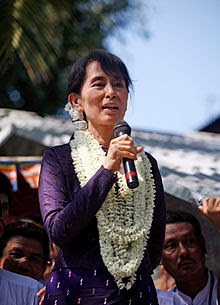
Aung San Suu Kyi addresses protesters in Monywa, Sagaing Division, on Thursday evening. (Photo: The Irrawaddy)

BANGKOK—For Aung San Suu Kyi the democracy activist, the 25-year struggle against Burma’s former military rulers was a largely black-and-white affair—a clear fight for freedom against one of the world’s most oppressive regimes.
But Suu Kyi the elected lawmaker is finding it a lot more difficult to pick her battles and is a lot more pragmatic when she does.
With the long-ruling junta gone and a reformist government in place, the political prisoner-turned-parliamentarian is now part of a nascent government dealing with a complex transition to democracy—even as she maintains her role as opposition leader.

This week, Suu Kyi moved to settle a dispute that has festered in the northwest for years: controversy over a military-backed copper mine in Letpadaung that has raised environmental concern and forced villagers from their land with little compensation.
The Nobel laureate made a two-day trip to the region to hear people’s grievances and try to help mediate a resolution. Hours before she arrived on Thursday, security forces launched a brutal crackdown on protesters that was the biggest of its kind since President Thein Sein took office last year.

Police used water cannons, tear gas and smoke bombs to break up an 11-day occupation of the mine project. Protesters saw their makeshift shelters ablaze. A nurse at a Monywa hospital said 27 monks and one other person were admitted there to be treated for burns.
Addressing a crowd of more than 10,000 people in the nearby town of Monywa on Friday, Suu Kyi criticized security forces but said protesters may have to accept a compromise for the sake of national honor.

Burma’s former army junta made past deals without taking into account the wishes of the people, she said, but such commitments must be honored “so that the country’s image will not be hurt.”
A Chinese company is part-owner of the mine, and Beijing previously complained when Burma pulled back on the Myitsone Dam project in Kachin State in which China had an interest.
In other comments during her trip to Monywa, Suu Kyi said she would work for the country’s benefit but called on people to be “open-minded.”
“To walk the democratic system is a tough path,” she said. “It’s not straight.”
Though mine protesters may not be satisfied by those words, they at least know that they have Suu Kyi’s attention. The Nobel Peace laureate has gotten less involved in other conflicts.

Since taking her seat in the legislature in April, Suu Kyi has not set foot in northern Kachin State, where a war is raging between rebels and the army that has forced than 75,000 people to flee. She also has yet to visit the western state of Arakan, where two waves of sectarian violence between ethnic Arakanese Buddhists and Rohingya Muslims has killed nearly 200 people and driven 110,000 people from their homes since June.

Suu Kyi has urged calm in both crises, but she not attempted to mediate, either.
“When entire communities of Rohingya and Muslims were wiped out in the state-backed ethnic cleansing in Rakhine [Arakan] State …. she didn’t even bother to tour the violence-struck” region, said Maung Zarni, a Burma expert and visiting fellow at the London School of Economics. “Why not?”

The answer, it seems, is that Suu Kyi has evolved into a pragmatic politician, one who must pursue personal and party goals without upsetting her new relationship with Burma’s new power brokers, including Thein Sein. The army still wields enormous power in this Southeast Asian nation, and Suu Kyi has argued she must work with them on the path to national reconciliation.
One of the most prominent signs of the 67-year-old’s pragmatism has been her failure to speak out strongly against what rights groups say is the widespread repression of the Rohingya minority.

Although she has condemned the recent unrest, she has pointedly refused to take sides, saying violence has been committed by both Buddhists and Muslims.
The Rohingya, though, are among the most persecuted people in the world, largely denied citizenship by Burma and rejected by Bangladesh. They have borne the brunt of the recent violence, which Maung Zarni and others argue is part of an effort by ethnic Arakanese to drive Muslims out of the state. The vast majority of the 110,000 displaced are Rohingya, many of whom lost homes in arson attacks.
But Suu Kyi is well aware of her movement’s desire to sweep national elections in 2015. The Rohingya are a deeply unpopular cause, and standing up for them is politically risky in a predominantly Buddhist nation where they are widely denigrated as foreigners from Bangladesh, even though many have lived in Burma for generations.

In April, Suu Kyi got a taste of the new political world she was entering shortly after her National League for Democracy party won almost all of the several dozen seats up for grabs in the country’s historic by-election.
Before taking their seats in the legislature, Suu Kyi’s party got embroiled in a major dispute over what they called the undemocratic wording of the oath of office. The party defiantly declared it would not take its seats until the phrasing was changed.
After a weeklong stalemate, Suu Kyi announced they would take the oath anyway and take their seats in a legislature where a quarter of seats are controlled by the army and most of the rest are occupied by retired military officers.
“Politics is an issue of give and take,” Suu Kyi said. “We are not giving up. We are just yielding to the aspirations of the people.

Wednesday, 28 November 2012

Suu Kyi: Heavy Lies The Head – Analysis


By:
November 28, 2012

During her recent trip to India, Daw Aung San Suu Kyi visited her alma mater the Lady Sri Ram College, where activists protesting the plight of the Rohingya Muslims in Myanmar are reported to have told Ms. Suu Kyi “to come out of her cocoon and take a stand on the Rohingya issue.”

 Some political analysts have described the Rohingya issue as a test of Suu Kyi’s ‘credentials and commitment’, her Buddhist faith and even as the true proof of her being worthy of the Nobel Peace prize . It is time to take a step back and look at Myanmar, take in the big picture and focus on Suu Kyi and the challenges that confront her.
Aung San Suu Kyi
Aung San Suu Kyi

Ms Suu Kyi today, is a popular leader of Myanmar. After winning 43 of the 45 parliamentary seats contested in the by-elections held in April this year, she is expected to gain control of the government after the elections scheduled for 2015; about three years from now. The world has been delighted to see Ms. Suu Kyi in the Myanmar parliament. She is an international symbol of courage and non-violent opposition to the military rule, having struggled bravely for human rights and political freedom while under house arrest for almost 15 of the 21 years from 20 July 1989 until her most recent release on 13 November 2010.

US president Obama, during his first trip abroad post re-election remarked in Bangkok last week, “Democratic transition in Burma is an ongoing process and the process needs to be in the spotlight.” Ms. Suu Kyi idolized by her people and the world, has what it takes to leverage this attention and bring about real and lasting change in Myanmar.
However, Ms. Suu Kyi cannot assume that her overwhelming popularity in Myanmar today will remain intact over the next few years and see her through to the elections in 2015. Her party, the National League for Democracy (NLD), needs to have a clear understanding of the country’s priorities and come to grips with these issues at the earliest. Ms. Suu Kyi, on the other hand, will have to evolve from being a resistance icon to a national leader; a challenging prospect.

According to the International Crisis Group, ethnically, Myanmar is one of the most diverse countries in the world. Consequently, since independence it has experienced a complex set of conflicts between the central government and ethnic minority groups seeking autonomy. Ethnic minorities constitute about one-third of the population and occupy roughly half of the country in terms of area. At present, despite almost all ethnic groups having accepted the Union of Myanmar and their demands being limited to increased local authority and equality within the federal state structure, the country is not beyond strife.

UNHRC data indicates that there are 777,859 refugees, asylum seekers and IDPs of Myanmar- origin displaced to its neighbours. There are a further 1,147,275 persons including 808,075 stateless persons within the country itself. The Myanmar refugee population in India is mainly from the Chin ethnic minority group, with a smaller proportion of Kachins, Rakhines, and Bamars.

Over 140,000 Myanmarese, mostly Karen, Karenni, Mon and Shan, among others are presently confined in camps in Thailand. Many have been displaced since the mid-1980s. In addition, there are probably at least 300,000 refugees outside these Camps in Thailand, including 250,000 Shan refugees. Suu Kyi has visited Mae La refugee camp on the Thai border, telling thousands of people that their plight has not been forgotten. She has also visited the town of Mahachai, outside Bangkok, home to Thailand’s largest population of Myanmar migrants.

It is in this country, torn by internal conflict and racked by armed ethnic insurgencies of various scales and intensities that Suu Kyi is trying to make the shift from opposition leader to a party, parliamentary and a national leader. Further as a Member of Parliament, Suu Kyi is now carries the cross of being part of Myanmar’s state establishment. Suu Kyi alone cannot solve the complex ethnic problems of Myanmar that have existed for decades. Her ultimate challenge will be to keep the country unified while addressing the demands of the minorities.

She has also to revitalise the grass root-level infrastructure of her party, the NLD. She has to find common grounds with the Military that would support the necessary amendments to the present Constitution without which she cannot assume leadership in the Myanmar.
Suu Kyi’s stance on the Rohingya issue has been influenced by three key factors: the public opinion in her own constituency, the collective view of her party, and the mainstream opinion in Myanmar. Incidentally her constituency, the rural township of Kawhmu, is known to have an extremely anti-Rohingya stance. Yet there is a requirement of articulating a coherent policy for the future, policy that diffuses the situation in Rakhine State and allows for humanitarian aid to flow in to refugees.

Staying on the Rohingya issue, Suu Kyi in one of her interviews to the media in New Delhi made three important points. One, the immediate step is for the violence to stop, effect de-escalation of the situation and allow access to humanitarian aid. Second, both communities have resorted to violence hence restrain has to be exercised by all stakeholders. Rhetoric and provocation has not helped either side. Third, was regarding the responsibility of Bangladesh on the issue.

A Danish Immigration Service fact finding mission in 2011 found that the Bangladesh government was concerned about the ‘pull factor’ related to the Rohingya’s exodus to Bangladesh. This was the reason the government did not want to provide support to development activities aimed at improving the living conditions of the Rohingya. A Joint Initiative by five UN agencies to develop for Cox’s Bazar, a two-year, $33 million development plan to strengthen education, health, livelihood ect could not get the Bangladesh Government’s approval. If Pakistan and Iran were to adopt a similar position on Afghan refugees, their plight would have been akin to the Rohingyas.

Suu Kyi’s endorsement of the Rohingya struggle at this stage will not get the Rohingyas what they want but for Suu Kyi anything more than a balanced stance on the Rohingya issue will definitely impact her position adversely in 2015. So let’s be fair and grant ‘Daw Suu’ some political manoeuvre space and her rightful place in Myanmar history.
This article appeared at South Asia Monitor and is reprinted with permission.
5
About the author:
Monish Gulati is an independent analyst based in New Delhi.. He can be reached at m_gulati_2001@yahoo.co

Tuesday, 27 November 2012

Puppet State America

by Paul Craig Roberts – TRANSCEND Media Service
The United States government and its subject peoples think of the US as “the world’s only superpower.” But how is a country a superpower when its entire government and a majority of the subjects, especially those members of evangelical churches, grovel at the feet of the Israeli Prime Minister? How is a country a superpower when it lacks the power to determine its own foreign policy in the Middle East? Such a country is not a superpower. It is a puppet state.

In the past few days we have witnessed, yet again, the “American superpower” groveling at Netanyahu’s feet. When Netanyahu decided to again murder the Palestinian women and children of Gaza, to further destroy what remains of the social infrastructure of the Gaza Ghetto, and to declare Israeli war crimes and Israeli crimes against humanity to be merely the exercise of “self-defense,” the US Senate, the US House of Representatives, the White House, and the US media all promptly declared their support for Netanyahu’s crimes.

On November 16 the Congress of the “superpower,” both House and Senate, passed overwhelmingly the resolutions written for them by AIPAC, the Israel Lobby known as the American Israel Public Affairs Committee, the only foreign agent that is not required to register as a foreign agent. The Global News Service of the Jewish People reported their power over Washington with pride. (http://current.com/19su0kc). Both Democrats and Republicans shared the dishonor of serving Israel and evil instead of America and justice for the Palestinians.

The White House quickly obeyed the summons from the Israel Lobby. President Obama announced that he is “fully supportive” of Israel’s assault on Gaza. Ben Rhodes, White House deputy national security adviser, told the media on November 17 that the White House “wants the same thing as the Israelis want.” This is an overstatement as many Israelis oppose the crimes of the Israeli government, which is not the government of Israel but the government of the “settlers,” that is, the crazed land-hungry immigrants who are illegally, with Netanyahu’s support, stealing the lands of the Palestinians.

Netanyahu’s Israel is the equivalent of the Lincoln Republicans 150 years ago. Then there was no international law to protect Southern states, who left the voluntary union, a right under the Constitution, in order to avoid being exploited by Northern business interests. Subsequently, the Union army, after devastating the South, turned on the American Indians, and there was no international law to protect American Indians from being murdered and dispossessed by Washington’s armies.

Washington claimed that its invasion forces were threatened by the Indian’s bows and arrows. Today there is international law to protect the Palestinian residents of the West Bank and Gaza. However, every time that the world tries to hold the Israeli government accountable for its crimes, Israel’s Washington puppet vetoes the UN decision.
The notion that Israel is threatened by Palestinians is as absurd as the notion that the US is threatened by Afghanistan, Iraq, Libya, Yemen, Syria, Somalia, Pakistan, and Iran. No government of any of these countries has ever made a threatening statement against the US. Even had such a statement been made, it would be meaningless. If a Superpower can be threatened by such impotent and distant counties, then it is not a superpower.

Demonizing a victim is a way of hiding state crimes. The American print and TV media is useless as a check on state crimes. The only crimes reported by the media are assigned to “terrorists,” that is, those who resist US hegemony, and to Americans, such as Bradley Manning and Sibel Edmonds, who liberate truth from official secrecy. Julian Assange of WikiLeaks remains in danger despite the asylum granted to him by the President of Ecuador, as Washington has little regard for international law.

In the US the exercise of the First Amendment is coming to be regarded as a crime against the state. The purpose of the media is no longer to find the truth, but to protect official lies. Speaking the truth has essentially disappeared as it is too costly to journalist who dare to do so. To keep one’s job, one serves Washington and the private interest groups that Washington serves.

In his November 19 defense of Israel’s latest war crimes, President Obama said: “no country on earth would tolerate missiles raining down from outside its borders.” But, of course, numerous countries do tolerate missiles raining down from the US. The war criminal Obama is raining down missiles in Afghanistan, Pakistan, and Yemen, and has rained missiles on Libya, Somalia, Iraq and Syria as well. Iran might be next.

The German assault on the Warsaw Ghetto is one of the horror stories of Jewish history. Such an event is happening again, only this time Jews are perpetrators instead of victims. No hand has been raised to stay Israel from the goal of the operation declared by Israeli Interior Minister Eli Yishai to be “to send Gaza back to the Middle Ages.” (http://www.independent.co.uk/news/world/middle-east/israel-pounds-gaza-from-air-as-troops-assemble-8326924.html)
_________________________
Paul Craig Roberts was Assistant Secretary of the Treasury for Economic Policy and associate editor of the Wall Street Journal. He was columnist for Business Week, Scripps Howard News Service, and Creators Syndicate. He has had many university appointmen

BGB more arrests Malaysia voyagers from Burma-Bangladesh border

BGB more arrests Malaysia voyagers from Burma-Bangladesh border

Cox’s Bazar, Bangladesh: Fourteen Malaysia voyagers (boat-people) were arrested by Border Guard Bangladesh (BGB) from Burma- Bangladesh border on November 25-26, said a local from border.
“They were arrested by the authorities while they were trying to leave for Malaysia by the sea-route.”

On November 25, Border Guard Bangladesh (BGB) arrested four Malaysia voyagers from Saparan union under the Teknaf police station. After arrest, they were handed over to Teknaf police station for further investigation, official said.
However, police have filed case against them regarding the illegal entry from Burma to Banggladesh.

On November 26, police also arrested 10-Malaysia voyagers from Innani under the Cox’s Bazar district in a raid. After arrest, police have investigated the matter and filed case against them, according to police official.

The authorities of Bangladesh have been arrested many Malaysia voyagers from different areas of border since October and many boat-people had been died in the sea, said an aide of police authorities.
He also said that the concerned authorities and fishermen also rescued many Malaysia voyagers from the sea while they were floating in the sea.

A businessman from Maungdaw said, Rohingyay people are going to Malaysia for seeking better opportunity because of persecution, such as — killing, raping, arresting and extorting and sending jail without any proper trial after the riots by Nasaka, police and army.

President Obama’s remarks on Rohingya in Rangoon speech led Thein Sein to seemingly change his mind to declare a four-point plan regarding Rohingya issue in Phenom Penh ASEAN conference recently. But his plans– prejudice, education, employments and family planning are neither the major factors that caused the violence against Rohingyas and subsequent displacements nor the solutions to the conflicts.

Thein Sein seems totally lost control over the Nasaka as in Arakan state where torturing, looting, killing, shooting and rapes have become normal habits against the Rohingya community, said a political leader.
The police, Nasaka and army are doing against the Rohingya community, so far. But their activities against the Rohingyas do not stop immediately as President Thein Sein gave promise to world community. A businessman said ,who denied to be named.
source-KPN.

Monday, 26 November 2012

West, Islam can unite over Rohingya cause

Tue, November 27, 2012 02:24:26 AM
Thomas Donilon, the US president's national security adviser, said that Barack Obama was to raise concerns over the plight of Muslim Rohingya in Rakhine state during his meetings with Myanmar President Thein Sein and opposition leader Aung San Suu Kyi. Doing so could be critical not only to resolving the conflict in Rakhine state, but it could also have great implications for relations between Islam and the West.

In the latest clashes last month, sectarian violence between the Buddhist majority and Muslim minority in Myanmar's westernmost state claimed 89 lives, according to official reports. While much of the world sees the situation as "merely" a clash between Buddhists and Muslims, it is much more complex.

At the heart of the conflict is the Rohingya's lack of protection from the state because they are not considered Myanmar citizens, despite having lived in the country for several generations. Buddhist Rakhines view the Rohingya with suspicion, as illegal immigrants from Bangladesh who refuse to speak the Burmese language and embrace the local culture.
To be fair, many who claim to be Rohingya are illegal immigrants and it is extremely difficult to determine who are real Rohingya and who are illegal settlers from Bangladesh.
Muslim countries are very interested in seeing better treatment of the Rohingya by the Myanmar authorities who are accused by international human rights organisations of favouring the Buddhists in the conflict. Turkey's first lady Emine Erdogan and Foreign Minister Ahmet Davutoglu visited Rakhine state in August, which led to widespread international media coverage of the conflict and jolted the Islamic world into paying attention.

Jusuf Kalla, former vice-president of Indonesia and current chairman of the Indonesian Red Cross, made it a personal crusade and led Indonesia's efforts to try and persuade the Myanmar government to find a peaceful settlement to the Rohingya issue. Saudi Arabia has called the conflict "ethnic cleansing" against the Muslim Rohingya and King Abdullah reportedly ordered $50 million in aid to be sent to the Rohingya community. Iran also spoke out against the treatment of the Rohingya and called on all Muslim countries and international organisations to take swift actions to stop the "genocide" in Rakhine state.
The Organisation of Islamic Cooperation (OIC), a bloc of 57 Muslim countries, sent a high-level delegation to Myanmar and has continued to be vocal on the issue. According to its secretary-general, the OIC sent a letter to the White House encouraging President Obama to raise the Rohingya issue with Myanmar's leaders during his trip to the country, the first ever visit by a sitting US president.

This solidarity within the Islamic world is unprecedented. Muslim nations are speaking with one voice and that voice favours the protection of human rights.
While some of these countries may be using the issue to deflect attention from their own flawed human rights policies, the plight of the Rohingya has created a common position among these Muslim countries. More importantly, these interests coincide with values traditionally espoused by the Western world.

It is imperative that the White House recognise this opportunity resulting from this shared interest. The US may equivocate when questions related to the Arab-Israeli conflict arise.
Turkey would rather avoid questions when asked about the government's harsh treatment of its critics and Kurdish political activists. Indonesia dissembles when asked about discrimination against its Christian minority. Saudi Arabia would rather not talk about women's rights at home, while Iran continues to speak out against intervention in Syria despite mass killings by the Assad regime. But all these countries agree that the Muslim Rohingya deserve basic human rights and better treatment from the Myanmar authorities.
US concern for the plight of the Muslim Rohingya will demonstrate that it is not in conflict with the Islamic world. The US can use this opportunity to work with Muslim countries to promote tolerance and respect for human rights in Rakhine state.
In his speech at Yangon University yesterday Mr Obama urged an end to the sectarian unrest saying that there was no excuse for violence against innocent people.
But the president should go further and develop the emerging shared values evident in the world's response to this conflict. (Of course, he must do so delicately without making the Buddhists feel like scapegoats.)

Islam and the West can find common ground in Rakhine state. It could well be that the road to reconciliation between Islam and the West will pass through this abject region in the westernmost part of Myanmar.

Fuadi Pitsuwan is is a non-resident WSD-Handa Fellow at Pacific Forum CSIS in Honolulu, Hawaii, and a Belfer IGA Student Fellow at Harvard University's Kennedy School of Government. The article originally appeared in the Pacific Forum CSIS Pacnet series.

Sunday, 25 November 2012

ARNO condemns the report of RFA

24 November,2012.

ARAKAN ROHINGYA NATIONAL ORGANISATION
ARAKAN, BURMA
(24 November 2012)

ARNO condemns the report of RFA

Our attention has been drawn to the news report dated 21 November 2012 of the Radio Free Asia (RFA) Burmese Section stating “since November 19, frontier checkpoint supervising day-return visit between Maungdaw (Burma) and Teknaf (Bangladesh), has been closed from Burma side for an indefinite period as the abduction of 3 Burmese military`s General Engineering Unit was believed to have been done by Arakan Rohingya National Organization (ARNO)”.


ARNO has no direct or indirect connection with the abduction of 3 GE Unit soldiers. We strongly condemn this concocted and politically motivated news aims at tarnishing the image of the ARNO. We demand RFA to clarify the source of the information. 

Meanwhile, we reiterate that ARNO is a peaceful political organization that believes in the negotiated settlement of the Rohingya problem through peaceful means with the cooperation of the international community. 

For details, please contact: 

Nurul Islam: + 44 7947854652

Japan intercepts N. Korea weapons-grade material bound for Myanmar

November 24, 2012
By YOSHIHIRO MAKINO/ Correspondent

North Korea tried to ship materials suitable for uranium enrichment or missile development to Myanmar via China this year, in violation of a U.N. Security Council resolution, The Asahi Shimbun has learned.
The shipment included about 50 metal pipes and 15 high-specification aluminum alloy bars, at least some of them offering the high strength needed in centrifuges for a nuclear weapons program.

Japan seized the items aboard a cargo vessel docked at Tokyo Port on Aug. 22, a raid which took place at the request of the United States, sources told The Asahi Shimbun.
Authorities concluded that the shipment originated in North Korea because the bars were found to be inscribed "DPRK," although investigators were unable to confirm the origin from cargo documents or from the ship's crew, the sources said.
Japan, the United States and South Korea believe Myanmar has abandoned its one-time nuclear weapons ambitions. This makes officials suspect that the aluminum alloy may have been intended for use in building missiles instead.

A South Korean government source said Myanmar may have been trying to develop short-range missiles in the event of border disputes with its neighbors.
The United States is among nations now easing sanctions against Myanmar and supporting its move toward democracy. On Nov. 19, Barack Obama, the first serving U.S. president to visit Myanmar, met with President Thein Sein in Yangon and requested that he sever military ties with North Korea.
The revelation of apparent continued links could hamper international reconciliation. And Pyongyang has complained of U.S. pressure on Myanmar to end relations.
It will also likely cause international criticism of Myanmar and China, which have both denied violating the U.N. ban on North Korean exports of weapons and related materials.
The cargo was to have been delivered to Soe Ming Htike, a Yangon-based construction company, which the U.S. government believes is a front for Myanmar's military procurement.

In an interview with The Asahi Shimbun, a company based in Dalian, China, confirmed that it had tried to send aluminum alloy to Myanmar.
"We became the cargo's owner at the request of a company," an official said. "We have learned that the cargo was seized, but we do not know why."
Japanese government officials believe North Korea acquired the aluminum alloy from China. They said North Korea is unlikely to possess the technology needed to produce such material.

At a meeting held to discuss the matter, Japanese officials from several government agencies agreed that the Chinese military—which ultimately controls its defense industry—must have approved North Korea's exporting the materials to Myanmar.
The sources said the cargo was loaded onto the 17,138-ton Wan Hai 215, a Singapore-registered cargo vessel operated by a Taiwanese shipping company, in Dalian on July 27.
On Aug. 9, the cargo was offloaded and placed aboard the 27,800-ton Wan Hai 313 in Shekou, China.
On Aug. 14, the cargo was scheduled to change ships once again in Malaysia and to reach Yangon Port the following day.
The United States learned about the cargo's possible contents and asked the Taiwanese shipping company not to carry out the transshipment in Malaysia.
The Wan Hai 313 entered Tokyo Port on Aug. 22. Officers from Tokyo Customs, the Ministry of Economy, Trade and Industry and other agencies examined the cargo and found the items in question.
For the first time, Japan applied a special measures law that allows the government to inspect cargo on ships suspected of carrying weapons and related materials to and from North Korea.

Meanwhile, the discovery could force Japan, the United States and South Korea to review their nuclear nonproliferation policy.
A Japanese government source said since North Korea has no apparent difficulty procuring the necessary aluminum alloy it now likely "has acquired a large number of centrifuges."
In November 2010, North Korea showed centrifuges to U.S. experts at a nuclear facility at Yongbyon. Officials claimed there were 2,000 centrifuges, enough to produce 40 kilograms of highly enriched uranium in one year, if certain conditions are met. That amount is sufficient for one or two nuclear bombs.
The U.S. and South Korean intelligence agencies suspect that North Korea is operating additional underground uranium enrichment facilities elsewhere.
"North Korea would never disclose all its cards," one South Korean government source said. "There must be other facilities."
It is difficult to monitor the activities of centrifuges with an intelligence satellite because the site needed is small compared with the large reactor needed to produce plutonium for bombs.

North Korea and Myanmar have had military ties for years.
Sources quoted Shwe Mann, speaker of Myanmar's lower house, as recently telling Japanese government officials that North Korea has yet to deliver some weapons ordered by Myanmar in the past. But, the speaker insisted, Myanmar would pursue no new weapons purchases from North Korea.
Shwe Mann's remark effectively contradicts Myanmar's official stance that it has not had any military transactions since spring 2011.
The United States and South Korea learned that Myanmar signed contracts to purchase military supplies from North Korea when Shwe Mann visited the country in November 2008 as joint chief of staff. Among facilities Shwe Mann inspected was a North Korean missile factory.

In January, a ship arrived at Yangon Port via China, carrying cargo that had been loaded in Nampho, North Korea, ordered by an organization affiliated with the Myanmar military.
"The cargo was a primary machine tool for weapons manufacture," said a diplomatic source in Yangon. "Military ties between Myanmar and North Korea have not been cut off."
North Korean military engineers have been spotted in Myanmar, as well as officials from a company that procures personal funds for the North Korean leader, Kim Jong Un.
The U.S. and South Korean intelligence agencies have stationed personnel at airports and ports in Myanmar to monitor traffic, but North Koreans are apparently traveling by land through China, sources said.

Investigations by Japan and the United States have found that Myanmar has—at some point—imported from North Korea weapons that include mortars.
Myanmar has also informally told the United States it built underground tunnels near Naypyidaw and elsewhere with technical assistance from the North Korean military.
Japan, the United States and South Korea have refrained from disclosing details about military ties between North Korea and Myanmar.

"If we went public with that, we would thrust Myanmar closer to China and North Korea," said one Japanese government source.
Meanwhile, a Chinese government source criticized the approach of countries such as the United States toward Myanmar.
"It does not contain only niceties, such as an evaluation of the pro-democracy movement," the source said. "This is a geopolitical confrontation between China and the United States."

By YOSHIHIRO MAKINO/ Correspondent
 
The Asahi Shimbun

13 Year Old Rohingya Girl Being Raped By Nasaka, Maungdaw

25 November 2012

A Rohingya girl was taken into the Nasaka camp of Zaw Matet village tract by Nasakas while she was coming back home after selling fire-woods in the Zaw Matet market.

“On 22nd Nov 2012, at 10:20AM, Nasakas from Zamatet Nasaka camp captured a 13 year old Rohingya girl known as Nur Bi Bi d/o Hansu hailed from Du-Thandar village tract of Maung Daw who was coming back home from Zaw Matet market after selling fire-wood. No one is allowed 


to go there to ask them to release her. The girl has not been released yet” said an eye witness who doesn’t want to be named.

“Like wise many Rohingya girls were taken to the camp, tortured, raped. Some of them were released while some others were even killed. So, without any doubt I can say that she will be released or may be killed after being raped” he added.

The local authorities are using Rohingyas as animals as though they have no right to live in the word. After the historic and remarkable speech of Obama, Rakhines with the help of Nasaka set fire on more than 10 houses of Rohingyas in Hintha Ya village of Zaw Matet, Maung Daw. Then Nasakas are torturing the Rohingyas (whose houses were burnt down) and making them to sign to confess that the houses were burnt by themselves.

Source MYARF:

Authority force Rohingya to accept Bengali

|  

Maungdaw, Arakan State:  The Nasaka (Burma’s border security force) was taking lists of Rohingya families as Bengali in the column of Nationality in a Form (provided by the government) by threatening (even with gun point) and also taking signature forcibly since yesterday in Maungdaw Township, according to a village leader who denied to be named.  
“Yesterday, the Imams (religious leader) of mosques together with village administration officers of under the Nasaka area No.1, 2, 5 and 6 were summoned to the local Nasaka headquarters. Having reached there to the office, they are ordered to put off the religious dress (cap and long shirt), taking photographs and to pay Kyat 500 each before entering the Nasaka camp.”

Besides, the Nasaka asked their names, age, and the names of their grandfather, grandmother and birth place of them. Later, the Nasaka asked their nationality.  When the Imams said that they are Rohingya nationality, not Bengali, but the authority was “writing in the Nationality column” as Bengali and forcibly taking their signatures, one of  the administration officers said.

The Nasaka personnel forcibly (with gun point) took signatures from some of the imams, but some others fled from the scene and went to their villages seeing the events. The Nasaka collected Taka 2,000 to 3,000 per head for photos, he more added.
“Today, the Nasaka also went to Maung Nama village of Maungdaw north and south as well as Maungdaw town and did similar to yesterday. Villagers do not like the Nasaka’s activities against the Rohingya community that they try to make us Bengali by using their power,” said a trader from Maungdaw. 
“In the wake of its cracks to forcibly to make Bengali to the ethnic Rohingyas, Burmese government has been implementing a measure one after another since last two months.”
“The government is making all efforts to prove its false accusing us of illegal immigrants from Bangladesh and is forcing us gently sometimes and terribly sometimes to identify themselves as Bengalis,” said a schoolteacher from Maungdaw Town.
The government’s first policy was dishonest offers and false promises that it will provide Rohingyas with all fundamental rights if they admit to being Bengalis as their ethnic origin, he more added.

When the government has realized that these offers and promises have fallen on deaf ears as nobody dared to lie about ethnicity Rohingyas, the government’s next attempt is to threaten the Rohingyas as by arresting, torturing, beating and extorting huge money.

Certainly, the government’s thinking beyond forcing the Imams first is that perhaps the public will follow them blindly in admitting to be illegal immigrants. And all these efforts are being made by the government to blind the world to its lying for decades and to show as proofs in need, said a Rohingya leader preferring not to be named.

We, the ethnic Rohingya are not motivated to accept the ideology of the brutal regime of President Thein Sein, forcefully; it wants to make us Bengali the whole ethnic Roingya with pressure. We'll constantly resist until end, we'll die as Rohingya, he more added.
“For too long, the people of this state, including ethnic Rakhine, have faced crushing poverty and persecution. But there is no excuse for violence against innocent people. And the Rohingya hold themselves – hold within themselves the same dignity as you do, and I do,” according to President Obama’s speech at Rangoon University.
But, the Rakhine Nationalities Development Party (PNDR) Chairman Dr. Aye Maung telling Irrawaddy, “I do not like the word ‘Rohingya and the word ‘Rohingya’ is newly invented by illegal immigrants. They are trying to be an ethnic group of our country with a grave intention. Obama has to study about them and he was ignorant to use the word “Rohingya”.
The government will pursue a four-point plan - changing people’s prejudices, promoting education, creating jobs—and introducing a program of birth control- aimed at resolving the bitter divisions between Muslim and Buddhist communities in Arakan State, said the Burma’s President Thein Sein, speaking to Burmese media at a press conference on the sidelines of the ASEAN Summit in Phnom Penh on November 21.

This is theoretically an excellent idea. The only problem is, it will go against the Rakhine pogrom of Rohingya extermination. How the President is going to fix that?said Dr.Abid Bahar, saying with reference of the Rakhine community- monks, politicians, political party and civilian- didn’t want to stay together with Rohingya community.
"The regime needs to be told that there are lots of misunderstanding about the origin of the Rohingya. In their minds, the Rohingya existence has been intimately tied up with "Indian seasonal migration" to Burma. But facts are different,” said Dr. Habib Siddiqui.
Dr. Siddiqui's recent communications with former Ambassador Derek Tonkin of UK amply shows that there were significant Arakanese Muslims all along and the Indian immigration for seasonal labor should not be confused with this indigenous group (that is term used in the British report by Baxter in 1940, after the race riots in Burma). Education to clear such false myths has to be a priority to create a more conduce society in Burma.

Fishermen rescue over 175 boat-people

Teknaf, Bangladesh: Fishermen from Bangladesh rescued over 175 boat-people from Bay of Bengal while floating in the sea on November 23, according to a fisherman from Shapuri Dip.

“A fishing trawler with 175 boat-people left for Malaysia by sea-route on November 11. But, on the way to Malaysia, the engine of the boat was damaged and it was floating in the sea for 13 days.”
The boat-people got connection with some relatives on this situation and told them regarding the event. So, their relatives requested some fishermen who were fishing in the Bay of Bengal to rescue the boat-people. However, Later, the relatives didn’t get connection with boat-people because of less network of cell phones in the sea. As a result, they were floating in the sea for long time, said a boat-people on condition of anonymity.
However, on November 13, two more fishing boats went to the deep sea and rescued them on that night. They were brought to the land and were sent to their destinations on November 14, in the early morning.

On being tipped off, police went to the spot, but they couldn’t arrest anybody from the group, according to sources.
One of the boat-people from the group said, “We went to nearby Akyab (Sittwe) of Burma while the engine of boat was damaged suddenly. So, we were floating in deep sea where fishermen don’t go there for fishing. But, we are lucky as fishermen saved our lives.”
“We gave Taka 30,000 to brokers (Leaders) in advance and the remaining money will be paid in Malaysia after reaching there. Among us, some are Bangladeshis and most of the people are Rohingyas,” he said.
He also said that they had food for 8 to 10-days, but they faced food and water shortage after 10-day. They starved for long in the sea.
“If fishing boats don’t rescue us, we will die within some days,” said another rescued boat-people.

Wednesday, 21 November 2012

One kills, 16 rescue, a boat sinks in Bay of Bengal


Nearly half of the Rohingya Boat People end their life either sinking or mediators' hands. I am very  much aware that due to genocide and denial of entry and widespread arrest in Bangladesh many Rohingyas choose dangerous boat boat journey . Guess how the stupid these Rohingya mediators are ?This's what our people earning money today. After reaching Thailand ,nearly 100%  boat people fall at the hand of brookers who kept the boat people at the organized secrete shelters before enter in to Malaysia. The mediators asked 60,000 Thai bath or 6000 Malaysian Ringit which is equal to 2000 USD. The boat people are tortured daily to realize the said amount.If they fail to arrange said amount within time frame,they are sold to fishing trawlers for two years.Many Rohingyas end their life at fishing trawlers.

    This is untold tragedy of boat people here .The mediators are very rich and they always to carry this monkey business by hiring local goons.This gang are very strong and cruel people.

      This way Rohingyas end their value able lives. Last two weeks ago I learn that six young Rohingyas girls were secretly kept at the cabin of Crews and captain. The crews are Maughs and Mons.Non of the boat people knew about the grils/women for 10 days.After reaching in Thailand ,the Rohingyas knew about the girls passengers. They were very angry but due the Rohingya dalal ,the situation was calm dawn.Now you can guess how the Rohingyas dalal make money from their fellow Rohingyas.This's common case for Rohingyas.

Maung Kyaw Nu.

One kills, 16 rescue, a boat sinks in Bay of Bengal


Teknaf, Bangladesh:  A boat loading with nearly 17 boat-people was sung in the Bay of Bengal today at around 4:00 am while ferrying these people to a big cargo boat, which was anchoring in the Bay of Bengal, according to a fisherman from Shapuri Dip. 
“After loading 17 people, the ferry boat was starting and going to the anchoring cargo boat to send the people, but half an hour, the boat was suddenly sinking in the Bay of Bengal. One man was killed and the rest 16 people were rescued by other fishing boats.”

However, the big anchoring cargo boat in the Bay of Bengal with 151 boat-people including rescued 16 boat-people will leave for Malaysia again tonight.  The big Cargo boat collecting 135- boat-people from Mosh Khali, Cox’s Bazar and other places, said another fisherman from Shapuri Dip.

The Mazi (Leader) or broker collected Taka 20,000 per head. The Mazi is from Shita Forika village of Maungdaw, namely Nabi Hussain.  The leader bought an old cargo boat with Taka 300,000 and bought a new engine with 350,000, the fisherman more added.

“Most of the boat-people are Bangladeshi and some are Rohingya. In Teknaf, no young Bangladeshi as all of them trying to sail to Malaysia.”

Besides, on November 19, at night, another boat with 100 passengers had already left for Malaysia from Arza Khali village of Shapuri Dip.  It is still on the way to Malaysia, said a local elder from Teknaf.

Myanmar: UN expert greets latest commitments on human rights and calls for swift implementation

GENEVA (20 November 2012) – The United Nations Special Rapporteur on the
human rights situation in Myanmar, Tomás Ojea Quintana, welcomed today the
latest commitments from the Government of Myanmar on human rights as
significant steps forward in the ongoing reform process, and encouraged the
authorities to focus now on their prompt implementation.

These pledges announced by the Government on 18 November include the
resumption of prison visits for the International Committee of the Red
Cross (ICRC), the setting up of a mechanism to review prisoner lists,
addressing the situation in Rakhine State, and an invitation to the UN High
Commissioner for Human Rights to establish a country office.

“These are significant commitments made by the Government of Myanmar, with
tremendous potential to effect significant improvements in the country’s
human rights situation,” Mr. Ojea Quintana said, noting that they are
consistent with some of his previous recommendations, including those in
his latest report* to the General Assembly last month.

“I now encourage the Government to work with all stakeholders, including
the international community, in working out the necessary details and
ensuring that they are properly implemented,” the Special Rapporteur said.


 “Full access to places of detention by international and national
monitoring groups will help to address ongoing concerns about the condition
and treatment of prisoners and detainees, including in Rakhine State where
many hundreds of people have been detained since June this year,” he
pointed out.

Regarding the setting up of the review mechanism on ‘prisoner cases of
concern’ by the end of December 2012, the Special Rapporteur emphasised
that a vital element of this commitment will be the involvement of relevant
stakeholders, including political and civil society organisations and
released prisoners themselves.

“The outcome of this mechanism should be that no prisoners of conscience
are left behind bars,” the human rights expert said. “To achieve this will
require meaningful consultation with a wide range of people from both
inside and outside of Government circles.”

In this regard, he welcomed the presidential order of 16 November that led
to the release of around 50 prisoners of conscience, but again called on
the Government to ensure that these releases are without conditions. He
also called for steps to be taken to ensure prisoners’ reintegration into
society, including access to medical services and education and employment
opportunities.

In Rakhine State, Mr. Ojea Quintana welcomed the commitment by the
Government to strengthen the rule of law, to work with the international
community to meet humanitarian needs, and to address ‘contentious’ issues
such as citizenship.

In addition, the expert highlighted the need for the Government to develop
a clear strategy to address the tensions that exist between groups on the
grounds of ethnicity and religion, which will include addressing the
discrimination and human rights violations committed against the Rohingya
community.

“Developing a strategy to tackle discrimination should be an integral part
of the Government’s efforts to secure a future where the range of ethnic
groups in Myanmar can live in equality and peaceful coexistence,” he
stressed.

The Special Rapporteur also welcomed the commitment to extend an invitation
to the UN High Commissioner for Human Rights to establish an office in
Myanmar.  He highlighted the importance of the office being given a full
mandate for the promotion and protection of human rights, and freedom of
movement and access across the country.
ENDS

Mr. Tomás Ojea Quintana (Argentina) was appointed by the United Nations
Human Rights Council in May 2008. As Special Rapporteur, he is independent
from any government or organization .


Tuesday, 20 November 2012

WHAT IS OBAMA'S REACTION OF LAST NIGHT BURNING OF ROHINGYA HOUSES IN MAUNGDAW SOUTH?


No excuse for violence against innocent people: US President

US President Barack Obama visited to Burma yesterday and used a historic speech in Burma to urge an end to sectarian unrest in the western state of Arakan (Rakhine), saying there was “no excuse for violence against innocent people”.
“National reconciliation will take time, but for the sake of our common humanity, and for the sake of this country’s future, it is necessary to stop the incitement and to stop violence.”
“I shared with President Thein Sein, our belief that the process of reform that he is taking is one that will move this country forward,” Obama told reporters, with Thein Sein at his side.
“I recognize that this is just the first steps on what will be a long journey, but we think that a process of democratic reform and economic reform here in Myanmar … can lead to incredible development opportunities here,” Obama said, using the country name preferred by the government and former junta, rather than Burma, which is used in the United States.”
Similarly, the President also met with Suu Kyi at the lakeside villa where she spent years under house arrest for her pro-democracy activism. Obama called the meeting a new chapter between the two countries.
“Here, through so many difficult years, is where she has displayed such unbreakable courage and determination,” Obama told reporters, standing next to Suu Kyi. “It is here where she showed that human freedom and human dignity cannot be denied.”

Regarding the US President Barack Obama’s visit to Burma yesterday, the Rakhine people are very angry and torched a Rohingya village named Alora Dil village under Horsara (Zawmatet) villagew tract of Maungdaw south yesterday at around 8 pm. Nine houses were burned down into ashes by local Natala  ( new settlers) villagers  with the help of Nasaka ( Burma’s border security force), said a local elder on condition of anonymity.

As regards the matter, today, the Nasaka Director Col Aung Naing Oo (Rakhine) went to the spot and compelled to say the local villagers that “the local villagers, they themselves torched the village.”
The Director also held a meeting in Maungdaw Town today in Township Administration Office inviting local officers and elders. In the meeting, he told that the local villagers, they themselves torched their village and accusing the security forces and local Natala villagers.
Besides, the Nasaka force is trying to arrest the local villagers to take signatures from them on blank whitepapers that admitting those (villagers) themselves torched the village.  But villagers refused to give signatures.