Tuesday, 2 April 2013

Rangoon officials blame school administrators for fire


By KO HTWE
Published: 2 April 2013
Muslims cry and pray during a funeral for victims of a fire at Yaeway cemetery in Yangon
Muslims cry and pray during a funeral for victims of a fire at Yaeway cemetery in Rangoon on 2 April 2013. (Reuters)
 
Rangoon government officials have accused two school imams of being ‘largely’ responsible for the fire that killed 13 children on Tuesday, which authorities claim was caused by an overheated power transformer.

During a press conference this afternoon in the commercial capital, Rangoon division’s chief minister Myint Swe dismissed rumours that the blaze was started by arson and pinned the blame on the two on-site school administrators.

“Since the fire was caused by the power transformer, it is largely the responsibility of the individuals in the building. There is a power generator to use during power outages and so there could be some [kind of] fuel or diesel stored around,” said Myint Swe, in reference to allegations from locals who claimed that some type of combustible fuel had been used to set the building ablaze.

“Police colonel Tin Win didn’t see [any fuel] when he arrived at the scene. The officials didn’t find the fuel as described in the rumours. However, when there is a fire, the individuals responsible would be charged and they could have been trying to put the blame on some others. And they created confusion by doing so.”

Rangoon Police Chief Win Naing said authorities had carried out a “thorough inquiry” at the scene and identified the two imams as “prime suspects”.
“[The children] shouldn’t have died — in fact there was a lot of opportunity to save them if it had not been for the slow decision making process and response from the mosque supervisors,” said the police chief.

“We heard that in a desperate attempt to cover up their fault, they have been accusing these ‘unscrupulous perpetrators’ of starting the fire.”

“I didn’t know it was started from a wire-shock. What I saw was two items of women’s clothing that stank of diesel fuel near to the staircase where the fire broke out, along with an iron rod. We took photos of those and handed them over to the officials.”

According to a report in the AFP, a teacher who was sleeping in the school when the fire erupted said he smelled petrol inside the building.
“I think someone started the fire intentionally,” Khin Maung Hla told the AFP.
Another teacher who spoke to DVB on the condition of anonymity said the fire might have been caused by clothing that was soaked in petrol.

According to the teacher, there were 17 children upstairs at the time of the blaze and four of them survived with minor injuries.
An official investigation commission has been established that will include Islamic religious leaders, firefighters, representatives from the Rangoon City Electricity Power Corporation and police officials, who will be tasked with identifying the source of the blaze.
The tragic fire comes as tensions between Muslims and the country’s majority Buddhists are at a fever pitch following sectarian riots in March, which largely targeted Islamic communities in central Burma.
Tags: , ,

cource-dvb

Urgent Phuket Plea for B Negative Blood as Rohingya Mother To Be Goes into Labor

The boy born on a Rohingya boat off Thailand earlier this year

Urgent Phuket Plea for B Negative Blood as Rohingya Mother To Be Goes into Labor

Tuesday, April 2, 2013
PHUKET: Doctors are making an urgent plea for B Negative blood donors for a pregnant Rohingya woman who is about to give birth at a Phuket hospital.

The woman is expected to go into labor at the Vachira Phuket Hospital in Phuket City later today.

Doctors have examined her and expect the delivery will involve complications. As soon as they have sufficient blood stocks, the birth will be induced.

The woman fled with 107 others on a boat from Sittwe in Burma that arrived at Kuraburi, north of Phuket, on January 27.

Since then, she has been housed with other women and Rohingya children at a family shelter not far from Takuapa, in Phang Nga province.

Doctors on Phuket say her condition is not as good as it should be because of the conditions in the Burmese camp for displaced persons where she was being held.

One of the women who fled Sittwe at the same time gave birth to a boy on board the boat. Other women fleeing Burma in advanced stages of pregnancy are known to have died at sea during childbirth.
Regimented rape, day-to-day brutality, lack of medical aid and restrictions on the right to work are among the reasons Rohingya give for fleeing the country in which they are denied citizenship.
Those who are not corralled in rough camps in Rakhine state, also known as Arakan, are confined to ghettos in Sittwe or surrounding townships.

Women and children have begun joining menfolk on boats from Burma in record numbers this ''sailing season'' since renewed violence broke out in June last year.

Those who wish to donate B Negative blood should call Vachira Phuket on             076 361234       or the Red Cross on             076 211766      .

I am a Buddhist and by definition an atheist by Dr Maung Zarni

Maung Zarni

I am a Buddhist and by definition an atheist.

But as a fellow human, a parent and an educator, I grieve over the death of these Muslim students burned alive

My heart goes out to the Burmese Muslim families who lost their loved ones in what appears to be an arson attack on the Madrasa school on the 48th Street, Bohtataung, Rangoon, 2 Apri.

My solidarity with the persecuted Burmese Muslims of Burma!

Down with Naypyidaw-sponsored neo-Nazism! (It doesn't go down by itself. Everyone of us who opposes neo-Nazism must push for its complete and utter collapse).
Like · Comment · Share

Monday, 1 April 2013

Breaking News-Muslim Students were burned to death

Advertisement
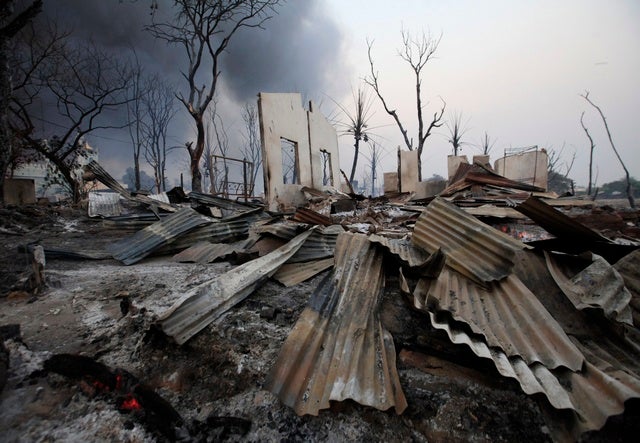
Security bars blocked most of the white building's windows, which were marked by black smoke in the late morning. The building burned from the inside, and firefighters had extinguished the flames before dawn.

Mosque member Soe Myint said most of the children were sleeping on the ground floor when the blaze began and they were able to flee to safety.
But 16 of them were sleeping in a small loft on the first floor and were trapped when the ladder that led to the loft caught fire. Three boys jumped to safety, he said, and the rest died.

Police officer Thet Lwin, who was at the scene before dawn, said the fire was triggered by an electrical short "and (was) not due to any criminal activity".
Every time he mentioned the word "electrical short", though, angry Muslims shouted and began banging on vehicles with their fists.

Zaw Min Htun, a member of a local Muslim youth organisation, said he raced to the mosque early on Tuesday after hearing it was on fire.

"Muslims are very angry," he said, calling on authorities to investigate what happened. "The children are innocent .... Someone burned the mosque."
Zaw Min Htun said he saw no burned wires inside the mosque and said the building's fuse box was in good condition.

Police failed to stop killing, arson: HRW

Author-AFP

Published: 1 April 2013
Soldiers stand guard on the side of a street in Meikhtila
Soldiers stand guard on the side of a street in Meikhtila on 23 March 2013. (Reuters)
 
Human Rights Watch (HRW) on Monday urged Burma to investigate the failure of police to stop a recent wave of Buddhist-Muslim killing and arson attacks.
The New York-based rights watchdog released satellite images which it said showed more than 800 buildings were totally destroyed in the central town of Meikhtila, leaving several charred areas where homes and properties once stood.

“The government should investigate responsibility for the violence in Meikhtila and the failure of the police to stop wanton killings and the burning of entire neighbourhoods,” said HRW Asia director Brad Adams.
Last month’s unrest, which later spread to several other towns, has left 43 people dead and more than 1,300 homes and other buildings destroyed, according to state media in the former army-ruled nation.

According to the United Nations, about 12,000 people have been displaced.
The worst-hit areas in Meikhtila are believed to be neighbourhoods once home to “a significant number of Muslims”, said HRW deputy Asia director Phil Robertson.
The violence “was allowed to run for days on end”, he told AFP. “There’s been plenty of information that we found, and that others have reported, of essentially the police allowing it to go on and not intervening.”
HRW said the destruction bore similarities to sectarian unrest in a different area in western Burma last year that killed at least 180 people and left “large, clearly defined residential areas in ashes”.

The situation appears to have calmed since President Thein Sein on Thursday vowed a tough response against those behind the violence, which he attributed to “political opportunists and religious extremists”.

In a radio address on Sunday, the former general appealed to members of the Buddhist clergy to “assist the government in promoting peace and stability”.
Some monks were involved in the recent violence, according to witnesses, while others have spearheaded a move to shun shops owned by Muslims.
Security forces have fired warning shots in some instances to disperse rioters, but they have also faced criticism from Muslim leaders in the Buddhist-dominated country for failing to stop attacks.

Last year HRW accused local security forces of killing Muslim villagers in the western state of Arakan while government troops “stood by and watched”.
Tags: , ,
Author:           

Arakan probe delays publication of anticipated report


credit-The Irrawaddy News
By DAVID STOUT
Published: 1 April 2013
burnt-houses
Destroyed houses stand amid ruins of a neighborhood burnt in violence at East Pikesake ward in Kyaukphyu on 6 November 2012. (Reuters)
 
The commission appointed to investigate the two bouts of sectarian rioting in western Burma’s Arakan state last year postponed the release of their final report that was set to be published in March.

According to a press statement released yesterday, the publication of the report was postponed to allow the team to hold a follow up a meeting with government officials to discuss evidence that has “links” to areas outside of Arakan state.
The government-mandated commission was established by presidential decree last August.
The 27-member team was ordered to investigate the sectarian riots that erupted in June and again in October in Arakan state, which pitted Buddhist Arakanese against Muslim Rohingyas.

Following the two rounds of rioting, 180 people were killed and more than 120,000 displaced, according to government statistics.

The commission had initially agreed to publish their report in September but pushed back their deadline until 31 March. The team’s report is set to be published on 23 April.
In a note posted on parliamentary MP Shwe Maung’s Facebook wall on Sunday, the representative from Buthidaung constituency in Arakan state slated the government for their inability to prosecute the “terrorists” involved in the rioting last year.

The MP described how the failure to prosecute the individuals responsible for the murder of 10 Muslim pilgrims, who were beaten to death by a mob in Taunggup township last June, allowed for the continuation of sectarian violence in Burma’s restive western state.
“Again no action was taken transparently and effectively. Therefore, terrorists became braver and plotted [a] second phase of violence in October 2012 [which spread] to other townships within a short period.”

The MP said the governments’ failure to prosecute agitators who’ve participated in the latest round of anti-Muslim riots in March could allow for the further spread of sectarian violence in the country.
“All terrorists, involved in the [violence] of Meikhtila and other parts of Myanmar (Burma), should be arrested immediately and actions must be taken against them according to law as soon as possible,” wrote Shwe Maung on Sunday.

“Actions shouldn’t be delayed. Otherwise, it will be difficult for the government to prevent further potential [violence].”
President Thein Sein has made two public statements in the last week stating that continued ethnic strife in the country has tarnished Burma’s image among the international community. The head of state also threatened to use force to prevent the further outbreak of violence.
Tags: , ,
Author:              Category: News, Politics

Weekly Highlights-Daw Aung San Suu Kyi’s Political Reconciliation with Burma’s Armed Forces

25-31 March 2013
 
Weekly Highlights
Daw Aung San Suu Kyi’s Political Reconciliation with Burma’s Armed Forces

On 27 March, Burma’s Armed Forces Day was commemorated with its usual military fanfare. But this year, Daw Aung San Suu Kyi sat in the front row of the parade, raising concerns about her closeness to the army.
Daw Aung San Suu Kyi was similarly criticized for her comment on BBC’s Desert Island Disks radio show about her “fondness” for her father’s army. While Daw Suu appears to be cozying up the Burma Army as an attempt of political reconciliation in her push towards the 2015 elections, the public widely continues to see the country’s security forces as the perpetrators of human rights violations especially in ethnic nationality areas and of brutal crackdowns on civilians in 1988, 2007 and most recently in November 2012 against protesters and monks at the Letpadaung copper mine.

The Burma Army continued this week to launch offensives against the Kachin Independence Army (KIA) in northeastern Shan State, two weeks after the latest peace talks in Ruili, China. There have also been reports of shelling and looting of villages in Kachin State despite President Thein Sein insisting on his visit to Austria at the beginning of the month, “There’s no more hostilities, no more fighting all over the country, we have been able to end this kind of armed conflict.” General Gun Maw, deputy chief of the KIA said after the 11 March talks, “They wanted us to sign a ceasefire agreement first, but there are many issues to discuss about the peace process before we can reach a ceasefire.”

Furthermore, the military has been implicated in the violence in Meikhtila, which has left 43 dead and 12,000 displaced by UN estimates. The UN Special Rapporteur on the situation of human rights in Burma, Tomás Ojea Quintana, revealed, “I have received reports of State involvement in some of the acts of violence, and of instances where the military, police and other civilian law enforcement forces have been standing by while atrocities have been committed before their very eyes, including by well organised ultra-nationalist Buddhist mobs. This may indicate direct involvement by some sections of the State or implicit collusion and support for such actions.”
In President Thein Sein’s speech on 28 March, he praised the army for playing “a pivotal role in safeguarding property and assisting victims.” In reality security forces took 3 days to respond to the violence in Meikhtila, allowing the destruction of property and attacks on people to continue. Human Rights Watch has released satellite images showing the extent of the destruction in the city.
With the military implicit in such violence, it is alarming to see Daw Aung San Suu Kyi sitting front and center at military parades, showing her de facto support for the role of the military in Burma’s transition. Senior General Min Aung Hlaing said at the Armed Forces Day ceremony, “While the country is moving toward modern democracy, our military plays a leading role in national politics. We will keep on marching to strengthen the democratic administrative path wished by the entire people.”
It is clear that the military has no will to let the civilian government lead the country politically, which poses a distinct threat to the Burma’s democratic transition. The truth remains that the military stands in the way of genuine democratic transition through its 2008 Constitution, which still bars Daw Aung San Suu Kyi from running for the presidency. Recently, two former generals from the Union Solidarity and Development Party (USDP) proposed and Parliament agreed to form a commission that will review the 2008 Constitution. Even if the military and its political party, the USDP, agree to particular changes that would allow Daw Aung San Suu Kyi to run for President, without thorough amendments that reduce the military’s power in Parliament, protect human rights for all and ensure a peaceful federal union, Burma will continue to be under the boot of the military rather than a true democracy.
 
News Highlights
According to state media, death toll in communal violence in Meikhtila has risen to 43
Violence spreads to Pegu Region and authorities impose curfews in more townships
 
Inside Burma
The government warns that religious violence could threaten democratic reforms and President Thein Sein blames the riots on “political opportunists and religious extremists” and warns that he “will not hesitate to use force” to quell the unrest
The President’s Office announces the formation a 10-member Central Management Committee for Emergency Period to deal with the riots and the Meikhtila investigation commission says it is is in its final stage of its report
Ye Htut, spokesman for the President’s Office, refutes the UN Special Rapporteur Tomás Ojea Quintana’s statement about receiving reports that the state was involved in the violence in Meikhtila
Young Buddhists, Christians, Muslims and Hindus call for peace and sign an appeal for "an end to violence"
The Restoration Council of Shan State/Shan State Army (RCSS/SSA) requests meeting with peace negotiator Aung Min to clarify the terms of ceasefire agreement as sporadic clashes between the Burma Army and RCSS/SSA continue
The United Wa State Army says it will continue to work toward achieving an independent state
US Ambassador Derek Mitchell and Assistant Secretary for Conflict and Stabilization Operations Fredrick Barton travel to Karenni State to discuss conflict resolution and landmine education
 
Regional
The UN High Commissioner for Refugees and partners provide aid to Ban Mae Surin refugee camp in Thailand after deadly fire while a police officer claiming the fire was not an accident is transferred to inactive post
Japan grants $1.2 million to the Myanmar Peace Center and $11 million to be distributed through Japanese NGOs towards resettlement of displaced persons in Karen State
International
The United States is providing $100,000 to help the victims of communal riots and says it is deeply concerned by the violence
Former US President Jimmy Carter plans to visit Burma to explore ways to support the ongoing democratic transition
Canada appoints Mark McDowell as first-ever Ambassador to Burma
The United Nations Office for the Coordination of Humanitarian Affairs warns of humanitarian crisis in Arakan State
 
Opinion

Root Out the Source of Meikhtila Unrest


COMMENTARY


A question popped up immediately after anti-Muslim rioting began in Meikhtila Township of central Burma last week: “Who is behind the unrest?”
A series of riots that started in Meikhtila and later spread to Pegu Division have taken at least 40 lives and destroyed many houses, buildings and mosques. As victims were killed, dead bodies scorched and buildings ransacked, many onlookers began to believe the violence had been systematically orchestrated.

A general hypothesis is that someone powerful must have been responsible. On the streets in Rangoon, pedestrians can be heard whispering more specific speculations. “Khin Nyunt [ex- chief of the former regime’s military intelligence unit] might be behind it,” one pedestrian said of the recent unrest. “Sandar Win [the daughter of late dictator Ne Win] got involved in plotting this rioting,” another alleged. And, “How about Aung Thaung and other hardliners in the military-backed, ruling Union Solidarity and Development Party?”

In past decades, many Burmese people believed rulers of the Socialist and military regimes used religious tension as a political weapon to distract the public from anti-government movements. When opposition protests took place, religious riots often occurred as well, and many were convinced this was no simple coincidence. Today, with the Meikhtila violence, people are coming to the same conclusion.

I raised a similar question earlier this week in Naypyidaw when I met Ye Htut, the deputy minister of information and a spokesman for the President’s Office.
He answered: “I think a group of people acted as instigators but then disappeared after managing to spread rumors and spark [the clashes]. Only those who were emotional and wanted to loot remained. Rumors have been systematically circulated.”
Kyaw Zwa Moe is editor (English Edition) of the Irrawaddy magazine. He can be reached at kyawzwa@irrawaddy.org.

But when asked whether the unrest could have been deliberately instigated by hardliners in the ruling party who oppose President Thein Sein’s current reforms, Ye Htut, a former military official, quickly denied the possibility.

“That’s impossible,” he told me. “The possible group [behind the unrest] would be those who don’t like the political trends that [opposition leader] Daw Aung San Suu Kyi is applying.”

Ye Htut added that in the D-Wave Journal, published by Suu Kyi’s National League for Democracy party, the Nobel Peace laureate recently wrote that she believed Burma was currently in a state of nation-building, not revolution.

“Personally, I think some remaining groups in exile which can’t accept her political strategy were likely behind it [the riots],” the president’s spokesman said.
On Thursday evening, Thein Sein said in a televised address that his government would not stand by and watch the riots continue. “I would like to warn all political opportunists and religious extremists who try to exploit the noble teachings of these religions and have tried to plant hatred among people of different faiths for their own self-interest: Their efforts will not be tolerated.”

The president added: “Individual freedom, which we consider to be a fundamental ingredient of democracy, can only mean freedom that does not infringe on the civil liberties of others. Our Constitution guarantees the right of all citizens to worship freely any religion they choose.”

These days in Rangoon, it is not uncommon to see monks and other individuals stirring up intolerance by distributing pamphlets, CDs and DVDs of radical Buddhist speeches to cars stopped at traffic lights. Their materials are all labeled with “969,” the name of a newly surfaced campaign against Muslim minorities in the country. In 969, the first 9 stands for the nine special attributes of the Buddha; the 6 for the six special attributes of his Dhamma, or Buddhist teachings; and the last 9 for the nine special attributes of Buddhist monks.
In Pegu Division, the name 969 has been spray-painted on the walls of destroyed buildings, mosques and vehicles in ransacked townships. On some cars and taxis, 969 stickers can also be seen. Many people in the country believe members of the 969 movement sparked the anti-Muslim riots.

But U Wirathu, a leading monk of the movement, denied accusations that 969 was a religious extremist group. “We’ve just become scapegoats because no culprits were found after the Meikhtila riots,” he said over the phone. “Within our circle, 969 is not violent.”
Although fingers have been pointed in different directions, almost everyone in Burma seems to agree that someone, or some group, is responsible for instigating the recent riots. Now, responsibility falls on the government to investigate and take action against the political opportunists or religious extremists behind this unrest. Only then can Thein Sein and other leaders uphold their reputation for reform and prove they are really sincere about bringing positive change to Burma.

credid-The Irrawaddy

Anti-Muslim Violence Finally Subsides in Central Burma

BURMA

Anti-Muslim Violence Finally Subsides in Central Burma

A mosque in Meikthila sustained major smoke damage after it was set a light during anti-Muslim riots on March 20-22. (Photo: Steve Tickner / The Irrawaddy)

RANGOON—No major anti-Muslim attacks have been reported in central Burma since Friday and the unrest seems to have subsided after nine consecutive days of violence in Mandalay and Pegu Divisions, police and Muslim leaders said.
Haj. Aye Lwin, chief convener of the Islamic Center of Myanmar, said he had heard of no incidents in the 11 townships in Mandalay and Pegu Division that were affected after riots first erupted on March 20 in Meikhtila town.

“After President Thein Sein delivered his public speech the situation became quiet,” the Muslim leader said on Monday.

Thein Sein held a speech last Thursday in which he warned that the government would not hesitate to use force to quell the unrest, which he claimed was being orchestrated by “political opportunists and religious extremists.”

Although the speech was welcomed, the government’s lack of effective protection for Muslim minority communities during the riots has been criticized. A UN rights envoy alleged that some state actors were in fact complicit in the anti-Muslim violence as they failed to stop attacks happening “in front of their very eyes.”

Aye Lwin said hundreds of Muslims residents who had fled the smaller towns in Pegu Division had left. “Many Muslim residents from Okpho and Gyobingauk townships arrived in Rangoon and these people will go back when the situation becomes stable,” he said.

Tha Aye, another representative of the Islamic Center of Myanmar’s representative, said it had been quiet in the previously affected townships, although he heard of one minor incident in Pegu Division.
“A small group of people came out in Paung Tea Township at 10 pm and used some slingshots to scare Muslim residents,” he said.

A Muslim resident of Okpho town said by phone that the dusk-till-dawn curfew there had been relaxed and the main market had been reopened. But he added, “Not one shop owned by Muslim people is open, and there were some who have run away from the town.”

Security forces were deployed in Okpho’s town center and authorities were cleaning up parts of the damaged mosques so that Muslim residents could use the building.

“We do not have places to pray and they burned down everything belonging to us. We don’t even have enough clothes to wear,” said the Muslim man, who declined to be named for fear of his safety. “They are cleaning rubble from the mosques; they say we will have a space to pray again.”

However, authorities were leaving it unclear whether the Islamic community would receive support for rebuilding their shops and mosques, said the man, who added, “I did not see the government take any action against the rioters.”

Aye Lwin, of the Islamic Center of Myanmar, said authorities were also blocking Rangoon-based Muslim groups from delivering aid in Okpho and Gyobingauk townships. “If we want to donate to victims in the town, we have to hand the aid to the township authorities who will distribute it,” he said.

Aye Lwin said the government should prosecute those who were responsible for orchestrating the violence and help rebuild destroyed Muslim building, shops and mosques.
On the weekend the government attempted to reconcile Buddhists and the Muslim minority in Burma by organizing a meeting of dozens of leaders of the two religions at the Myanmar Peace Center in Rangoon.

U Wirathu, a fire-brand nationalist Buddhist monk who has been accused of stoking anti-Islamic sentiments, was also present.
 “We [Muslim leaders] told him [U Wirathun] that if anything is unclear about Muslim culture, please let us know because we want to explain it,” Aye Lwin said, adding, “The Quran does not allow violence.”

According to government figures, a total of 43 people were killed and 93 were hospitalized in the riots, while 1,227 homes, 77 shops and 37 mosques were destroyed. The UN said almost 13,000 people, mostly Muslims, have been displaced in Meikhtila.
On Monday, a senior officer at Meikhtila Police Station said security forces remained a heavy presence in the town, which is under a state of emergency.
“It is peaceful already and we detained 30 people, while more than 30 people have been charged and they face lawsuits at the court,” said the officer, who declined to be named as he was unauthorized to speak to the media.
Asked if any ultra-nationalist Buddhist monks were among the detained in Meikhtila, he said, “We don’t care about the suspects’ religion. But no monks have been detained.”

A local resident said that Meikthila’s market had been reopened in the past two days, although Muslim-owned shops remained closed.

The Irrawaddy news.

OIC to Take Burma Persecution to UN


Sunday, 31 March 2013 00:00
Burma, Muslims, Buddhists, UN, violence
The OIC plans to take the issue of attacks against Muslims in Burma to the United Nations 
 
CAIRO – A global Muslim body is planning to take the issue of persecution of Muslims in Buddhist-majority Burma to the United Nations to help stop continuing attacks against the minority.

“The Organization of Islamic Cooperation (OIC) intends to raise the issue in the Security Council and the Human Rights Council to find a solution that contributes to putting an end to religious persecution against Muslims in Burma,” an OIC official told Arab News on Sunday, March 31.

“The OIC had previously tried to contact government officials in Burma to no avail.”
Rohingya Muslims...An Open Wound
Fearful Muslims Abandon Burma Villages
Burma Blocks OIC Office
Burma Buddhist Monks Reject OIC Office
Burma Generals Incite Buddhist Chauvinism
The Jeddah-based group plans to hold a meeting in Saudi Arabia on April 14 to discuss attacks against Muslims in Burma.

OIC chief Ekmeleddin Ihsanoglu said the organization was “ready to take all necessary measures and actions” in dealing with the impending crisis.
Ihsanoglu also urged the Burmese government to “put an end to Buddhist extremism and hate campaigns, as well as ethnic cleansing.”


The OIC move follows attacks against Muslims, which left at least 43 people dead and several mosques burnt in a week of sectarian violence in the central city of Meiktila.
The violence started by an argument between a Buddhist couple and gold shop owners and spread to at least 10 other towns and villages in central Burma.
“Violence has extended to target all Muslims in Burma,” the OIC official said.
“The recent violence in the central regions of the country confirms all too well that there is religious persecution.”

In October, the OIC tried to open an office in Burma to help Muslims there, but the move was blocked by President Thein Sein following massive protests by Buddhist monks.
“The OIC attempted to open an office in Myanmar (Burma) over the past year to supply aid to Muslims in Myanmar but extremist Buddhists demonstrated against this attempt,” the official said.

“There has also been an Egyptian proposition to send a special delegation headed by the Secretary General of the OIC, Ekmeleddin Ihsanoglu, and includes a number of foreign ministers of member countries to Myanmar, but this visit has been postponed.”

Radical Monks

With Buddhist mobs chasing Muslims from village to another, experts blame radical monks for the new wave of sectarian violence in Burma.
“It is clear that there are some agents provocateurs with radical anti-Muslim agendas at work in the country -- including influential Buddhist monks preaching intolerance and hatred of Muslims,” Jim Della-Giacoma, a Burma expert with the International Crisis Group think-tank, told The Week.


“Also, the systematic and methodical way in which Muslim neighborhoods were razed to the ground is highly suggestive of some degree of advance planning by radical elements.”
Tension between Buddhists and Muslims has been simmering since last year’s sectarian violence in western Rakhine state, which displaced thousands of Muslims.
Monks were seen igniting the violence by preaching a so-called “960 movement”, which represents a radical form of anti-Islamic nationalism that urges Buddhists to boycott Muslim-run shops and services.

“When the profit goes to the enemy's hand, our nationality, language and religion are all harmed,” said Wirathu, a monk from Mandalay known for his radical anti-Islam rhetoric.
“They will take girls with this money. They will force them to convert religion. All children born to them will be a danger to the country. They will destroy the language as well as the religion,” he said in a speech put online.

 Burma’s Muslims -- largely of Indian, Chinese and Bangladeshi descent -- account for an estimated four percent of the roughly 60 million population.
Muslims entered Burma en masse for the first time as indentured laborers from the Indian subcontinent during British colonial rule, which ended in 1948.

But despite their long history, they have never fully been integrated into the country.
“We need to fight this incitement by a group of bad people,” said Thet Swe Win, a human rights activist who co-organized a recent prayer service for Burma’s peace.
“We must prevent racial and religious disputes.”
Related Links:
Buddhist Attacks on Burma Mosques Escalate
Many Dead, Mosques Burned in Burma Riots
Rohingya Muslims...An Open Wound
‘Open Prison’ for Rohingya Muslims

Who can stem the tide of Buddhist supremacy in Myanmar?


E-mail Print PDF

The recent communal violence between Buddhists and Muslims in central Myanmar seems to be a result of the conflict which took place in Rakhine State last year.

Demonstrators shout slogans and burn placards reading “Stop 969 Group!” during a protest in Kuala Lumpur on March 25, 2013. (AFP)
Muslims already feel threatened throughout the country and the tension has been building. However, there are more than two million Muslim people in Myanmar who have been living peacefully side-by-side with Buddhists in the country for generations.

It just needed a trigger like a brawl between the Muslim gold shop owner and Buddhist customers in Meiktila to flare up into serious inter-communal violence like it did. The devastating effect of this violence was many deaths, countless injured and the destruction of Muslim mosques and businesses.

Finally, the army stemmed the unrest in Meiktila. However, not before the violence spread to other towns nearby and then further south to the Bago Region, closer to Yangon.

What is most alarming is the organized nature of these Buddhist zealots who travelled to different towns and villages in groups on motorcycles. There, in the dead of night, they set fires to mosques and Muslim-owned businesses.

The initial violence in Meiktila could have been mass-hysteria, but the relentless destruction of Muslim homes, mosques and businesses in different towns and villages seems to be a concerted attack by zealots fired up by a Buddhist clergy preaching a mix of religion and nationalism. The sheer ferocity of the attacks and destruction is alarming.

One hopes that this trend is stopped before it spreads across the nation and grows into a “Buddhist Supremacy” movement.

Although Muslims comprise of only four percent of the population, traditionally it was harder for Muslims to assimilate into the main Myanmar population due to the religion's strict marital codes that requires anybody who inter-married have to convert to Islam. This has always been a thorn in the side and a projected threat by the majority Buddhist society.

Other religious groups—Christians, Hindus and even Animists—have assimilated more easily as there are no strict marital codes like in Islam.

Buddhists and Muslims lived in peaceful co-existence for more than a century before the violence in Rakhine State left most Muslims in Myanmar feeling threatened.

This inter-communal strife must be stopped at this juncture through concerted measures by the government, inter-faith religious leaders, Buddhist Sangha Councils, politicians, civic society groups. Not to do so may allow these zealots to morph into something like the White Supremacists who launched attacks against the black minority in the USA.

The American case is similar to the phenomenon taking place in Myanmar but in a different form. It is Buddhism mixed with nationalism, which is proving to be a dangerous and explosive combination.

Current unrest can be contained through the law, but these zealots are not going to go away overnight—especially when 969 Buddhist monks are preaching against the Muslim minority. It seems that this is the most dangerous source of this anger and violence. Why is the Supreme Sangha Council doing nothing to reign in these wayward monks?

President Thein Sein came out fairly strongly in his speech to the nation—this is what the people on both sides need to hear. There are also some interfaith dialogues being held at the Myanmar Peace Center, chaired by Minister Aung Min. Mandalay held an interfaith vigil; the National League for Democracy (NLD) in places like Taunggyi is spearheading the formation of committees to assure stability in the region; and the 88 Generation leaders are forming civic society and interfaith groups.

But why is Aung San Suu Kyi not speaking up? Is she going to stay silent like during the Rohingya and Kachin issues? Where is she in the battle to stem this tide of hatred?

She should at least appeal to the wayward monks to separate Buddhism and nationalism. She is a national hero to both the clergy and the Myanmar population. Here is the perfect chance for her to mediate and try to resolve the situation. Otherwise she may find that she will inherit a huge mess if the NLD wins in 2015.

The whole nation needs to be vigilant and create a safe atmosphere for both Buddhists and Muslims if Myanmar does not want to end up grappling with its own religious supremacists further terrorizing the minority Muslims.
Myat Thu Pan is an interested observer of the political, socioeconomic and crucial issues happening in present-day Myanmar.

Violence ‘harms country’s image’: Thein Sein More Sharing ServicesShare Comments (0) By AFP


Published: 1 April 2013
Destroyed furniture are seen in a market in Sitkwin
Destroyed furniture and belongings are seen in a market in Sitkwin 29 March 2013. (Reuters)
 
 
Communal conflict in Burma “tarnished” the country’s world image, President Thein Sein said Sunday, in the wake of violence targeting Muslims that saw dozens killed and sparked international concern.

A wave of violence that began on 20 March saw mosques and homes burned in several towns in central Burma, leaving at least 43 dead and prompting the government to impose emergency rule and curfews in some areas.

 “Some members of the public have killed and committed arson in the spirit of anger rather than be governed by the law and their actions have tarnished the country’s image on the world stage,” said Thein Sein in a radio address late Sunday.
 
The former general added that such incidents would “badly harm the country’s dignity” with the international community and warned that Burma’s fledgling democratic transition could be destabilised by the communal fighting.

The United States and United Nations are among those that have voiced alarm about the clashes, which were the worst sectarian strife since violence between Buddhists and Muslims in the western state of Arakan last year left at least 180 people dead.

Thein Sein vowed a tough response to the fighting in a speech on Thursday, his first public address over the violence, which he attributed to “political opportunists and religious extremists”.

 The situation has since appeared to have been calm although thousands remain homeless.
Rioting was apparently triggered by an argument in a gold shop that turned into a mass brawl, but witnesses say the wave of violence in other central Burmese towns since then appears to have been organised.

The conflict poses a major challenge to Thein Sein, who has won international praise for his reform efforts since taking office in 2011 following the end of decades of outright military rule.

Burma’s Muslims account for an estimated four percent of the population of roughly 60 million.
Burma on Friday strongly rejected suggestions of state links to the unrest from the UN’s human rights envoy to the country, Tomas Ojea Quintana, who cited the reluctance of security forces to crack down on rioters.

The Organisation of Islamic Cooperation said on Saturday that member states will meet on 14 April in Saudi Arabia to discuss violence against Muslims in Burma.

Credid-DVB.

Burma Says Govt Not to Blame for Religious Riots

Destroyed furniture and belongings are seen in a market in Sitkwin on March 29. Since 42 people were killed in violence that erupted in Meikhtila town on March 20, unrest led by hardline Buddhists has spread to at least 10 other towns and villages in central Burma. (Photo: Reuters / Soe Zeya Tun)
 
RANGOON—Burma’s government on Saturday rejected remarks by a UN human rights official suggesting that the authorities bear some blame for recent mob attacks by Buddhists on minority Muslims that killed dozens of people.
The UN official, Tomas Ojea Quintana, urged Burma’s government on Friday to investigate allegations that security forces watched as Buddhist mobs attacked Muslims. He also said the government needed to do more to protect the country’s Muslims.
Deputy Information Minister Ye Htut said on his Facebook page Saturday that he “strongly rejected” the comments by Quintana, the UN Special Rapporteur on Human Rights in Burma.

Ye Htut, who is also the presidential spokesman, wrote that it was “saddening that Mr. Quintana made his comments based on hearsay without assessing the situation on the ground.”

He added that such remarks amounted to ignoring efforts by the government, security personnel, religious leaders and civil society organizations trying to restore order.
State television announced Saturday that President Thein Sein had formed a 10-member State of Emergency management central committee to control the ongoing violence.
The committee will expose and detain those who instigated the violence, and seek ways to prevent recurrence of racial and religious conflicts, and enable rapid response in times of conflict and better coordination between security forces.

The formation of committees to investigate unrest has become a minor hallmark of Thein Sein’s government, but there is little sign they have been able to solve any problems, or even serve as a pressure valve because of the polarizations in society.
The state-run Kyemon newspaper said Saturday that 43 people had died and 86 were injured since rioting first flared on March 20 in the central town of Meikhtila. It said there were 163 incidents of violence in 15 townships in the country, with 1,355 buildings damaged or destroyed.

It reported that a few attacks against “religious buildings,” shops and houses continued Friday, a day after President Thein Sein declared that his government would use force if necessary to quell the rioting, which was sparked by a dispute between a Muslim gold shop owner and his Buddhist customers.
The report said soldiers and police had to shoot into the air to disperse the mobs Friday, though no casualties were reported.

Thein Sein warned in a televised address Thursday that efforts by “political opportunists” and “religious extremists” who tried to sow hatred would not be tolerated.
Quintana welcomed Thein Sein’s public call for the violence to stop, but said authorities “need to do much more” to keep the violence from spreading and undermining the reform process.

“The government has simply not done enough to address the spread of discrimination and prejudice against Muslim communities,” Ojea Quintana said in his statement. He also called on the government to look into allegations that soldiers and police stood by “while atrocities have been committed before their very eyes, including by well-organized ultra-nationalist Buddhist mobs.”

Police in Meikhtila had been criticized for failing to act quickly and decisively against the rioting, in which mostly Muslim-owned houses, shops and mosques were burned down.
Occasional isolated violence involving majority Buddhists and minority Muslims has occurred in the country for decades, even under the authoritarian military governments that ruled Burma from 1962 to 2011. But tensions have heightened since last year when hundreds of people were killed and more than 100,000 made homeless in violence in western Burma between ethnic Arakan Buddhists and Muslim Rohingya.

Thein Sein took office in 2011 as part of an elected civilian government after almost five decades of repressive military rule. By instituting democratic changes and economic liberalization, he has built a reputation as a reformer and restored relations with Western nations that had shunned the previous military regime for its poor human rights record.
Related Posts :

Burma: Satellite Images Detail Destruction in Meiktila Investigations, Accountability Needed to Deter Future Attacks Apr 1, 2013 ,Press release


Credid-Phil Robertson,Human Rihts Watch.
Investigations, Accountability Needed to Deter Future Attacks
April 1, 2013.
The government should investigate responsibility for the violence in Meiktila and the failure of the police to stop wanton killings and the burning of entire neighborhoods. Burma’s government should have learned the lessons of recent sectarian clashes in Arakan State and moved quickly to bolster the capacity of the police to contain violence and protect lives and property.
Brad Adams, Asia director
(Bangkok) – The Burmese government should thoroughly investigate and hold accountable those who incited and committed deadly violence in Meiktila in central Burma from March 20 to 22, 2013. Decisive government action to combat impunity, end discrimination, and promote tolerance among religious groups is needed to end the tide of attacks against Muslim communities.

An estimated 40 people were killed and 61 wounded in the clashes between Muslims and majority Buddhists in Meiktila in the Mandalay Region. Satellite images analysed by Human Rights Watch show the scale of the destruction: an estimated 828 buildings, the vast majority residences, were totally destroyed and at least 35 other buildings were partially destroyed. Areas with near total destruction were concentrated within three locations in Meiktila measuring more than 24 hectares in total area west and northeast of the city’s main market. The destruction appears similar to satellite imagery of towns affected by sectarian violence in Arakan State in 2012, in which arson attacks left large, clearly defined residential areas in ashes.

“The government should investigate responsibility for the violence in Meiktila and the failure of the police to stop wanton killings and the burning of entire neighborhoods,” said Brad Adams, Asia director. “Burma’s government should have learned the lessons of recent sectarian clashes in Arakan State and moved quickly to bolster the capacity of the police to contain violence and protect lives and property.”


Meiktila (Main Damage Area 1)
442 likely residential buildings destroyed or severely damaged.
Move the slider to compare images from before and after the violence.
handle
Before: Meiktila (Main Damage Area 1)
After: Meiktila (Main Damage Area 1)


Meiktila (Main Damage Area 2)
345 likely residential and commercial buildings destroyed and severely damaged
Move the slider to compare images from before and after the violence.
handle
Before: Meiktila (Main Damage Area 2)
After: Meiktila (Main Damage Area 2)

According to a needs assessment released by the United Nations Office for the Coordination of HumanitarianAffairs (OCHA), over 12,000 people were displaced by the violence in Meiktila and are in shelters around the town.
Since the Meiktila violence, attacks against Muslims have occurred elsewhere in central Burma, including Okpho, Gyobingauk, and Minhla townships of Pegu region. Soldiers reportedly fired warning shots in the air to disperse protesters in Pegu, and an estimated nine townships in Burma are under emergency provisions or curfew, limiting public assembly.
The spread of anti-Islamic sentiment and religious intolerance is a serious challenge to the rights of Muslims in Burma. Some well-known members of the Buddhist monkhood, or Sangha, have given sermons and distributed anti-Muslim tracts and directives that call on Buddhist residents to boycott Muslim businesses and shun contact with Muslim communities.

Burma’s 2008 Constitution contains provisions that ensure religious freedom and states that the government should “assist and protect the religions it recognizes to its utmost.” President Thein Sein’s office on March 28 called for “earnest effort[s] to control and address all forms of violence including instigations that lead to racial and religious tensions in the interest of the people in accord with the Constitution and existing laws.”

Such efforts need to be accompanied by strong measures, including holding those who planned, organized, and carried out the recent violence accountable, irrespective of the person’s position or the community from which they originate. The government should also make it clear that it will not tolerate incitement to violence, especially by clergy or others in positions of authority.

The government should also take urgent steps to ensure that the police respond impartially to violence. During the violence in Arakan State in June and October, police frequently sided with the majority Buddhist community against the minority Rohingya Muslim population. Frequently the police did nothing to stop the violence against Muslims and in many cases joined with Buddhist mobs to attack predominantly Muslim villages.

“Burma’s government and political, religious, and community leaders should demand an end to the hate speech that has fuelled violence and discrimination against communities in Burma’s fragile multicultural society,” Adams said. “Decisive government action according to the rule of law is critically important to deter extremists and anyone else using violence to further economic, religious, and political agendas.”