Tuesday, 31 January 2012

The Rohingya: Myanmar's outcasts

Source from Aljazeera, 30 Jan 2012
The Rohingya ethnic group of Myanmar is not recognised by the government [GALLO/GETTY]
This article is the first in a series by Ambassador Akbar Ahmed, a former Pakistani high commissioner to the UK, exploring how a litany of volatile centre/periphery conflicts with deep historical roots were interpreted after 9/11 in the new global paradigm of anti-terrorism - with profound and often violent consequences. Incorporating in-depth case studies from Asia, Africa, and the Middle East, Ambassador Ahmed will ultimately argue that the inability for Muslim and non-Muslim states alike to either incorporate minority groups into a liberal and tolerant society or resolve the "centre vs periphery" conflict is emblematic of a systemic failure of the modern state - a breakdown which, more often than not, leads to widespread violence and destruction. The violence generated from these conflicts will become the focus, in the remainder of the 21st century, of all those dealing with issues of national integration, law and order, human rights and justice. 

The Rohingya ethnic group of Myanmar is not recognised

Washington, DC - The image of a smiling Daw Aung San Suu Kyi receiving flowers from her supporters is a powerful message of freedom and optimism in Myanmar, the symbol of democracy in a country which has known nothing but authoritarian oppression for decades.
Yet few ask one of the most pressing questions facing Daw Suu Kyi. How will she deal with the Rohingya? "The Rohingya," you will ask. "Who are they?"  

The Rohingya, whom the BBC calls "one of the world's most persecuted minority groups", are the little-publicised and largely forgotten Muslim people of the coastal Rakhine state of western Myanmar. Their historic lineage in Rakhine dates back centuries, as fishermen and farmers. Over the past three decades, the Rohingya have been systematically driven out of their homeland by Myanmar's military junta and subjected to widespread violence and the total negation of their rights and citizenship within Myanmar. They are a stateless Muslim minority.

The continued tragedy of the unrecognised Rohingya, both in Myanmar and as refugees abroad, casts a dark shadow over the bright hopes and prospects for democracy in a country plagued by violence and civil war. Suu Kyi is ideally placed to extend democratic reforms to all ethnic peoples, including the Rohingya, in a free Myanmar.

Though the Rohingya may be small in number at less than two million, the real lesson of the Arab Spring is that no notion of democracy can succeed without the inclusion of all people within a country's borders. Every member of society, regardless of race and religion, must be given their due rights as citizens.
"While many ethnic minorities in Myanmar have been the victims of the central government's oppressive measures, the Rohingya stand apart in that their very existence is threatened." 
While many ethnic minorities in Myanmar have been the victims of the central government's oppressive measures, the Rohingya stand apart in that their very existence is threatened. The Rohingya's plight abroad as refugees in places such as Bangladesh and Thailand has seen glimmers of the media spotlight, but less attention has been brought to the underlying cause of their flight: the violence and cultural oppression at home.
These policies were enacted by Myanmar's government to force the Rohingya outside of Myanmar as a result of their being Muslim and ethnically non-Myanma. The government erroneously labelled them as "illegal Bengali immigrants" in their efforts to eradicate the Rohingya culture.

Kings to refugees
Yet, the long history of the Rohingya and the Rakhine state contradicts the government's claims. The medieval Kingdom of Arakan, encompassing the Muslim Rohingya, was once an enlightened centre of culture, knowledge and trade, displaying a harmonic blend of Buddhism and Islam in its administration and court life. The kingdom's cosmopolitan and international capital city, Mrauk U, was described in the 17th century as "a second Venice" by a Portuguese Jesuit priest and was often compared to Amsterdam and London by travellers and writers of the time.

It was the 1784 military conquest by Bodawpaya, the king of Burma (now Myanmar), that transformed this once vibrant kingdom into an oppressed peripheral region. After this, many haunting tales began to circulate of Burmese soldiers rounding up the Rohingya in bamboo enclosures to burn them alive, and marching thousands to the city of Amarapura to work, effectivley as slave labour, on infrastructure projects.

Rohingya boat people stuck in limbo
With the rise to power of the military junta in 1962 under General Ne Win, a policy of "Myanmarisation" was implemented as an ultra-nationalist ideology based on the racial purity of the Myanma ethnicity and its Buddhist faith. The Rohingya, as both Muslims and non-Myanma, were stripped of their legitimacy and officially declared foreigners in their own native land. With the passage of the junta's 1982 Citizenship Law, they effectively ceased to exist legally.

Stripped officially of their citizenship, the Rohingya found their lives in limbo: prohibited from the right to own land or property, barred from travelling outside their villages, repairing their decaying places of worship, receiving an education in any language or even marrying and having children without rarely granted government permission. The Rohingya have also been subjected to modern-day slavery, forced to work on infrastructure projects, such as constructing "model villages" to house the Myanmar settlers intended to displace them, reminiscent of their treatment at the hands of the Burmese kings of history.
The denial of citizenship and rights was accompanied by a military strategy of physical and cultural war designed to drive the Rohingya out of Myanmar.
The initial push of the military's ethnic cleansing campaign came in 1978 under Operation Naga Min, or Operation King Dragon. The purpose of this operation was to scrutinise each individual within the state as either a citizen or alleged "illegal immigrant". This resulted in widespread rape, arbitrary arrests, desecration of mosques, destruction of villages and confiscation of lands among the Rohingya people. In the wake of this violence, nearly a quarter of a million Rohingya fled to neighbouring Bangladesh, many of whom were later repatriated to Myanmar where they faced further torture, rape, jail and death.
In 1991, a second push, known as Operation Pyi Thaya or Operation Clean and Beautiful Nation, was launched with the same purpose, resulting in further violence and another massive flow of 200,000 Rohingya refugees into Bangladesh.
Non-governmental organisations from Europe and North America estimate that 300,000 Rohingya refugees remain in Bangladesh, with only 35,000 residing in registered refugee camps and receiving some sort of assistance from NGOs.

Acknowledging the Rohingya
Those remaining, more than 250,000, are in a desperate situation without food and medical assistance, largely left to slowly starve to death. The December 2011 refugee repatriation agreement reached between Myanmar President Thein Sein and Bangladeshi Prime Minister Sheikh Hasina will exclude the Rohingya, due to their lack of Myanmar citizenship, one of the conditions for repatriation for the expected 2,500 returning refugees.

The Rohingya predicament underlines a paradox for the world's great faiths, straddling the divide between Islamic Asia and Buddhist Asia. Each emphasises compassion and kindness and yet, we see little evidence of this in their dealings with the Rohingya people.

As part of this current study on the relationship between centre and periphery in the Muslim world, we recently interviewed Dr Wakar Uddin, Chairman of The Burmese Rohingya Association of North America (BRANA). A gentle and learned man, he is an energetic ambassador for his Rohingya people with a firm grasp of regional history. All the Rohingya want is the reinstatement of their citizenship in their own land, as revoked by the former dictator General Ne Win, and the dignity, human rights and opportunities that come with it.
Suu Kyi and the National League for Democracy have a unique opportunity to reach out to the Rohingya people and include them in the new democratic process. The NLD should work with the central government to expand the role of all ethnic minorities as full Myanma citizens.

By acknowledging their rights, the government will bestow upon the Rohingya the dignity and the responsibilities of citizenship and present opportunities for mutual cultural understanding and the repatriation of the thousands of refugees existing in purgatory, separated from their homes and families. Great strides have recently been made by the Myanmar government towards the creation of an open and democratic political system and an end to ethnic violence, yet this is only the beginning.

With the recognition of the Rohingya as Myanma citizens, Suu Kyi will honour the memory of her father, Aung San, as he, before his untimely and tragic death, also reached out to ethnic minorities to participate in an independent Myanmar. Only then can a democratic and modern Myanmar be legitimate and successful in the eyes of its own people.
But the first step is to acknowledge the Rohingya exist.

This article is based on research being conducted by Professor Akbar Ahmed, Ibn Khaldun Chair of Islamic Studies at American University, Washington, DC, and Harrison Akins, a Research Fellow attached to the Chair, for the forthcoming study, Journey into Tribal Islam: America and the Conflict between Center and Periphery in the Muslim World, to be published by Brookings Press, exploring the conflict between Muslim tribal groups and central governments across the Muslim world in the context of the US-led 'war on terror'. 
Ambassador Ahmed is a former Pakistani High Commissioner to the UK and former administrator in Waziristan and Balochistan. He is the award-winning author of numerous books, including Discovering Islam, and Journey into America: The Challenge of Islam (Brookings Press, 2010).
The views expressed in this article are the author's own and do not necessarily reflect Al Jazeera's editorial policy.


The views expressed in this article are the author's own and do not necessarily reflect Al Jazeera's editorial policy.

Friday, 20 January 2012

Burma 'blacklisting' Rohingya children

Source from DVB, 19 Jan 2012


Rohingya children who fled to Bangladesh bathe using water from a pond at a refugee camp in Cox's Bazaar (Reuters)

Despite recent tentative steps towards democratic reform in Burma, the government has continued with a discriminatory policy against the Rohingya ethnic group in the countrya's western Arakan state that includes banning Rohingya children born out of wedlock from obtaining travel permits, attending school and, in the future, marrying.

The racial profiling of children immediately after birth contradicts the praise heaped on the pseudo-civilian government by world leaders in recent months, says The Arakan Project, which is this week submitting a report to the UN Committee on the Rights of the Child (CRC).

The UN body is currently reviewing the situation of children's rights in Burma, and The Arakan Project claims the blacklisting of Rohingya babies stands in stark contrast to pledges of reform by the Thein Sein administration.

Chris Lewa, director of The Arakan Project, says the new government continues to ignore the existence of the Rohingya in its state party reports to the CRC, and has refused to implement the body's recommendations first made in 2004.

"Rohingya children bear the full brunt of the state's policies of exclusion, restrictions and arbitrary treatment," she said. "These systematic policies gravely impair their physical and mental development as children and will affect the long-term future of their community."

Successive Burmese governments claim the Rohingya, a Muslim minority group, are of Bengali origin, and thus have consistently denied them citizenship- The Arakan Project says their status in Burma "relies entirely on the political will of the government", which is predominantly Buddhist and whose current representative at the UN, Ye Myint Aung, said during his prior tenure as Consul-General to Hong Kong that Rohingya were 'ugly as ogres'.

Rohingya support groups say however that there is evidence that Islam existed in Burma prior to the now-dominant Theravada Buddhism, and that the Rohingya's roots in Arakan state go back centuries.
For decades the government has meted out hefty treatment against the group, forcing hundreds of thousands to flee the country. Up to 400,000 Rohingya are living as refugees in neighbouring Bangladesh, with hundreds attempting perilous journeys by boat each year to Thailand and Malaysia. Various NGOs have described them as one of the world's most persecuted minority groups.
Those that remain in Burma suffer persecution at the hands of government officials as well as from local Arakan communities, where anti-Muslim sentiment, reinforced by the government, is strong and where many inhabitants consider them illegal immigrants.

"If children are not in their family list they cannot stay in the village," a nine-year-old boy told researchers working on the CRC submission. "Like my brother- my parents could not include my younger brother's name in their family list. That is why they had to leave the village.
"Some parents still live in the village without registering their children but they have to hide them. Or they have to register them with other parents. Like me. I am registered as the son of my grandmother."
Another boy, 12, told the group that he was "a prisoner in [his] own village" and could not leave the confines of his village without travel documents. An 11-year-old said he was often made to skip school when local authorities forced him to help repair nearby roads, with no pay.

The Burmese government justifies this treatment of the Rohingya on national security grounds, claiming that the policy is aimed at managing "illegal migration". A ban on Rohingya parents producing more than two children stems from alleged "control on population growth", The Arakan Project says, and unauthorised marriages can result in a 10-year prison term.
The group estimates that more than 40,000 Rohingya children have been left unregistered, with parents fearing punishment if they come forward with children born out of wedlock. Those not registered face severe difficulties accessing education and healthcare.

The government has mooted a programme of registering blacklisted children and adding them to population censuses, but progress has been slow. In addition, "Despite [UN refugee agencya's] advocacy efforts to address their lack of status with the government, little progress has been achieved to date," says the report.

Lewa urged the government to "build on its reform credentials and mark a break from past regimes by taking immediate steps to end all discriminatory policies and practices against the Rohingya". The group warns that racial profiling by the government "has demoralised the Rohingya community, resulting in increased refugee outflows since September 2011".

In Brief: 40,000 Rohingya children in Myanmar unregistered

source from IRIN, 19 January 2012
More than 700,000 Rohinya live in Myannmar
BANGKOK, 19 January 2012 (IRIN) - An estimated 40,000 Rohingya children are believed to be unregistered in Myanmar, according to a new report

"Despite recent reform efforts in Myanmar, the government has reaffirmed its deeply discriminatory policies against the Rohingya, and the children bear the brunt of this," Chris Lewa, director of The Arakan Project and author of the report, told IRIN before a session of the UN Committee on the Rights of the Child in Geneva on 19 January.

These include the requirement of government authorization for marriage and a "two-child policy". These restrictions have made children "evidence" of unregistered marriages, an act punishable with up to 10 years in prison, while third and fourth children who are unregistered are essentially "blacklisted" for life - unable to travel, attend school or marry.

Under Myanmar's 1982 citizenship law, Rohingya children - both registered and unregistered - are stateless and hence, face limited access to food and healthcare, leaving them susceptible to preventable diseases and malnutrition. Many are prevented from attending school and used for forced labour, contributing to a Rohingya illiteracy rate of 80 percent. More than 60 percent of children aged between five and 17 have never enrolled in school, the report said.

Saturday, 14 January 2012

Burma prisoner amnesty – 13 Jan releases (Jailed Rohingya MP Kyaw Min, who was election in the 1990 polls, has been released along with his family)

Source from DVB, 13 Jan 2012
 
Published: 13 January 2012
Student leader Ko Ko Gyi [L] sits alongside Min Ko Naing. Both were released from prison today (Reuters)
We will be keeping you updated with breaking news as the day progresses. Updates in Rangoon time (+6.30 GMT). Confirmation hard to get, so note when labelled rumour
Final: Unprecedented events today in Burma, and the strongest signal yet of genuine reform? Let’s wait and see. The government released the country’s highest-profile political prisoners – Min Ko Naing, Ashin Gambira, Khun Tun Oo, Ko Ko Gyi, Khin Nyunt and many more – and the sceptics may be rethinking their stance somewhat. Suspicion still surrounds the government however (“They still have characteristics of a dictatorship,” said Gambira) but unlike past amnesties, few will be disappointed with this one. This is how it fits into the recent history of prisoner releases in Burma:
DATE                          TOTAL                  POL. PRIS           PERCENT
18 Nov 2004               3,937                            28                    0.7%
29 Nov 2004               5,311                            12                   0.2%
13 Dec 2004                5,070                           21                   0.4%
3 Jan 2005                   5,588                           26                   0.5%
6 Jul 2005                    334                             253                  75.7%
3 Jan 2007                   2,831                           50                   1.7%
23 Sept 2008               9,002                          10                    0.1%
20 Feb 2009                6,313                           24                    0.4%
17 Sept 2009               7,114                           28                   1.8%
16 May 2011                14,578                        55                    0.1%
13 Jan 2012                 651                             651                  100%
TOTAL                        60,729                       1258               2.0%
18.02pm: Filmed interview with former prime minister Khin Nyunt, who was released today. He speaks about the ceasefire signed yesterday between the government and KNU, and his newfound freedom.

17.40pm: Former army captain-turned-charity worker Nay Myo Zin also freed. He was jailed shortly after the new government came to power in March 2011 after intelligence found allegedly seditious documents on his laptop.
17.05pm: Twenty-three released from Mandalay prison: four National League for Democracy members, four activists from the September 2007 uprising, nine border security officials and six monks.
From Kyaukphyu prison, 10 prisoners of conscience and three former military intelligence (Weekly Eleven).
16.40pm: Filmed interivew with ethnic Shan leader Khun Tun Oo, who was released from Putao prison near the Chinese border today.

16.30pm: Released student leader Mya Aye “will arrive in Rangoon 5.30pm local time. He says campaigning must continue for all political prisoners to be released.” — Burma Campaign UK

16.05pm: Jailed Rohingya MP Kyaw Min, who was election in the 1990 polls, has been released along with his family. A volunteer with Burma Campaign UK spoke to him this morning: “U Kyaw Min thanked those around the world who have campaigned for the release of political prisoners. He says he is in good health.”
Also freed is Myint Hlaing, who helped DVB reporter Hla Hla Win on various assignments and was arrested alongside her in 2009.

15.50pm: Monk Ashin Gambira tells DVB of his experiences in prison:
“It was very bad in the beginning. I was kept in solitary confinement when I arrived in Insein prison [in 2008], then also in Mandalay prison. I was beaten up and then put in solitary confinement in Khamtee prison. I was also in solitary confinement for the first month I arrived in Kalay Prison. And then I was transferred to Myaungmya Prison on December 16 and now I’m out. The conditions in the prisons initially was very bad – there was no sufficient medical supply and no doctor.”
“I think [Burma] has still a long way to go. Although they are releasing prisoners now, they still have the characteristics of a dictatorship. What kind of democracy is this? They had to wait until today to release us.”
15.34pm: Tally of 591 prisoners of conscience released ties with NLD’s prisoner list released late last year. One wonders what has/will happen to the 1,000-odd counted by the Assistance Association for Political Prisoners-Burma.
NB: of the 11 ‘political prisoners’ jailed in Taunggyi prison, one, Shwe Htoo, still remains behind bars, having been convicted on explosives charges, implying the NLD do not count those who have committed – or intended to commit – acts of violence as prisoners of conscience’.
14.49pm: Prominent student activist Ko Ko Gyi, who was jailed alongside Min Ko Naing, is free and on a plane bound for Rangoon, where he is expected to arrive shortly.  More details soon…
14.45pm: Of 651 prisoners released today, 591 are “prisoners of conscience” – the remaining 60 are former military intelligence officials and customs officials, Weekly Eleven says. Important distinction between ‘political prisoners’ and ‘prisoners of conscience’ used by government officials.
14.24pm: Leader of All Burma Federation of Student Unions (ABFSU) group, Kyaw Ko Ko, who was sentenced in 2009, is released from prison today. He told DVB that no conditions were placed on his release.
14.05pm: Thant Zin Aung, a freelance photojournalist arrested while boarding a flight to Thailand in 2008 after intelligence found a video on him showing the destruction caused by Cyclone Nargis in 2008, is among seven political prisoners released from Hpa-an jail in Karen state.
14.00pm: Another group of political prisoners released, this time from Kale jail in Sagaing division: Sai Nyunt Lwin [Shan Nationalities League for Democracy], Myo Naing Aung, Tin Yu, Kyaw Aung, Kyaw Kyaw, Soe Yazar Phyu, Wei Phyo, Min Min Htun, Naing Linn, Htay Aung and Nay Linn Aun.
13.50pm: The Irrawaddy quotes Khin Nyunt praising Aung San Suu Kyi: “I welcome Daw Aung San Suu Kyi’s efforts. If she is in the Hluttaw [Parliament], it will be better than it is now because she is brave and outspoken.”
13.40pm: DVB reporter Win Maw has been released from Kyaukphyu prison in Arakan state. He becomes the last of the named DVB reporters to be freed, although several more whose names were kept anonymous so far remain in prison. More on Win Maw here.
13.25pm: We’ve got confirmed names of 87 political prisoners released so far today, but that doesn’t include the 82 released from Insein prison, so number so far around 172. The count continues…
13.00pm: Grandchildren of Burma’s first dictator Ne Win among the 82 political prisoners released so far from Insein prison in Rangoon.  Others include members of the Karen National Union, activist group Generation Wave, NLD members, monks arrested in 2007 and former military intelligence officials, says The Voice.
12.53pm: Former PM Khin Nyunt says he will cease political activities and concentrate only on social and religious work, according to economist Khin Maung Nyo who met with him this morning.
12.33pm: Khin Nyunt tells crowds he is “in good health”.
“I’m happy and so my is family. But my men still remain in detention and some of them deserve to be free. It would be the best if everyone is released and could reunit with their families.
“I feel that it’s a bit self-centered that only they are being released like this. I wish everyone could be released and hope that they will be at one point since the current government is taking one step after another.”

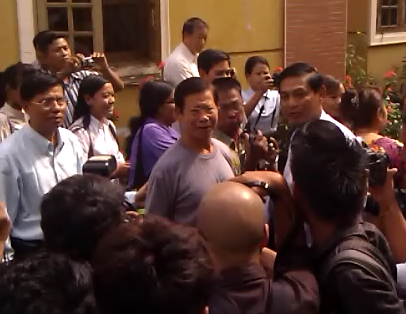
Former prime minister Khin Nyunt seen shortly
after his release today (DVB)
12.15pm: News just in - DVB reporter Hla Hla Win has been released from Kathar prison in Sagaing prison. She was serving a 27-year prison sentence after being caught with video interviews of monks criticising the former junta’s crackdown on protesters in September 2007. More about her here.
Four DVB reporters have so far been released from prison today. Chief Editor Aye Chan Naing said:  ”I am very happy for the release of some of DVB’s journalists.  I hope all our journalists will be free today.”
11.53am: Quote from released Shan leader Khun Tun Oo: “Firstly I would like to say it is important to free those who remain [in detention]. It would be best if there’s no one left in the prisons.
“I feel no emotion at all to be released because I wasn’t supposed to be arrested in the first place. I didn’t commit any of the crimes they accused me of – there was no national treason. I have wasted seven years of my life for something I didn’t do and there’s nothing to be happy about now.”
11.45am: Journalist Zaw Thet Htwe is among those released from Taunggyi prison, according to his wife. Kyaw Kyaw Htwe (aka Marky) released from Insein Prison, according to The Voice.
11.40am: Shan ethnic leader Khun Tun Oo, one of Burma’s most famous political prisoners, released from Putao prison in northernmost Burma close to the China border. He was serving a 93-year sentence on charges of sedition and planning to overthrow the former junta.
11.35am: From Sittwe prison in Arakan state, Weekly Eleven reports the following eight political prisoners have been freed – Dr Thet Lwin, Than Tin (aka Ko Gyi Than), Pyi Phyo Hlaing, Aung Aung Kyaw, Zeyar Oo, Payit, Kyaw Zin Win and Dawpon Nay Nay.
11.30am: Prominent blogger Nay Phone Latt among those released from Hpa-an prison in Karen state. He was serving a 20-year sentence. Also freed from Hpa-an: Nyi Pu (1990 People’s Parliament Rep), Nanda Sitt Aung, Thant Zin Aung (jailed alongside Zarganar), Kyaw Kyaw Naing, Pyi Phyo Aung and Nyan Linn, according to The Voice.
11.21am: Two more activists from the 88 Generation Students’ Group, Panatee Htun and Nilar Thein (f), released today.
11.15am: IMPORTANT: Today’s amnesty announced under Act 401(1) - “When any person has been sentenced to punishment for an offence, the President of the Union may at any time, without conditions or upon any conditions which the person sentenced accepts, suspend the execution of his sentence or remit the whole or any part of the punishment to which he has been sentenced” (our italics).
Past amnesties have been done under Article 204(b) of the constitution: ”The power to grant amnesty in accord with the recommendation of the National Defence and Security Council”.
So it seems today’s releases have not been done with full consent of the powerful National Defence and Security Council, and that some may only be suspensions. We’ll try to find more on this…
11.08am: Sage words from the 21-year-old DVB reporter Sithu Zeya, who was released today:
“As for the president, I think he’s pretty decent as he is [enacting reforms] under a lot of pressure. But also it depends a lot on the men behind him – just one decent person won’t make the change happen. We need all-inclusive cooperation from both sides to build a democratic system.”
11.06am: The following political prisoners have been released from Buthidaung prison in Arakan state, according to Weekly Eleven:
Sithu Maung, Thant Zin Myo, Kyaw Min, Htun Nyo, Htay Kywe, Aung Zaw oo, Pyay Kyaw, Wunna Pantha, Kyaw Win San and Maung Maung Latt.
11.03am: NLD spokesperson says amnesty a ”positive sign. We welcome the release. Some (dissidents) are on their way home already,” AFP quotes.
10.56am: 12 political prisoners released from Mingyan prison, including female activist Htet Htet Aung.
10.48am: The Voice journal reports than former Burmese prime minister Khin Nyunt has been released from house arrest, along with his son. He was detained in 2004 after falling foul of former junta chief Than Shwe.
1044am: Freed DVB reporter Sithu Zeya says conditions attached to his release – if he commits any crime in the future he will be forced to serve his full 18-year sentence.  “It’s like we are being freed with leashes still attached to our necks. So I’m happy but with a leash still on my neck.”
Not clear if this ruling applies to all political prisoners released today.
10.42am: Hla Htwe (monk Vilasakka), Lah Yang Kywe, Ko Ko Naing, D Nyein Linn and Nobel Aye (f) freed from Monywa prison, according to Weekly Eleven magazine.
10.40am: Ngwe Soe Linn’s release brings to three the number of DVB reporters freed today. More on Ngwe Soe Linnhere.
10.39am: The following political prisoners released from Lashio prison, according to Weekly Eleven – Min Zeya, Min Han, Zarni Aung, Naing Oo (monk Pyinya Wunthua), Myint Naing, Aung Than Myint (Maggin monastery abbot Einraka), Ngwe Soe Linn, Min Htun, Myat Linn Htut, Honey Oo (f).
10.35am: 11 political prisoners, plus former military intelligence officials under Khin Nyunt, released from Taungoo prisons.
10.30am: The Voice magazine says Min Ko Naing was released at 10am (Rangoon time) today, along with 26 other political prisoners from Thayet.
10.25am: Confirmed that 88 Generation activists Zaw Htwe, Jimmy and Mya Aye are among those release from Taunggyi prison, according to Zaw Htwe’s wife. Still not clear if Min Ko Naing and Ko Ko Gyi are free, although we got a tip-off that Min Ko Naing’s family is en route to meet him.
10.20am: Comedian Zarganar writes on Facebook that jailed monk U Gambira, who had been severely tortured in prison, has been released.
10.16am: Rumours that leading 88 Generation activists, including Min Ko Naing and Ko Ko Gyi, will be released. Reuters quoteed from an official at Thayet prison saying Min Ko Naing will walk.
10.10am: Second DVB reporter U Zeya, father of Sithu Zeya, has already been released, according to reports from inside Burma. More details soon
09.50am: The 21-year-old DVB reporter Sithu Zeya was among the first political prisoners to be released today. He was given an 18-year jail term for videoing the aftermath of the April 2010 grenade attacks in Rangoon. Sithu Zeya had been forced to reveal under torture that his father was also a DVB journalist.
Sithu today walked from Henzada prison and will be reunited with his family.

Saturday, 31 December 2011

Myanmar: Rohingya Refugees and Thailand's "Push-Back"

Source from IPCS, 30 Dec 2011

Panchali Saikia
Research Officer, IPCS
email: panchali@ipcs.org

The Rohingya refugee crisis is not a new phenomenon, and it has now grabbed the attention of the international media for all the wrong reasons. The Rohingyas, in large numbers, are now trying to escape to Malaysia via the sea route through Thailand, but are being denied entry by Thai authorities and forcibly pushed back. Earlier this year around 91 persons believed to be Rohingyas were rescued near Andaman Island by the Indian Navy and around 129 by the Indonesian Navy in Aceh. The Rohingyas have been sheltered by Bangladesh for nearly three decades. What is the reason for their escape to Malaysia? Why is Thailand forcibly pushing them back to sea? Thailand has provided shelter to hundreds and thousands of other displaced people from Myanmar, why is then expelling the Rohingyas?

Why are the Rohingyas escaping to Malaysia?
Rohingyas fled repression in Myanmar and lived in exile, mainly in Bangladesh. Since Myanmar̢۪s independence in 1948, its successive governments have attempted every possible way to push them out. The Emergency Immigration Act of 1978 and later the ethnic cleansing campaign known as Naga Min, or Dragon King, prosecuted illegal entrants, primarily in Rakhine state. This drove out nearly 200,000 Rohingyas from Myanmar.

However, after providing shelter to the Rohingyas for nearly three decades, Bangladesh is now concerned about the annual increase in their numbers. Apart from being an economic burden, the Rohingyas̢۪ involvement in insurgent activities along the Myanmar-Bangladesh border is feared by the government. Hence to reduce the influx, the government has declared that it will no more consider any asylum seeker as refugee. Also, it has now denied permits for aid agencies to assist unregistered refugees. Anti-Rohingya communities in Bangladesh have also pressurized the government to repatriate the Rohingyas. Due to the denial of protection, assistance, and fear of repatriation, the Rohingyas are now escaping to Malaysia through the sea route. Malaysia is seen as the best destination because of the religion factor. Also, the Malaysian government̢۪s permit to access the UN Refugee Agency (UNHCR) has attracted asylum seekers.

Rohingyas: A threat to and burden for Thailand This trend has become a major concern for Thailand, as most of these migrants/refugees escaping are landing in Thailand. It is not for the first time that Thailand has pushed them back. In 2008 and 2009, the Thai authorities were condemned by the international community for pushing the Rohingyas into international waters without any assistance or protection.

The Thai authorities are apprehensive of the influx and suspect that the Rohingyas are assisting the Muslim-led insurgency in southern Thailand, which has intensified in recent times. Furthermore, nearly 1 million other migrants from Bangladesh and Myanmar are estimated to already be in Thailand. The exceeding numbers of illegal migrants will add to the economic burden and pose a threat to Thai national security. Unlike the other migrants in Thailand who play a major role contributing to the Thai economy (http://bit.ly/vl6ylg), the Rohingyas are only a liability and burden; they cannot get a work permit in Thailand as this requires a nationality verification certificate which the Rohingyas do not have.

Myanmar’s denial of citizenship to RohingyasThe primary problem and responsibility should lie with Myanmar. Rohingyas are primarily a Muslim ethnic group from the northern part of Arakan province (Rakhine State) of Myanmar. The term ‘Rohingya’ is derived from the Chittagonian dialect (Bengali language), in which the Rakhaine or Arakanese people are called 'Rohangya’. In this context Myanmar should consider them a national ethnic group. But, they are denied citizenship and not recognized among the 135 national ethnic groups under the 1982 Citizenship Law, leaving them stateless and as illegal immigrants in their own country. Even under the Constitution of the Republic of the Union of Myanmar which was passed in 2008 it is stated that ‘Citizenship, naturalization and revocation of citizenship shall be as prescribed by law’. Their condition has not improved even today; approximately 800,000 Rohingyas living in Northern Arakan state and Rangon are effectively stateless and are subjected to discrimination and exploitation.

Most of the countries are hesitant to host the Rohingyas because they are denied citizenship in Myanmar and because of this, reaching an understanding with the Myanmar government on their resettlement or repatriation is difficult. For instance, earlier in December 2011 an agreement was reached at a meeting between President Thein Sein and Bangladeshi Prime Minister Sheikh Hasina to repatriate Myanmarese refugees. But the Myanmarese government made it clear that only those refugees who met the key criteria under Myanmar citizenship law would be taken back, leaving the Rohingyas out in the cold.

Thailand has earlier attempted to repatriate refugees to Myanmar (http://bit.ly/s0OVak) but mostly only the Karen and Karenni ethnic groups. The increasing number of Rohingyas will be a serious issue, first, owing to the difficulties in cooperating with Myanmarese government, and second, because of identification. In Thailand̢۪s nine refugee shelters, most of the refugees belong to the Karen and Karenni ethnic groups of Myanmar and only 10-12 per cent is Muslim. As the Rohingyas are not able to register themselves in Thailand, there are no official records on their numbers, because of which resettlement or repatriation becomes impossible.

The plight of the Rohingyas and the growing concern over their influx is not only confined to Myanmar, Bangladesh and Thailand. Other regional powers like India, Indonesia and Malaysia must also engage themselves considering its security implications. The forcible push-backs are a major threat to the maritime as well as border security of these countries. Left with no other option, the Rohingyas are vulnerable to being recruited by sea pirates and involved in arms and drug smuggling.

Friday, 9 December 2011

Burma jails Rohingya on immigration charges

Source from DVB , 8 Dec 2011


Rohingya fishermen pull a boat near a refugee camp in Teknaf, Bangladesh. In 1982 Burma passed a law that made it impossible for Rohingya to get full citizenship (Reuters)

A group of Rohingya refugees attempting to reach Malaysia have been given prison sentences of one and a half years each by a Burmese court after their boat ended up on the shores of southern Burma.

The boatload of 63 had travelled from Bangladesh, where up to 300,000 Rohingya reside having fled decades of persecution in their native Arakan state in western Burma. A BBC Burmese report says they were left stranded at sea by their broker 16 kilometres from the coastal town of Kawthaung in Tennasserim division.
Despite the hazardous nature of the journey, hundreds of Rohingya attempt the nearly 2,000-kilometre voyage from Bangladesh to Malaysia each year in search of work. The 63 however are thought to be the first Rohingya jailed under immigration charges in Burma, signifying how government policy works to ensure they are not considered Burmese citizens.

A law passed in 1982 made it impossible for the Muslim minority group to gain citizenship in Burma. The Buddhist government there claims they are of Bengali origin and thus should not be afforded the same rights as Burmese. Various Rohingya advocacy groups argue however that their roots in western Burma can be traced back to before the spread of the now-dominant Theravada Buddhism in the country.
Of the hundreds of thousands living in Bangladesh, only around 28,000 are registered by the UN. Dhaka is concerned that offering official support to all refugees would create a pull-factor for those still living in Arakan state, meaning that the majority eke out a perilous existence in unofficial camps and slums on the edge of Chittagong in eastern Bangladesh.

Following talks in Naypyidaw this week between Bangladeshi Prime Minister Sheikh Hasina and Burmese President Thein Sein, however, the Dhaka-based Financial Express claimed Thein Sein had agreed to take back the refugees “after verifying them and as per the agreed criterion between the two countries”.
Kitty McKinsey, regional spokesperson for the UN High Commission for Refugees (UNHCR), said that while in principle she would welcome any positive solution for the Rohingya, “we will wait to see an official government statement confirming this” before drawing any conclusions from the meeting.

Chris Lewa, head of The Arakan Project, which advocates for the rights of the Rohingya, said she doubted whether Hasina’s visit prompted a breakthrough in the protracted issue of whether the Burmese would accept the refugees back, many of whom have been living in Bangladesh for decades.
The issue of the ‘boatpeople’ shot to global attention in January 2009 when a large group that washed up on the Thai coast were towed back out to sea by coastguards and left to die. Thailand last month intercepted another boatload but later released them.

Thursday, 10 November 2011

BBC report stirs anti-Rohingya sentiment

Source from DVB, 9 Nov 2011
Published: 9 November 2011
 
Amended map first published on BBC on 6 November 2010 (BBC)
A BBC report from last November that carried a map depicting Arakan state as populated by the ethnic Rohingya minority has caused anger in Burma, and once again brought to the fore accusations of entrenched racism within Burmese society.
Although published a year ago, and since corrected, the BBC report has circulated rapaciously on the internet in recent weeks, and has become the subject of a number of blog posts either criticising the BBC for implying the Rohingya are part of the Burmese population, or lamenting the vitriolic responses its report has attracted.

The map in question demarcates areas of Burma as belonging to specific ethnic groups, albeit somewhat erroneously: the Shan, for instance, are said to inhabit only a third of modern-day Shan state, and the Karen are shown as the main ethnic group in Irrawaddy division.

But it was the identification of Arakan state as the home of the Rohingya, a Muslim minority group that has been the subject of a perennial and fiery dispute over its origins, that has sparked outrage.
Following the publication, the BBC’s Burmese Facebook page was hit with hundreds of complaints, some from monks, calling on the organisation to issue a public apology and even remove any reference to Rohingya from the map. Failing to apologise should result in a boycott of the BBC, some even argued. The BBC has since amended the map to include ‘Rakhine’, the name given by the government to Arakanese, as also populating the state, but anger continues to boil.

Many Burmese believe the Rohingya to be of Bengali origin that over centuries have migrated to western Burma, a sentiment shared by the Burmese government which denies them citizenship and which for decades has meted out hefty treatment against the group, forcing hundreds of thousands to flee the country.
Rohingya support groups say however that there is evidence that Islam existed in Burma prior to the now-dominant Theravada Buddhism, and that the Rohingya’s roots in Arakan state go back centuries.
Rumours circulated in Rangoon today that a protest would be held outside the British embassy over the BBC report, although except for a number of local and foreign journalists, little appeared to happen. Jeremy Hodges, deputy head of mission at the embassy, told DVB that he had made himself available to accept any petition that may have been circulated among protestors, but that nothing was in sight.
“We know there is a perception among some Arakanese groups that Rohingya are singled out for preferential treatment by groups like the International Organisation for Migration, and that money is given to them at the expense of other Arakanese, but we feel this is a misconception,” he said.

Unlike many Arakanese, Rohingya are prevented from travelling freely outside of specially-designated zones, and are often subject to racial and religious persecution. Up to 400,000 are living as refugees in neighbouring Bangladesh, having fled decades of maltreatment at the hands of the military and local civilians.
An article last week on the New Mandala blog, run by academics from the Australia National University, said the cries of protest were somewhat hypocritical.

“…although Arakan ethnic members very often talk against majority ethnic Burmans (or Bamar) for what they call the ‘colonization of Arakan’,  ‘Burmanization’ and Burmese chauvinism, they now mobilize the entire Burmese population against Rohingyas to ‘protect Burma and its ‘national races’’.”
Among critics of the Rohingya are high-profile Burmese, including Berlin-based historian Khin Maung Saw, whose paper, “Islamization of Burma Through Chittagonian Bengalis as ‘Rohingya Refugees’”, triggered angry responses.

Widespread anger was also vented at current Burmese ambassador to the UN, Ye Myint Aung. During his tenure as Consul-General to Hong Kong, he wrote in a letter to other heads of mission, and copying in international newspapers, that Burma’s ethnic Rohingya were “ugly as ogres”
 
--See BBC report on 6 Nov 2010  "Bleak outlook for Burma's ethnic groups"-

Thursday, 8 September 2011

Burma, Bangladesh and the Rohingya: a Failure to Protect?

Source from e-international relations, September 6, 2011
 
Forced migration and refugee flows in Burma are becoming increasingly difficult for the international community and the region to deal with.[1] The minority group of Rohingyas that have fled north of the Burmese border into Bangladesh have remained stateless for over 50 years and have been continuously persecuted in their homeland Burma whilst denied protection in Bangladesh from violence, corruption, abuse and poverty. [2]

The Rohingyas are accused of being fundamentalists in Bangladesh and are often labelled as illegal or economic immigrants rather then being recognized as refugees. To date the international community has done little to help protect over 100,000-250,000 people who have no homeland and are routinely discriminated against.[3] Whilst much has been written about refugees and forced migration on the Thai-Burmese border little academic work has focused on the plight of the Rohingyas and the inability of the region and the international community to deal with this issue.[4]

The challenge for Burma and Bangladesh to deal with refugee flows and forced migration reflects a wider issue in the region when it comes to displacement and human security. This reflects the failure of states and the region to provide adequate protection for the Rohingya and is an abuse of sovereignty and international law.[5]
Failure at state, regional and international level to deal with the problems facing the Rohingya reflects a wider need to re-evaluate international protection regimes when it comes to dealing with forced migration and minority groups in Southeast Asia. In order to understand this, the plight of the Rohingyas will be highlighted and international and regional protection norms will be explored.

The Rohingya in Burma and forced migration: A History of persecution
The Rohingya population has its origins in the Arakan or Rakhine state in the north of Burma and linguistically are derived from the Bengali language. In 1784 the mostly Muslim population of Arakan was incorporated into the larger Buddhist kingdom of Burma and a majority of Rohingyas fled to Cox’s Bazaar, in the then British controlled colony of East Bengal.[6] Following British colonization of Burma in the 1800’s, the British moved populations such as the Rohingya between East Bengal and Burma to fit their labour needs.[7]

At this time many Rohingyas took the opportunity to flee back to Burma and return to their homes. These movements were considered internal, however the current government in Burma views this as illegal and has refused citizenship to the majority of the Rohingyas who have remained in Burma.[8]  After becoming independent in 1948, tensions between the government and the Rohingyas grew with the government attempting to move all Muslins living in Burma and integrate them into East Bengal which was now known as East Pakistan and continued to treat those who remained in Burma as illegal immigrants.

The Rohungya population in Burma faced daily persecution with properties and land seized, and people forcibly relocated as part of ‘brutal discrimination policies’ so that new villages could be built for those migrating from central and northern Burma.[9] In 1977-1978 over 200,000 Muslims fled across the border to Bangladesh to escape persecution from Burmese army harassment and intimidation. [10]The Burmese junta under operation ‘Nagamin’ aimed to ‘scrutinize every individual living in the state, designating citizens and foreigners in accordance with the law and taking actions against foreigners who have filtered into the country illegally.’[11] This in fact meant the targeting of civilians such as the Rohingya resulting in widespread killing, rape, destruction of mosques and religious persecution.

Following international pressure the majority of those who had fled where allowed to return to Burma, yet in 1988 following the military coup those who opposed these actions fled in fear of persecution and were stripped of their citizenship.[12]  In 1992-93, 250,000 refugees again fled to Cox’s Bazaar following widespread forced labour, executions, torture and rape. Often the Rohingya would work without pay on government based infrastructure and economic projects and human rights violations continued to occur.[13]

Abuse and prejudice against the Rohingya and Muslim population in Burma has continued since this time with lack of citizenship maintaining exclusion from employment opportunities.  Under Burmese citizenship laws, the Rohingya are not considered to be a national ethnic group and are therefore ineligible for full citizenship whilst the laws make no provision in relation to stateless persons.[14]

Furthermore a permit is required for the Rohingya to get married and this has led to delays and backlogs in applications whilst movements of the Rohingya population have been greatly restricted in the Arakan with a pass now required for any movement between villages, even for day trips to health clinics. [15]

These widespread abuses and discriminations reflect Burma’s failure as a sovereign state to protect its citizens and its responsibility to provide adequate  ‘life-supporting’ assistance. Failure to protect its citizens reflects the need for regional and international involvement and whilst the United Nations High Commissioner on Human Rights has been heavily involved in repatriation of Rohingya refugees more must be done to protect their rights. Perhaps one of the reasons why international protection regimes are not implemented effectively is the fact that both Burma and Bangladesh are not signatories to the 1951 Refugee Convention.[16]

It is under these conditions that many Rohingya have fled to Bangladesh in search of protection and a new life, but have instead met with discrimination, suspicion and violence.  As one refugee has stated: ‘In Burma the military regime tells us we have no rights and no place. In Bangladesh the government tells us we have no rights and no place.’[17]

The borders of Burma have been for sometime unsecure and movement between Burma and Bangladesh has created regional issues of great importance to stability in the region and internationally.[18] Burma views this as an internal issue for its government alone, however this issue is becoming of great concern to Bangladesh whose ability to deal with the influx of refugees is becoming more problematic each day.

Stateless in Bangladesh: a State, Regional and International Problem
Rohingya refugees that have fled to Cox’s Bengal in just north of Bangladesh are faced with a grim reality. Over 26,000 Rohingyas are recognized as refugees by the UNHCR in two camps controlled by the Bangladeshi government at Nyapara and Kuntapolong, whilst 7,000 live in a makeshift camp in Teknaf. Added to this number are over 200,000 unregistered refugees who live in the area outside the camps.
These Rohingya are not recognized as refugees and are often labeled economic or illegal migrants. The camps are rife with corruption, violence, sexual abuse, abductions, trafficking and death from malnutrition and untreated medical conditions happens far to often.
Eileen Pittaway described the situation in the camps as the worse she has seen stating that:
‘I’ve never before been in an established camp where the fear was so palpable and pervasive….a systemized regime of terror has left a population of refugees in a state of trauma with little or no hope for the future.[19]
Sexual abuse and gender violence is endemic and this has had a major impact on women and girls in the camp as well as their families, whilst corruption which is rife on all levels of governance in the camps including government officials, police and military personnel prevent the refugees from living any sort of life in peace and security. Conditions are horrific in the camps and the Bangladeshi governments view is that the Rohingya are a heavy burden on Bangladesh economically, socially, environmentally and also in terms of law and order.
The government is of the view that the Rohingya should be repatriated to Burma, but under current circumstances the refugees are at risk of being persecuted, beaten and raped on return to Burma.[20] Continuing violence and persecution in the Arakan has seen nearly 2,000 more refugees arrive in Cox’s Bazaar monthly since the beginning of 2010.[21]

Added to this is the fact that many in Bangladesh at a government and community level fear that Islamic fundamentalists will use the camps as breeding grounds for new recruits. Utpala Rahman in his article  ‘The Rohingya Refugee: A Security Dilemma for Bangladesh’ has argued that the alienation that Rohingya refugees feel leaves the stateless refugees vulnerable and desperate which could lead to them becoming more militant in an order to protect their interests.[22]

Whilst groups such as the Rohingya Solidarity Organization and the Arakan Rohingya Islamic Front are extreme in their attempts to foster an independent homeland for the Rohingya and there have been reports that militants from Al-Qaeda are hiding out in the camps, the majority of refugees living there are being discriminated against on the basis that they are of the Muslim faith. [23] Bangladesh security concerns about militancy in the camps highlight the need for the regional and international community to deal with the plight of the Rohingyas to prevent conflict and ensure that citizen’s rights are equally protected. The issue of forced migration must be resolved if stability in the region is to be achieved. As Hazel Lang has pointed out:
Attention to the human security dimensions of internal conflict and displacement is vital for present and future efforts in resolving conflicts, building durable peace and achieving a sustainable repatriation of refugees and IDP’s’[24]
The failure of Burma and Bangladesh to protect the rights of the Rohingya minority is an indictment of Southeast Asia’s inability to deal effectively with forced migration and the international protection regimes failure to properly enforce international law and norms to protect refugee’s rights. In order to understand this we must now turn to the regions application of international law and attempts of the international community to enforce such laws.

Burma, Bangladesh Southeast Asia and International Refugee Law: An uneasy relationship
International law referring to refugees was established under the 1951 Convention Relating to the Status of Refugees and the 1967 Protocol Relating to the Status of Refugees. The majority of Asian states rejected the Convention and Protocol as Eurocentric and irrelevant to Asian refugee experiences.[25] Furthermore there has been no attempt at a regional level for states to respond uniformly to refugee crises.  Claims that the international refugee laws are Eurocentric are thinly veiled excuses by corrupt and oppressive countries such as Burma to continue their systematic discrimination and persecution of populations such as the Rohingya. That said the application of the 1951 convention during the time its was developed was solely related to the legal protection and assistance of refugees in Europe and Asian understandings of Refugee problems were not included in the drafting of either statute.  However the 1961 convention extended this protection to refugees outside Europe.[26]

Whilst Asian countries have rejected the international conventions on refugee laws a majority of Asian states including Burma and Bangladesh are party to the Bangkok Principles on the Status and Treatment of Refugees adopted in 1966 by the Asia African Legal Consultative Organization.[27]

The Bangkok Principles acknowledge the existence of refugees and insist that member states provide asylum, however these principles limit the exercise of the rights of refugees to cases where the security of the state is not threatened and the responsibility remains upon each state to decide whether or not the principles are applied.[28] Furthermore the Bangkok principles are neither enforced nor monitored, so there is no way to tell whether states are adhering to the provisions.

Bangladesh and Burma whilst signatories to the Bangkok Principles are not signatories to the 1951 convention and there are many explanations for why states such as Burma and Bangladesh refuse to grant refugees citizenship and rights. One explanation is that there is a fear that migrants endanger the already fragile social cohesion of developing countries, but yet again this feels like a weak attempt at pushing the issue aside.[29] The consequences of the failure of states on a regional or international level to deal with the issue of refugee law means that the majority of asylum seekers and internally displaced do not and cannot seek permanent legal status or assistance as refugees.

Whilst the United Nations High Commission for Refugees has attempted to repatriate a number of Rohingyas from the camps in Bangladesh, often other Asian states are unwilling to take them, as they fear that they will fuel fundamentalism. Whilst the Thai government has agreed to resettle Rohingya and various other minority groups such as the Karen that have streamed across their borders, the Bangladeshi government is fearful that a resettlement program would lead to more refugees flooding in.[30] Furthermore many states in the region do not won’t to become involved in the debate on the Rohingya’s situation and attempts by refugees to flee to Malaysia have been met with the same restrictions faced in Bangladesh.[31]
The plight of the Rohingya’s is not new or uncommon for the Burmese state as it has major refugee and forced migration issues on its border with Thailand.[32] The eastern border of Burma and Thailand is estimated to have about 500,00 internally displaced people in camps and in January 2009, 400 Rohingya refugees were prevented from entering Thai waters and forced to return to Burma by the Thai Navy. [33]
This highlights the wider issue of the Burmese government’s failure to protect its citizens and the larger problem of how to deal with internal displacement and forced migration in the region.[34] Whilst resettlement to a third country is an option, many Rohingya wish to stay in Bangladesh due to the close linguistic and cultural links between the two.  The fact remains that the Bangladeshi government must accept these refugees into their population and adhere to international human rights and refugee law by granting them the rights of citizens. To allow the Rohingya to remain stateless and in squalor in the camps is to risk larger regional fights between Burma and Bangladesh and could fuel further unrest and violence.

Burma has failed in its obligation to protect its citizens and as such it is up to the international community to attempt to deal with situation. Whilst Burma claims absolutely sovereignty its inability to protect its citizens negates this sovereignty, as it has not met it responsibilities under the international norm of the responsibility to protect.

The Responsibility to Protect, IDP’s and human security
The international norm of the responsibility to protect was first developed by Roberta Cohen and Francis Deng.[35] In 1993 Deng was the United Nations Special Representative on Internally Displaced People and was faced with the problem that the fate of internally displaced people was determined by the policies of domestic government’s, as there were no international laws providing protection for those displaced. Deng and Cohen focused on the principle of ‘sovereignty as responsibility’, meaning that it was the state’s primary role in offering protection and that if it failed to do so the sate was accountable to the United Nations.[36]
Whilst this norm has now been adapted to apply to humanitarian intervention, it is still relevant to the debate over internal displacement and challenges the notion that sovereignty is sacrosanct. State centric conceptions of security have over taken the importance that human security plays in stabilizing a region such as Asia, if we place the plight of the Rohingya and the internally displaced within the concept of the responsibility to protect norm we challenge assumptions about security issues and place the onus back on the state, region and international community to come up with a viable solution.

While states are responsible for the protection of their own citizens ‘the people may not be secure from the
state.’[37] The international norm of the responsibility to protect can be placed within the context of the Rohingya’s plight and reflects the need for greater international involvement in the issue.

Conclusion
The Rohingya minorities of Burma and Bangladesh have suffered persecution and discrimination at the hands of governments that do not recognize their rights as refugees and human beings. They remain stateless and without hope, yet attempts by the UNHCR and the Bangladeshi government to repatriate some of the refugees suggests that some progress is occurring. That said more can be done on a state, regional and international level. The Bangladeshi government must integrate and allow the Rohingya refugees that are living in camps to gain citizenship and protection as they risk being sent back to Burma to face further trauma. The international community under the responsibility to protect norm must place pressure on the Bangladesh to accept these refugees as legitimate and place pressure on Burma to lift its restrictions and discriminations against its citizens. The plight of the Rohingyas highlights a major problem in Southeast Asia when dealing with forced migration and internal displacement, it is only when we start to discuss these issues outside the parameters of state sovereignty and national interest will we be able to deal effectively with refugee flows and provide adequate protection for minorities.

Bibliography
  1. Adelman, H ed., Protracted Displacement in Asia: No Place to call home, Ashgate Publishing Limited, Hampshire, 2008
  2. Afolyan, A, ‘Issues and Challenges of Emigration Dynamics in Developing Countries’, International Migrations, Vol.39, No.4, 2001, pp 5-38
  3. Ananta, A and Nurvidya Arifin, A ed., International Migration in Southeast Asia, Institute of Southeast Asian Studies, Singapore, 2004
  4. Banki, S, ‘Contested Regimes, Aid Flows, and Refugee Flows: The Case of Burma’, Journal of Current Southeast Asian Affairs, Vol.28, No.2, 2009, pp 47-73
  5. Brees, I, ‘Refugees and transnationalism on the Thai-Burmese border’, Global Networks, Vol.10, No.2, 2010, pp
  6. Bunte, M, ‘The Politics of Refugees in and outside Burma/Myanmar’, Journal of Southeast Asian Affairs, Vol.28, No.2, 2009, pp 3-5
  7. Burke, A and McDonald, M ed., Critical Security in the Asia-Pacific, Manchester University Press, New York
  8. Cohen, R and Deng, F, Masses in Flight: The Global Crisis of Internal Displacement, Brookings Institution Press, Washington D.C, 1998
  9. Davies, S, ‘The Asian Rejection?: International Refugee Law in Asia’, Australian Journal of Politics and History, Vol.52, No.4, 2006, pp 562-575
  10. Ekeh, C, ‘Minorities in Burma’, Briefing Paper, UNHCR, accessed at http://www.unhcr.org/refworld/pdfid/47298f632.pdf
  11. Grundy-Warr, C and Wong Siew Yin, E, ‘Geographies of Displacement: the Karenni and the Shan across the Myanmar-Thailand Border, Singapore Journal of Tropical of Geography, Vol.23, No.1, 2002, pp93-122
  12. Lanjouw, S, ‘Internal Displacement in Burma’, Disasters, Vol.24, No.3, 2000, pp 228-239
  13. Mydans, S, ‘Burmese Refugees Persecuted in Bangladesh’, The New York Times, 21/2/2010, pg 6
  14. Rahman, U, ‘The Rohingya Refugee: A Security Dilemma for Bangladesh’, Journal of Immigrant and Refugee Studies, Vol.8, No.2, 2010, pp 233-239
  15. Skidmore, M and Wilson, T ed., Myanmar: the state, community and the environment, Asia Pacific Press, Canberra, 2007
  16. Steinberg, D, Burma: The State of Myanmar, Georgetown University Press, Washington D.C, 2001
  17. Thakur, R and Weiss, T, Global Governance and the UN: An Unfinished Journey, Indiana University Press, Bloomington, 2010
  18. The Bangkok Principles, accessed at http://www.unhcr.org/refworld/pdfid/3de5f2d52.pdf
  19. UNHCR raises Rohingya issue in Dhaka for discussion with Burma and the USA’, Burma news international, 29/9/2009 accessed at http://www.bnionline.net/news/kaladan/7123-unhcr-raises-rohingya-issue-in-dhaka-for-discussion-between-burma-and-usa.html
  20. Myanmar: The Rohingya Minority: Fundamental Rights Denied, Amnesty International, May 2004 accessed at http://www.amnesty.org/en/library/info/ASA16/005/2004

[1] Lanjouw, S, ‘Internal Displacement in Burma’, Disasters, Vol.24, No.3, 2000, pg 228
[2] Mydans,S, ‘Burmese Refugees Persecuted in Bangladesh’, The New York Times, 21/2/2010, pg 6
[3] ‘UNHCR raises Rohingya issue in Dhaka for discussion with Burma and the USA’, Burma news international, 29/9/2009 accessed at http://www.bnionline.net/news/kaladan/7123-unhcr-raises-rohingya-issue-in-dhaka-for-discussion-between-burma-and-usa.html
[4] South, A, ‘Conflict and Displacement in Burma/Myanmar’, in Skidmore, M and Wilson, T ed., Myanmar: the state, community and the environment, Asia Pacific Press, Canberra, 2007, 54
[5] Cohen, R and Deng, F, Masses in Flight: The Global Crisis of Internal Displacement, Brookings Institution Press, Washington D.C, 1998, pg 7
[6] Pittaway, E, ‘The Rohingya Refugees in Bangladesh: A Failure of the international protection regimes’, in Adelman, H ed, Protracted Displacement in Asia: No Place to call home, Ashgate Publishing Limited, Hampshire, 2008, 86
[7] Ibid., 86
[8] Steinberg, D, Burma: The State of Myanmar, Georgetown University Press, Washington D.C, 2001, pg 245
[9] Ibid. 245
[10] Banki, S, ‘Contested Regimes, Aid Flows, and Refugee Flows: The Case of Burma’, Journal of Current Southeast Asian Affairs, Vol.28, No.2, 2009, pg 51
[11] Myanmar: The Rohingya Minority: Fundamental Rights Denied, Amnesty International, May 2004 accessed at http://www.amnesty.org/en/library/info/ASA16/005/2004 pg 7
[12] Steinberg, D, Burma: The State of Myanmar, Georgetown University Press, Washington D.C, 2001, pg 245
[13] Myanmar: The Rohingya Minority: Fundamental Rights Denied, Amnesty International, May 2004 accessed at http://www.amnesty.org/en/library/info/ASA16/005/2004 pg 9
[14] Ekeh, C, ‘Minorities in Burma’, Briefing Paper, UNHCR, accessed at http://www.unhcr.org/refworld/pdfid/47298f632.pdf pg 4
[15] Ibid. pg 4
[16] Davies, S, ‘The Asian Rejection?: International Refugee Law in Asia’, Australian Journal of Politics and History, Vol.52, No.4, 2006, pg 563
[17] Pittway, E, ‘The Rohingya Refugees in Bangladesh: A Failure of the international protection regimes’, in Adelman, H ed, Protracted Displacement in Asia: No Place to call home, Ashgate Publishing Limited, Hampshire, 2008, pg 95
[18] UNHCR raises Rohingya issue in Dhaka for discussion with Burma and the USA’, Burma news international, 29/9/2009 accessed at http://www.bnionline.net/news/kaladan/7123-unhcr-raises-rohingya-issue-in-dhaka-for-discussion-between-burma-and-usa.html
[19] Pittaway, E, ‘The Rohingya Refugees in Bangladesh: A Failure of the international protection regimes’, in Adelman, H ed, Protracted Displacement in Asia: No Place to call home, Ashgate Publishing Limited, Hampshire, 2008, pg 83
[20] Ibid. 85
[21] Mydans, S, ‘Burmese Refugees Persecuted in Bangladesh’, The New York Times, 21/2/2010, pg 6
[22] Rahman, U, ‘The Rohingya Refugee: A Security Dilemma for Bangladesh’, Journal of Immigrant and Refugee Studies, Vol.8, No.2, pg235
[23] Pittaway, E, ‘The Rohingya Refugees in Bangladesh: A Failure of the international protection regimes’, in Adelman, H ed, Protracted Displacement in Asia: No Place to call home, Ashgate Publishing Limited, Hampshire, 2008, pg 95
[24] Lang, H, ‘Freedom from fear’: conflict, displacement and human security in Burma (Myanmar)’, in Burke, A and McDonald, M ed., Critical Security in the Asia-Pacific, Manchester University Press, Manchester, 2008, pg 106
[25] Davies, S, ‘The Asian Rejection?: International Refugee Law in Asia’, Australian Journal of Politics and History, Vol.52, No.4, 2006, pg 563
[26] Davies, S, ‘The Asian Rejection?: International Refugee Law in Asia’, Australian Journal of Politics and History, Vol.52, No.4, 2006, pg 570
[27] The Bangkok Principles, accessed at http://www.unhcr.org/refworld/pdfid/3de5f2d52.pdf
[28] Davies, S, ‘The Asian Rejection?: International Refugee Law in Asia’, Australian Journal of Politics and History, Vol.52, No.4, 2006, pg 563
[29] Afolyan, A, ‘Issues and Challenges of Emigration Dynamics in Developing Countries’, International Migrations, Vol.39., No.4, 2001, pg 15
[30] Pittaway, E, ‘The Rohingya Refugees in Bangladesh: A Failure of the international protection regimes’, in Adelman, H ed, Protracted Displacement in Asia: No Place to call home, Ashgate Publishing Limited, Hampshire, 2008, pg 98
[31] Brees, I, ‘Refugees and transnationalism on the Thai-Burmese border’, Global Networks, Vol.10, No.2, 2010, pg 282
[32] Grundy-Warr, C and Wong Siew Yin, E, ‘Geographies of Displacement: the Karenni and the Shan across the Myanmar-Thailand Border, Singapore Journal of Tropical of Geography, Vol.23, No.1, 2002, pg 94
[33] Bunte, M, ‘The Politics of Refugees in and outside Burma/Myanmar’, Journal of Southeast Asian Affairs, Vol.28, No.2, 2009 pg3,
[34] Grundy-Warr, C, ‘The Silence and Violence of Forced Migration: The Myanmar-Thailand Border, in Ananta, A and Nurvidya Arifin, A ed., International Migration in Southeast Asia, Institute of Southeast Asian Studies, Singapore, 2004, pg 229
[35] Cohen, R and Deng, F, Masses in Flight: The Global Crisis of Internal Displacement, Brookings Institution Press, Washington D.C, 1998, pg 7
[36] Thakur, R and Weiss, T, Global Governance and the UN: An Unfinished Journey, Indiana University Press, Bloomington, 2010, pg 314
[37] Lang, H, ‘Freedom from fear’: conflict, displacement and human security in Burma (Myanmar)’, in Burke, A and McDonald, M ed., Critical Security in the Asia-Pacific, Manchester University Press, Manchester, 2008, pg 108
Written by: Rebecca Devitt
Written at: University of Melbourne
Written for: Dr. Lewis Mayo
Date written: April/2010

Saturday, 12 February 2011

Than Shwe ‘ordered shooting of monks’

Source from DVB, 11 Feb 2011
 

A dead monk is seen floating in a Rangoon river during following the crackdown on the September 2007 uprising (DVB)
Burmese junta chief Than Shwe had ordered troops to shoot protesting monks during the September 2007 mass uprising, leaked US diplomatic cables allege.
The claim is buried in the middle of a November 2007 cable sent from the US embassy in Rangoon to Washington by former US political and economic chief to Burma, Leslie Hayden.
Published in Norwegian daily, Aftenposten, the cable sees Hayden paraphrasing a redacted source who claims his “military contacts” knew of Than Shwe’s intent during the protests.

“According to [TEXT REMOVED BY AFTENPOSTEN]´s military contacts, both Than Shwe and Maung Aye gave the orders to crackdown on the monks, including shooting them if necessary,” it says, referring to the junta chief’s second-in-command.

“Number three General Thura Shwe Man personally opposed the order, but carried it out, quietly advising regional commanders to do so with minimal bloodshed.”
How many monks died in what became known as the Saffron Revolution is unknown, as is the total number of demonstrators killed by Burmese troops. Burmese state media put the official toll at 13, while UN Human Rights Council’s special rapporteur Paulo, Sérgio Pinheiro, quoted independent sources who claimed that 30 to 40 monks were among the more than 100 killed.

Sparked by a sudden 66 percent rise in fuel prices, the protests became the biggest show of defiance against the ruling junta since the student uprising of 1988.
Burmese Foreign Minister Nyan Win responded to early criticism of the way the army handled the protests by saying that the hundreds of thousands of men and women on the streets had been encouraged by foreign or exiled forces.
“Recent events make clear that there are elements within and outside the country who wish to derail the ongoing process (toward democracy) so that they can take advantage of the chaos that would follow,” he said, making no reference to the deaths.

He also praised the initial “restraint” shown by troops in the early days of the protests, which gained momentum on 18 September, but said the subsequent crackdown was necessary “to restore the situation”. Up to 6000 people are believed to have been detained.

Despite the reverence with which Burma holds its monastic community, monks currently account for 254 of Burma’s 2,189 political prisoners. One monk, U Nanda Vathu, is serving a 71-year sentence, while nearly two dozen of those detained are serving sentences of 20 years or more.

The cable, dated 28 November 2007 and titled “BURMA: THE DIALOGUE IS DEAD”, is one of thousands released by whistleblowing website, Wikileaks. They also reveal French concerns about business operations in Burma, as well as heightened US concerns about Burma’s cosying relationship with North Korea.