Friday, 26 July 2013

Parliament Forms Committee to Review Constitution

BURMA


Opposition leader Aung Sun Suu Kyi, left, sits next to Lower House Speaker Shwe Mann during lunch at the World Economic Forum (WEF) in Naypyidaw. (Photo: Simon Roughneen / The Irrawaddy)
RANGOON — Burma’s Parliament on Thursday established a committee to review the country’s Constitution to consider changes that could allow opposition leader Aung San Suu Kyi to become president. The changes might also allow ethnic minorities increased self-rule.
The 109-member committee includes lawmakers from all parties in Parliament, including Suu Kyi’s National League for Democracy and President Thein Sein’s ruling Union Solidarity and Development Party, along with the military’s allotted representatives.

The NLD considers the current Constitution undemocratic because it gives the military a substantial percentage of parliamentary seats and disqualifies Suu Kyi from running for president. Ethnic minority parties seek to elect their own chief ministers in their regions, rather than have them appointed.

Conflict with ethnic minorities seeking greater autonomy has bedeviled democratic and military governments alike since Burma obtained independence from Britain in 1948, and has often involved armed rebellions. Thein Sein’s government is seeking to establish cease-fires and eventually political accords with all of them.
The Constitution was drawn up under the previous military regime to ensure its continuing influence in government. The next election is in 2015.

Since coming to office in 2011, Thein Sein has instituted a series of political and economic reforms after almost five decades of repressive army rule. A major achievement was persuading Suu Kyi’s party to rejoin the electoral process after decades of government repression, and her NLD won 43 of 44 seats it contested in by-elections last year.

State television on Thursday announced a cabinet reshuffle involving 17 positions but signaling no obviously significant changes. The ministers for energy and railways traded portfolios, as did those for industry and labor, while a new national police chief was appointed, the old one retaining his other position as deputy home minister. As is customary, no reason was announced for the changes.

  Responses to Parliament Forms Committee to Review Constitution

Maung Kyaw Nu, a former political prisoner of conscience.
Your comment is awaiting moderation.
Since Ne Win seized power from back door,the democratic loving people have been trying to restore 1948 constitution scrap all successive regimes made jungle laws and constitutions. We have lost hundreds of our democrat’s lives to restore democratic institution ,rule of law and equality. How some well known democrats including Daw Suu is helping Nagis constitution reshaping. Before and after Nargis Constitution was in place, all democrats including Suu Kyi rejected this. I wonder ,is that the political direction today? Where our ethics have gone? It is shameful !
Reply
crdit.The Irrawaddy. 

Thursday, 25 July 2013

Saudi Arabia mission offers aid to Rohingya

Saudi Arabia mission offers aid to Rohingya

Representatives from the Royal Embassy of Saudi Arabia in Thailand provided relief bags to 102 Rohingya children and women yesterday at Songkhla's Children and Family Home.

The representatives explained that they wanted to provide basic necessities to the refugees as they try to help look for a third country that would offer them refuge. They also thanked the government and officials at the shelter for taking care of them.

The embassy officials also visited other shelters such as the one at the Sadao border to hear the refugees' problems, particularly their plea for refuge in a third country and not to be sent back to Myanmar.

The Rohingya are in temporary detention after they fled Myanmar in search for a "better life" in Malaysia and Indonesia via Thailand.

Trade with Myanmar Key Part of US Pivot to Asia

ECONOMY

Trade with Myanmar Key Part of US Pivot to Asia


US President Barack Obama shakes hands with Burma’s President Thein Sein in the Oval Office at the White House in Washington on May 20, 2013. (Photo: Reuters / Larry Downing)
Is there a pivotal link between the United States’ concerns over China’s assertiveness in the South China Sea and inroads into the Indian Ocean and bids from the US to expand Yangon’s airport and improve the roads between Myanmar’s main commercial city and Mandalay?
The rapid rapport developing between Washington and Naypyitaw coincides with US efforts to reassert influence in the Asia-Pacific region as China’s belligerent territorial claims on most of the South China Sea create angst for old US allies such as the Philippines.

US concern about China’s growing influence and assertiveness in East Asia has led to President Barack Obama’s so-called pivot to Asia, and the key element of Washington’s bid to counteract China is not military but commercial. The days of cold war politics are past.
“Simply put, the pivot is meant to be a strategic ‘rebalancing’ of US interests from Europe and the Middle East toward East Asia,” said The Atlantic, a Washington based business-political magazine, in April.

This pivot lies behind Obama’s promotion of yet another Asia-Pacific trade grouping, the Trans-Pacific Partnership, or TPP.

Obama’s TPP is both new and still small, with just 11 countries, plus firm interest from Japan. Following its most recent meetings this year, the TPP loosely comprises tiny Brunei, Chile, Singapore, New Zealand, Australia, Peru, Vietnam, Malaysia, Mexico, Canada and the US. It is also still drawing up its trade pact plans.

The Atlantic described the TPP as “one of Washington’s most ambitious trade proposals in years” and a key element of the pivot to Asia.
“For Washington, improving relations with established markets like Tokyo and Seoul and emerging ones like Jakarta and Manila presents tremendous opportunity, while for these countries the American presence acts as a check against growing Chinese power,” the influential US magazine said.

But it isn’t just the Pacific Rim that concerns Washington. China’s expansions into the Indian Ocean are of equal concern, say analysts. And this is where greatly improved US-Myanmar relations seem highly relevant.
“The opening up of Myanmar after decades of isolation will make it an increasingly important geopolitical country, not just for the United States but also for India, China and the Asean bloc,” a military attaché at a Western embassy in Bangkok told The Irrawaddy.
“Until now China has held the box seat in Myanmar and it has clearly used its influence to secure large supplies of gas and to use the country for access to the India Ocean. We can clearly see the benefit of this in the port and oil pipeline the Chinese have built to open up a new supply route into its landlocked southwest region,” said the embassy official, speaking on condition of anonymity due to the sensitivity of the subject.
China has plans to further strengthen its infrastructure to the Indian Ocean with a new railway route from its southwestern Yunnan Province through Myanmar to the coast at Kyaukphyu, where its oil transhipment port is based. Kyaukphyu will also be the focus of a special economic zone, as yet still only on the drawing board in Naypyitaw.
As well as a diplomatic smiles offensive in Myanmar, the US is clearly eager to match China’s infrastructure build-up in the re-awakening economy.

US business is already bidding to win contracts to expand Yangon’s international airport and to build much-needed roads, notably in the main commercial corridor between Yangon and Mandalay.

It is significant that the US State Department’s former Assistant Secretary for East Asian and Pacific Affairs, Kurt Campbell, is playing a “pivotal” role in the airport development bid.
Mr. Campbell and his former colleague at the State Department, Nirav Patel, have formed a consulting company which has now teamed up with a US business consortium, the ACO Investment Group, bidding for infrastructure projects in Myanmar.
Mr. Campbell was an influential component of Mr. Obama’s decision to re-engage with Myanmar and through visits to Naypyitaw laid the path for Washington’s suspension of sanctions.

“The ACO consortium is clearly interested in capitalizing on that work,” said the Washington magazine Foreign Policy recently. “Kurt Campbell is widely regarded as one of the key architects of the United States’ efforts to engage and normalize relations with Myanmar,” the political magazine noted.
The ACO includes several prestigious US companies, including Boeing and Burns & McDonnell Engineering.

Another still influential Washington political figure, former Secretary of State Madeleine Albright, has also suddenly taken a renewed interest in Myanmar, as chairwoman of the National Democratic Institute, an organization created by the US government to promote democracy in developing countries.
The US is not alone in being concerned about China’s rising influence in the Indian Ocean rim. India is now flanked by two ports managed exclusively by Chinese state-owned interests—Kyaukphyu on the Bay of Bengal and Gwadar on Pakistan’s coast abutting the Arabian Sea.

“It is possible that if the political situation in Myanmar had not changed the Chinese might have gone on to develop some sort of naval port on Myanmar’s coast. This would have been worrying for both Washington and Delhi, but I do not see this happening now,” the Bangkok embassy official told The Irrawaddy.

“What we are seeing instead in Myanmar is a free for all. China’s continued presence is certain but it will be less influential and must compete now more on commercial grounds with the rest of the world, notably I would think Japan and increasingly the United States.”

This story first appeared in the July 2013 print issue of The Irrawaddy magazine.
credit- The Irrawaddy News.

Wednesday, 24 July 2013

Defining Myanmar’s “Rohingya Problem”

Latest article on Myanmar's Rohingya, written in a personal capacity.  It appears in the American University Washington College of Law's Human Rights Brief, linked and attached:

Defining Myanmar’s “Rohingya Problem”
by Benjamin Zawacki*

Much has been written either empathetically or as
a challenge of Myanmar’s “Rohingya problem.”
Between June and November 2012, the Rohingya
bore the brunt of communal violence, human rights violations,
and an urgent humanitarian situation in Rakhine State, and still
face an uncertain future.

A great deal of rhetoric has attended
these accounts—by officials and citizens
of Myanmar, Rohingya organizations,
journalists, human rights groups, and
others—essentially attaching labels to
the situation. And while there have been
a number of thoughtful attempts to define
or even explain the Rohingya problem in
historical or political terms, they have
been largely drowned out by emotive
outbursts and media-friendly sound bites.
This is not only unfortunate, it is also consequential, for as was
seen in 2012, rhetoric can influence both the way in which a
crisis plays out as well as in how it is responded to. In other
words, how we talk about what it is we are talking about matters.
What do we mean when we talk about the “Rohingya problem”?
In proffering a modest definition of Myanmar’s “Rohingya
problem”—one almost entirely of its own making—three
distinct but related areas of law and fact warrant particular
examination: 1) nationality and discrimination, which focuses
exclusively on Myanmar; 2) statelessness and displacement,
which implicates Myanmar’s neighbors as well; and 3) the
doctrine of the Responsibility to Protect, which draws into the
discussion the role of the international community.

please continue to read-
 
Defining Myanmar's Rohingya Problem.pdfDefining Myanmar's Rohingya Problem.pdf
610K   View   Download  

Immigration Police Nab Six Trafficked Rohingya in Price 'Sting'


Nosima, 20, believed to be the woman bought with four boys in a ''sting''

Immigration Police Nab Six Trafficked Rohingya in Price 'Sting'

By Chutima Sidasathian and Alan Morison
Thursday, July 25, 2013
PHUKET: Immigration officers have apprehended a fleeing Rohingya woman and four boys after agreeing to pay money to human traffickers for them in a ''sting'' operation.

It's believed the officers hope evidence from the Rohingya group will lead them to traffickers operating north of Phuket and any renegade law enforcement officers who might have been helping them.

After a dramatic afternoon of price negotiations, the traffickers in the province of Surat Thani put the woman and the boys, all aged 15 or under, on the 8.40pm train for Bangkok tonight.

The price: 10,000 baht for the lot. It was to be 5000 baht but by creating a competition between the ''sting'' buyer in Bangkok and a second would-be buyer in Malaysia, the Surat Thani trafficker boosted her reward.

The group were among 18 Rohingya women and children who escaped from the government-run family shelter in Khao Lak, north of Phuket, at 2am on Sunday.

Twelve people from that group have since been trafficked across the border into Malaysia, Phuketwan confirmed tonight in a telephone conversation with one of the 12.

The fate of the other six, with no family able to raise cash on their behalf, was to be determined by the trafficker, who kept them in a safe house in Surat Thani.

One of the boys - the oldest is 15 - escaped and his whereabout is not known.

Working with members of the Rohingya community in Thailand, the Superintendent of Phang Nga Immigration, Colonel Neti Kanboon, hatched the plan to get back at least some of the Rohingya.

Tonight, the plan succeeded and Immigration officials working with railway police apprehended the Rohingya from Row 57 and too kthem to Ranong, a port on the Thai-Burma border, for questioning.

Immigration officers should soon have first-hand accounts of how the trafficking netwrok works in Thailand.

The would-be buyer in Malaysia told the trafficker in Surat Thani that he intended to sell the boys to contacts in the Malaysian fishing industry.

Scores of women and children have been enticed from family shelters by traffickers since January, when about 2000 Rohingya were freed from Thai-Malaysia border trafficking camps or apprehended on boats.

The Thai Government gave itself six months to make a decision on the status and future of the captive Rohingya. The deadline is up on Friday.

Since January, news reports have accused renegade officers in the police force and among the military of being involved in the trafficking. Senior officers in the military have consistently denied any conection.
----------------------
 Commented by Maung Kyaw Nu,Burmese Rohingya Association in Thailand.

Thanks a lot for this successful rescue operation . This's also a credit of Phuketwan news.
  We do hope the positive step from the Thai government regarding the fate of Rohingyas detainees on Friday .We also aspect that the Rohingya detainees case will be ended international standard.
 The traffickers are waiting to hunt the Rohingya detainees.
   The culprits must be booked for heavy punishment.


Sunday, 21 July 2013

HUMAN TRAFFICKERS ARE GAINING ALWAYS.ITS NEEDS TO BE TRACED OUT URGENTLY! Women, Children And Rape Case Trio Flee Rohingya Shelter North of Phuket

Captive Rohingya women and children are escaping Thailand
Photo by phuketwan.com/file January 2013
HUMAN TRAFFICKERS ARE GAINING ALWAYS.ITS NEEDS TO BE TRACED OUT URGENTLY!

It's not escaping from the centers but management of human traffickers. The traffickers combination with local big guys' pre planned process helped theses 18 Rohingyas selling. I am sure the traffickers gang made minimum a million Bts from this single Rohingya groups. A handful Rohingyas  so called translators ,social workers ,newsmen guiders and informer of authority are always in trafficking business with local big men.
  This is also very sad news that Rohingyas have been kept in different  cages known as IDC in Thailand since January 2013. How these people can alive in these cages where everything is subhuman level. This's my ardent request to Honorable Prime Minister of Thailand again that to release all these escapees  
of genocide under the supervision of UNHCR. Your Excellency's immediate action can save these detainees' lives. 
  If your Excellency fails to solve this Humanitarian crisis in times ,I am sure most of them must fall again in the traffickers' trap.

MAUNG KYAW NU,
PRESIDENT OF BURMESE ROHINGYA ASSOCIATION IN THAILAND,
 BRAT.
SECRETARY GENERAL OF ROHINGYA CLUB OF THAILAND ,RC.
----------

TOURISM

Women, Children And Rape Case Trio Flee Rohingya Shelter North of Phuket

By Chutima Sidasathian and Alan Morison
Sunday, July 21, 2013
Latest Thailand's wait-and-see policy on captive Rohingya boatpeople lies in tatters as 18 more women and children flee a shelter north of Phuket. More »

Saturday, 20 July 2013

Rohingya Muslims grapple with Israeli-style repression: Mark Mason

فارسی
Saturday Jul 20, 201308:23 PM GMT
Rohingya Muslims grapple with Israeli-style repression: Mark Mason
Wed Apr 3, 2013 11:8AM GMT
1

64
83
Interview with Mark Mason
Please download and watch Press TV here.http://www.presstv.ir/detail/2013/04/03/296312/myanmar-muslims-akin-to-palestinians/
So here we have people who are effectively very much, the Rohingya Muslims are very much like the Palestinians in the Gaza Strip. They are a stateless people. Burma has refused to acknowledge that they are citizens. They are a stateless people. People who don’t have citizenship; they are driven into slave labor working on roads, railways and pipelines. So this is a horrendous human rights violation here in South Western Burma.”
An analyst says the sufferings of Myanmar’s Rohingya Muslims who are forced into slave labor and subject to horrendous human rights violation is reminiscent of the Palestinian plight.


The comment comes as the Human Rights Watch has called on Myanmar’s government to adopt effective measures aimed at putting an end to attacks against the Rohingya Muslims in the Asian country.

In a statement released on Monday, the New York-based human rights group said security forces stood by and allowed deadly violence and arson attacks against Muslims to continue for days. The New York-based rights group then called on Naypyidaw to investigate the issue and bring to justice those responsible for violence in the central city of Meiktila between March 20 and 22.

More than 40 people were killed in the chaos and 12,000 others were driven from their homes in the spate of violence.

Press TV has conducted an interview with political commentator, Mark Mason, in San Francisco to further discuss the issue. What follows is an approximate transcription of the interview.

Press TV Mr. Mason first of all there is a lot of questions now on how involved the Myanmarese government is in the violence?

Mason Well, they’re directly involved, the military junta and the military security forces are directly involved in citing conflicts between the Burmese, I will refer to the country as Burma if you will allow me in South Western Burma between Burmese Buddhists and the ethnic group called Rohingya Muslims. They are about 800,000 population in South Western Burma.

About 125,000 of them have been driven off of their land; their villages burned; individuals have been murdered by state military troops, rapes, horrible crimes against humanity have been committed against the Rohingya Muslims in South- Western Burma.

And all this connects back in again with gas and oil, natural gas and oil, they’re being driven off of their lands because of the coming state of Burma will be releasing off-shore oil and gas leases next month that will be used for the construction of a Shwe pipeline that will funnel oil and gas from the Bengal offshore Western Burma into Yunnan [province], China providing about six percent of Chinese oil and gas needs.

So here we have people who are effectively very much, the Rohingya Muslims are very much like the Palestinians in the Gaza Strip. They are a stateless people. Burma has refused to acknowledge that they are citizens. They are a stateless people. People who don’t have citizenship. They are driven into slave labor working on roads, railways and pipelines. So this is a horrendous human rights violation here in South Western Burma.

VG/JR


Breakingnews > Myanmar lifts emergency

 credit-Bangkok Post
Published: 20 Jul 2013 at 13.42
YANGON - Myanmar on Saturday lifted a state of emergency imposed four months ago in the Mandalay region to control sectarian violence that claimed at least 44 lives.
President Thein Sein said "peace and stability has already been restored" in the townships of Meiktila, Mahlaing, Wundwin and Thazi in the central Meiktila District, in a statement oublished in The New Light of Myanmar newspaper.

The move came as the president was wrapping up a European tour that was aimed in part at cleaning up the image of a country wracked by religious violence.
Thein Sein told France 24 TV that allegations of "ethnic cleansing" in the state of Rakhine were not true and were part of a "smear campaign" by outsiders.

The unrest in Meikhtila was sparked by a quarrel at a Muslim-owned gold shop on March 20, but escalated after a group of Muslim men pulled a monk off his motorcycle and burned him to death.

Enraged, Buddhist-led mobs destroyed 12 of the city's 13 mosques and burned down hundreds of homes before marching to a prestigious Islamic school, where they killed 36 teachers and students as police and local officials looked on.
The violence, which left a total of 44 people dead, went unchecked until a state of emergency was declared March 22.

It imposed a curfew from 10pm to 4am and barred assemblies of more than five people. It also allowed local authorities to seek military assistance to help bring the situation under control.

"Lifting the emergency order is an important step, but the critical question is what is the government's plan to foster reconciliation between Buddhist and Muslim communities in these areas," said Phil Robertson, deputy director for Asia with New York-based Human Rights Watch.

He noted that 7,000 displaced people were still afraid to return to their homes to start rebuilding their lives. "Just hoping for the best is not much of a plan," he said.
Myanmar only recently emerged from a half-century of isolation and brutal military rule.
The struggle to contain tensions between the country's Muslim and Buddhist communities - more than 250 people have died in clashes in the last year - is proving another major challenge for Thein Sein's reformist administration.

Many of those targeted have been ethnic Rohingya Muslims, who have lived in Myanmar for generations but are still viewed by many Buddhists as foreign interlopers from Bangladesh.
Human Rights Watch accused the government in an April report of an "ethnic cleansing" campaign. It said officials, community leaders and Buddhist monks organized and encouraged mobs to target the minority group, sometimes with the backing of security forces.
Robertson stood by the report's findings Saturday, and disputed Thein Sein's allegations of a smear campaign against the government.

"Thein Sein's dismissals of ethnic cleansing in Rakhine state have zero credibility," he said. "Don't forget this is the man who last year tried to persuade the visiting UN High Commissioner for Refugees to take all the Rohingya out of Burma.

"Thein Sein's self-appointed investigation commission didn't even bother to address accountability for the violence in 2012, and he's continually looked the other way as his security forces have continued their abuses and covered up their atrocities against the Rohingya."

GAZA FACING FOOD AND FUEL CRISIS - MAPIM URGES INTERNATIONAL AGENCIES TO PRESSURE EGYPT TO OPEN RAFAH CROSSING.


  • Press Release MAPIM
    20th July 2013

    GAZA FACING FOOD AND FUEL CRISIS - MAPIM URGES INTERNATIONAL AGENCIES TO PRESSURE EGYPT TO OPEN RAFAH CROSSING.

    Since July 5, the Egyptian authorities as a result of the internal situation, has closed the Rafah crossing, and began a systematic process of destroy tunnels along the border of the Gaza Strip .

    The situation is moving towards a humanitarian crisis in Gaza if the Egyptian authorities continue to hamper the free flow of goods and people through the Rafah crossing.

    The result of the closure of the Rafah border has resulted in the following predicaments :

    1. The disruption of the movement of passengers to and from the Gaza Strip, where the average daily departure is of 1,000 passengers, including students, patients and businessmen, as well as the cancelation the Umrah season for the month of Ramadan.

    2. An average of 300 patients travel each day from the Gaza Strip to Egypt for treatment. the partial opening of the Rafah crossing for only 4 hours a day, results in the decrease of travelers in addition to depriving some of them from complete access to medical treatment.

    3.There is an acute shortage of main building materials and therefore the closure of the Rafah crossings and bombing of the tunnels have stopped the construction of humanitarian projects, including the of restoration of orphan houses and school construction, and threatens all work in the construction industry for their business . This has created the sudden jump in the rate of unemployment that is already high.

    4. Gaza is now facing food shortages as the market begins to use up stored supplies and there is concern of the increase in deficit of food if the crisis continues.

    5. Power plant suffers the largest crisis since a long time and now it is close to the consumption of its own reserves of fuel stocks , expected to be depleted soon.

    6. Ambulances that run on gasoline have stopped running and those that run on diesel are also facing a possibility to stop its operation.

    7. Dumping of untreated sewage into the Sea of Gaza, threatens an environmental disaster. This is due to solid waste collection patrols are unable to make their rounds because of shortage of fuel and an inevitable environmental crisis is likely to erupt.

    8. Many agricultural irrigation have stopped operation as water wells are not able to be pumped out due to pumps dependent on fuel . This eventually threatens crop failure in the fields.

    9. Cessation of fishing activities due to lack of fuel for the boats and thereby worsening the livelihood of the fishermen and jeopardizing protein supply for Gaza.

    The Malaysian Consultative Council of Islamic Organizations (Mapim) is alerting the international agencies and the world community , with Gaza still under siege by Israel , it is most vulnerable to any interruption of basic needs flowing into Gaza.

    We call on the world bodies to deploy an urgent action to demand Egypt to open the Rafah border and not hamper the flow of goods urgently needed by Gaza . Intentionally doing so is tantamount to denying the Gaza populace their Human Rights.

    MOHD AZMI ABDUL HAMID
    President MAPIM

Friday, 19 July 2013

Myanmar president says not preparing himself for 2015 election

Myanmar's President Thein Sein speaks before a lunch with Japan's Prime Minister Shinzo Abe at the Myanmar International Convention Centre in Naypyitaw May 26, 2013. REUTERS/Soe Zeya Tun
PARIS | Fri Jul 19, 2013 8:15am EDT
 
(Reuters) - Myanmar President Thein Sein is not preparing himself at the moment to contest the 2015 presidential election and has "no objections" to Nobel peace laureate Aung San Suu Kyi running, he said in an interview aired on Friday.

Thein Sein was speaking to France 24 television after the former military leader had completed a visit to London and Paris as part of a tour aimed at securing Western aid to help his country, the former Burma, emerge from decades of dictatorship.
"As of now, I have not prepared myself to run for the 2015 presidential election," he said, through an interpreter.

British Prime Minister David Cameron, who visited the former military dictatorship last year, has pressed Thein Sein to ensure the constitution is changed to allow opposition leader Suu Kyi to contest the election.
A year ago, Suu Kyi was feted at home and abroad, flush from her National League for Democracy (NLD) party's landslide wins in April 2012 by-elections, which swept her into parliament.
But to emerge as president after the election, Suu Kyi, 68, must convince the military-dominated parliament to amend the constitution, which now bars from the presidency anyone married to a foreigner or who has children who are foreign citizens.
Suu Kyi and her late husband, British academic Michael Aris, had two children who are British.
Thein Sein said the constitution was amendable, but added it was up to lawmakers to decide on amendments and if needed the provisions required would have to be put to a referendum.
"As far as her candidacy is concerned I have no objections," he said.
Western leaders have praised Thein Sein for ending Suu Kyi's house arrest and other reforms but want him to loosen the military's grip further.

ETHNIC CLEANSING

Even if the constitution were amended in time, Suu Kyi could then face a voter backlash over her position on a violent and widening rift between Myanmar's Buddhist majority and its minority Muslims.
Her rare public expressions of support for Muslims, who have borne the brunt of waves of sectarian violence, have put her in a politically fraught position.
Thein Sein said on Sunday that he had disbanded a security force accused of rights violations against the Rohingya Muslims in Rakhine State in the west of Myanmar.
He dismissed accusations of ethnic cleansing.
"This is not ethnic cleansing," he said. "Outside elements are just exaggerating and fabricating news. The government has been able to contain this communal violence and things have returned to normal."

He has already freed some political prisoners and earlier in the week he promised to free all those remaining by the end of this year, saying a special committee was tackling the backlog.
Thein Sein told France 24 there were fewer than 100 political prisoners left in jail.
(Reporting By John Irish, editing by Gareth Jones)

"I'd never even been to the next village" - Rohingya woman who fled to Malaysia by boat

Source: Thomson Reuters Foundation - Fri, 19 Jul 2013 05:15 AM

Author: Thomson Reuters Foundation Correspondent
 
Enlarge image
A Rohingya woman from a camp for internally displaced persons carries a pot as she lines up to collect food at a school outside of Sittwe, on May 17, 2013. REUTERS/Soe Zeya Tun
 
KUALA LUMPUR (Thomson Reuters Foundation) – In June 2012, violence shook Maungdaw, one of three districts in Rakhine state in western Myanmar where Rohingya Muslims make up the majority of the population. Rising community tensions boiled over on June 9, and spread to Rakhine’s capital Sittwe. Rival mobs of Rohingya and ethnic Rakhine Buddhists torched each other’s homes.

After another bout of violence in October, many Rohingya – whom Myanmar does not recognise as citizens despite the fact they have lived in the country for generations – fled on flimsy wooden fishing boats. They headed for Malaysia, where tens of thousands of Rohingya have found refuge.
Sarjida, a 19-year-old from Maungdaw, spoke to Thomson Reuters Foundation about her experience from her new home on the outskirts of Kuala Lumpur, Malaysia, a dingy three-storey house she shares with other Rohingya families.
“I’m from a village called A Le Than Chaung in south Maungdaw. My parents are farmers. I'm the fifth child and the first daughter.
“We lost our home in the June violence. We built a shelter with whatever we could find because we didn't get much help to rebuild our house. We didn't even have blankets when the monsoon came.
“There was a troop of Nasaka [the border administration force – made up of the police, the military and customs and immigration officers – that once controlled every aspect of Rohingya life] near our village. After the violence, there were more soldiers in the area, the restrictions [on movement and jobs] worsened and the Nasaka started taking the men away. Some returned. Some didn’t.
Parents started worrying what they would do to the girls so my family told me to leave.  I’d never even been to the next village. This was the first time I'd left home and travelled alone.
“I was scared because I’d heard the boat trips were dangerous, but if I’d stayed in Myanmar, the situation could have got worse.

“I left Myanmar in April under the cover of darkness. The journey took 25 days. I travelled to a village about six miles away to get on a small boat. There were about 50 women and girls and about 20 men. We drifted for about five days because the boat didn’t start its engine. I think it was because our boat owner didn't get a signal from the bigger boat.
“We were very tightly jammed in and had to squat on the boat for the whole trip. I had taken two pairs of clothes, lots of water and a little food, especially sour snacks to take when I felt dizzy on the boat.

“After five days, we met up with the bigger boat and were transferred onto it. There were more than 100 people on this boat. We were given a meal and a glass of water a day.
“The food wasn’t enough. People were getting very weak because of the lack of food and water. Some were becoming ill. I was seasick myself. I got dizzy and threw up numerous times. But nobody could help because everyone was unwell.
“There were strong winds too and I was really scared when the boat started rocking from side-to-side. But nobody died.

“We spent eight days on the big boat before reaching Thailand. I don’t know where exactly. We were put in a compound near the sea. I could see the hills too.
“The traffickers separated the men from the women. We (women) were put in a tarpaulin tent. It had a roof but no sides. They placed a sheet on the ground for us to sit on. I was treated well. The traffickers spoke Burmese so I think they must have been from Myanmar.
“We spent about five days there. We weren’t told why we were there. Then we had to walk towards a mountain and sleep overnight in the open. The next morning cars transported us to Malaysia. We arrived in Penang very early in the morning after another full day and night of travelling.

“A fellow villager I’d known for a while, who left for Malaysia about four years ago, picked me up and brought me to Kuala Lumpur. He also paid the brokers 300,000 kyats (over $300) for me to get to Thailand and 5,500 ringgit (about $1,750) to reach Malaysia. We got married a week after I arrived here.
“I feel better now that I’ve arrived here but I miss my family.
“If Myanmar is peaceful then I think I'd like to go back there because my childhood was peaceful."
Topical news

Why is the UK so silent on Burma’s human rights abuses?

Why is the UK so silent on Burma’s human rights abuses?

19 Jul 2013
Without increased pressure from the US and UK, the apparatus of Burma’s military dictatorship will continue to exist, says Mike Harris

This article was first published at the Daily Telegraph
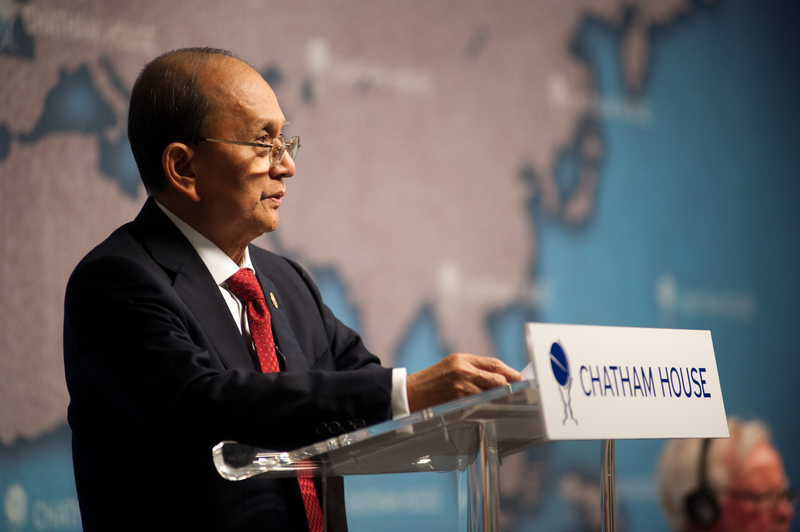
HE Thein Sein, President of Myanmar speaks at Chatham House in London | Demotix
Thein Sein, President of Myanmar speaks at Chatham House in London | Demotix

If you want to know how much has changed in Burma since the much-vaulted transition, try and put on a punk gig in the capital, Rangoon. It’ll take two months and require the signatures of eight bureaucrats from varying levels of government. You may never get permission. But to punks in Burma, the idea they may even be able to play publicly at all is progress.

This is transition Burma, a country full of contradictions where the military no longer hold captive Aung San Suu Kyi and have released some of the thousands of her fellow political prisoners — yet the full apparatus of the military state still exists. The worry is, while the UK and US drop sanctions and William Hague took the time to congratulate President Thein Sein in London for the progress made, little is being done to keep this progress on track. With the army implicit in the ethnic cleansing of the Rohingya Muslims and the country on the verge of widespread unrest, Burma is merely a few steps away from a full blown military dictatorship.

The transition to civilian rule is supposed to be making steady progress, yet power lies in the same place — with the military. As one journalist told us, “the generals have only changed their suits.” The sight of Aung San Suu Kyi alongside 43 of her National League for Democracy compatriots elected to Parliament in 2012 was hugely symbolic. But it is no more than symbolism for the League to hold an eleventh of the seats in the lower house.
The Union Solidarity and Development Party (USDP), a front for the old military junta, still controls all the main institutions of state. The USDP controls the presidency, nearly half the seats in the lower house and over half the seats in the upper house of the Burmese parliament. When the seats directly appointed by the military are included, the USDP has an overwhelming majority in both chambers. The majority of these USDP parliamentarians are former army officers or government officials with strong military connections. The lifting of economic sanctions will prompt new trade with Burma, but the West will be dealing directly with these generals who control both the state and many of the major economic interests.
While we were still watched by the secret police when we returned in 2013, we could operate openly. People came over freely to speak to us. Burma is now a country where comedian Zarganar (released from jail in October 2011) performs satirical skits on corruption with the President apparently watching on TV. Artists are pushing the boundaries of political art, Burmese producers mock the government with films such as “Ban that scene” that parodies the mean-spirit and laziness of bureaucratic censors and — for the first time — horror films are being made inside the country legally.

Politics is vibrant too. Cafe88 in Mandalay hosts political discussions that were illegal just a few years ago by former political prisoners, TV celebrities and journalists. The media is more free as well. Daily newspapers are back on sale and the infamous censorship boards that ruined courageous journalism by painting physically over articles with black ink have been abolished.

This new freedom, months old, is perilously fragile. As Index’s report on Burma found, the transition is not underpinned by essential legal and political reform. The current atmosphere of freedom stems from the police and security services not using their powers to curtail free speech. The full apparatus of the military state exists — it just isn’t being employed to the same extent — at the moment.

For instance, using an email account for “political purposes” carries a prison sentence of 15 years. If you use more than one account your sentence can be increased by 15 years per email address. Restrictions on public protest or performance are extremely strict, particularly outside Rangoon. At the start of this month, Time Magazine was banned under emergency legislation after it led with a front cover of nationalist monk U Wirathu and the title, “The Face of Buddhist Terror”. The ban criminalised the possession of even a single copy of Time. Meanwhile newspapers face the threat of a new press law that would bring in statutory regulation of the press.

President Thein Sein told Chatham House that in Burma “free speech exists … but of course more freedom can and will be granted when there is increased understanding of the duties and responsibilities that go with it.” This isn’t good enough. To protect free speech the government needs to put in place reform now. Pleasantries at Downing Street and congratulations at the Foreign Office can’t mask the fact that progress has stalled. The UK mustn’t allow President Thein Sein to get away with stalling reform until after the next election in 2015.

Unless the UK, EU and US are willing to put sanctions back on the table and in the meantime insist on a clear road map for reform, an incredible opportunity for a military dictatorship to become a civilian democracy will be lost.
Mike Harris is Head of Advocacy at Index on Censorship. @mjrharris

Thursday, 18 July 2013

Fleeing Rohingya women fall prey to traffickers in Thailand

Source: Thomson Reuters Foundation - Thu, 18 Jul 2013 04:05 AM

Author: Thomson Reuters Foundation Correspondent
Enlarge image
Narunisa, 25, cries as she hugs her daughters on June 18, 2013, upon returning to the shelter where she and about 60 Rohingya women and children have been detained in southern Thailand. REUTERS/Damir Sagolj

PHANG NGA, Thailand (Thomson Reuters Foundation) – The men managed to gain access to the detained women and promised Narunisa she would be reunited with her husband, who had left for Malaysia seven years ago when their second daughter was just a year old. So the stateless Rohingya Muslim from Myanmar sneaked out of a government-run shelter in southern Thailand where she has been held since January.
Instead of taking Narunisa to Malaysia, the traffickers smuggled her, her two daughters and two other Rohingya women in and out of numerous hideouts where they were kept against their will. One of the men raped Narunisa repeatedly.
She now wants the traffickers, including a Thai policeman, to be punished, but the slow, creaky wheels of Thai justice are proving a challenge.
The incident also raises concerns over the safety and vulnerability of detained Rohingya women in Thailand and shines an unflattering light on Thai police - at some officials’ possible complicity in the trafficking of Rohingya and in harming rather than helping victims.
Narunisa is one of 62 women and children at the shelter in Phang Nga, near Thailand’s popular beach resorts. The 25-year-old fled Rakhine state in western Myanmar when it became impossible to make a living after two bouts of sectarian violence last year left scores dead and some 140,000 displaced, most of them Muslims.
Although the Rohingya have been in Rakhine for centuries, Myanmar has excluded them from the country’s 135 recognised ethnic groups and denied them citizenship, rendering them stateless. Rights groups say they face some of the worst discrimination in the world, which worsened after the riots.
Narunisa’s village, unlike many others, was not destroyed in the violence, but her source of income quickly vanished when she could no longer go to the main market in Rakhine’s capital Sittwe to sell fruits and vegetables she had grown. Sittwe is now, except in one cordoned off area, devoid of Muslims
RAPED AT KNIFEPOINT
Three days after arriving on Thailand’s shores in a wooden boat, Narunisa was detained and sent to the shelter in Phang Nga. Soon after, traffickers gained access.
“The guys came once first and looked from the outside. They came again and got permission from the shelter people, and we started talking,” Narunisa said in an interview with Thomson Reuters Foundation at the shelter. She gave one of the traffickers, a Rohingya, her husband’s phone number in Malaysia.
“He called him and said, 'I'll bring your wife and kids to you, send me money’.” 
She persuaded two other women to escape from the shelter with her on May 27. Two men were in a pick-up truck waiting for them - 26-year-old Rohingya Korlimula and a Thai man, who Narunisa later learned was Senior Sergeant Veerayut Ferngfull.
They were taken to different hideouts. The traffickers asked for 50,000 baht (about $1,600) from each woman for the journey. Narunisa’s husband, who now has a second wife, paid the full amount for his wife and daughters but the other two could not afford to pay in full.
After 12 days, the two other women were taken elsewhere - Narunisa did not know it yet, but they had been released after failing to pay more money and brought by police back to the shelter - while she and her 8- and 10-year-old daughters were brought to a house on an island.
That night, after her children had fallen asleep, Korlimula said he wanted to marry her. When she refused, he raped her repeatedly at knifepoint for the next three nights.
“I told him, ‘You know I'm married and my husband is in Malaysia. You call him “brother”. Why are you doing this?’” she recalled in tears.
On June 13, Narunisa and her children were dumped on the side of the road in Phang Nga province’s Kuraburi district.  
After police found her, she was charged with absconding from the shelter and was kept in a police station. Her daughters were sent back to the shelter. 
DEATH THREATS
On June 18, Narunisa was released and went to the Khao Lak district police station to press charges. Thomson Reuters Foundation was present and saw firsthand the problems faced by rape victims seeking justice in Thailand. 
The petite woman, dressed in a brown headscarf, a green top and a printed pink sarong, recounted her experience while waiting patiently to get the attention of the policemen, who for at least 15 minutes argued among themselves whether Khao Lak was the right jurisdiction to investigate the crime.
They then questioned her in detail - a process that required four languages - and were flippant when she was unable to recall some details.
The police continued to voice concerns over jurisdiction problems. At one point they asked for the exact address of where she was raped, despite repeated explanations that she is unfamiliar with Thailand. They finally started taking notes, nearly an hour after the victim had stepped inside the station. 
“He told me he was going to take me to my husband and then raped me. This shouldn’t happen. He should be punished,” Narunisa said, remaining her composure.
She only burst into tears later, as her daughters ran out to greet her when she was taken back to the shelter.
Her ordeal is not over yet. A day after filing her complaint, a Thai man reportedly turned up at the shelter and threatened Narunisa and the shelter director, saying he had killed several Rohingya already and killing more “would be no problem”, according to Human Rights Watch
The threat was reported to the authorities, but no police protection has yet been assigned to the shelter at the time of writing. The shelter director has purchased a gun and set up surveillance cameras.
Korlimula and Veerayut the policeman have since been charged but they remain free. Veerayut is believed to be the first Thai official to be charged with trafficking of Rohingya.
Both deny the charges. Korlimula claims he and Narunisa were in love. Meanwhile, Chalit Kaewyarat, Phang Nga provincial police commander, told Thomson Reuters Foundation “an internal investigation shows it was unlikely (the policeman) was involved in human trafficking.”
(Additional Reporting by Jutarat Skulpichetrat) 

Wednesday, 17 July 2013

NEWS RELEASE-Myanmar: UN expert greets abolition of notorious border security force in Rakhine State and calls for accountability

Myanmar: UN expert greets abolition of notorious border security force in
Rakhine State and calls for accountability

GENEVA (16 July 2013) – The United Nations Special Rapporteur on the human
rights situation in Myanmar, Tomás Ojea Quintana, today welcomed the
abolition of Nasaka, the notorious border security force operating in
Rakhine State. He urged the authorities to investigate and hold accountable
those members of the force responsible for human rights abuses.

“I have received allegations of the most serious of human rights violations
involving Nasaka, particularly against the local Rohingya population,
including extrajudicial killings, arbitrary arrest and detention, and
torture in detention,” Mr. Ojea Quintana said. “I have no doubt that the
violations committed over the years with complete impunity has undermined
the rule of law in Rakhine State, and had serious consequences for the
peaceful coexistence of communities there.”

In his March report* to the UN Human Rights Council, the Special Rapporteur
recommended that the Government suspend all Nasaka’s operations in Rakhine
State and introduce fundamental reforms to this border security force.

“The abolition of Nasaka should not mean that the credible allegations of
widespread and systematic human rights violations committed by its members
are not properly investigated and the perpetrators held to account,” he
said.

“Furthermore, whatever force takes the place of Nasaka, it is vital that
the issue of impunity is addressed,” Mr. Ojea Quintana stressed. “If the
new force is not held accountable for its conduct, then the Government will
not have addressed the underlying problem.”

The human rights expert also urged reforms of the discriminatory laws and
regulations which Nasaka used to extort money from the local Rohingya
population, including with regard to marriage permits, freedom of movement,
registration of new born children, and access to education and employment.

“Reform of discriminatory laws needs to accompany institutional reform, in
line with the country’s national reform efforts,” the Special Rapporteur
said.  “How the Government deals with the situation in Rakhine State is a
good indicator of the depth and commitment of its efforts at the national
level to bring democracy, respect for human rights and national
reconciliation to the people of Myanmar.”

(*) Report available at:  http://www.ohc
hr.org/Documents/HRBodies/HRCouncil/RegularSession/Session22/A.HRC.22.58_AUV.pdf

Myanmar Government response to report available at:
http://www.ohchr.org/Documents/HRBodies/HRCouncil/RegularSession/Session22/A.HRC.22.58.Add.1_AV.pdf


ENDS

Mr. Tomás Ojea Quintana (Argentina) was appointed by the United Nations
Human Rights Council in May 2008. As Special Rapporteur, he is independent
from any government or organization and serves in his individual capacity.
Learn more, log on to:
http://www2.ohchr.org/english/countries/mm/mandate/index.htm

UN Human Rights, country page – Myanmar:
http://www.ohchr.org/EN/countries/AsiaRegion/Pages/MMIndex.aspx

For more information and media requests, please contact Daniel Collinge
(+41 22 928 9173 / dcollinge@ohchr.org)

For media inquiries related to other UN independent experts:
Xabier Celaya, UN Human Rights – Media Unit (+ 41 22 917 9383 /
xcelaya@ohchr.org)

UN Human Rights, follow us on social media:
Facebook: https://www.facebook.com/unitednationshumanrights
Twitter: http://twitter.com/UNrightswire
Google+ gplus.to/unitednationshumanrights
YouTube: http://www.youtube.com/UNOHCHR
Storify:        http://storify.com/UNrightswire

Watch “The Riddle”: http://www.youtube.com/embed/sYFNfW1-sM8?rel=0


 Office of the United Nations High Commissioner for Human Rights (OHCHR)
Regional Office for South-East Asia
ESCAP, UN Secretariat Building
6th Floor, Block A
Rajdamnern Nok Avenue, Bangkok 10200
Tel. (662) 288 1235, Fax. (662) 288 1039
Website: http://bangkok.ohchr.org
Email: ohchr.bangkok@un.org
pic15416.gifpic15416.gif
8K   View   Download  

AMNESTY INTERNATIONAL PRESS RELEASE 17 July 2013 Myanmar: Arrests continue amid promise to release all prisoners of conscience


AMNESTY INTERNATIONAL 
PRESS RELEASE
 
17 July 2013
 
Myanmar: Arrests continue amid promise to release all prisoners of conscience  
 Amnesty International has called into question President Thein Sein’s recent commitment to clear Myanmar’s jails of prisoners of conscience by the end of the year. On the same day he made this promise to delegates at a conference in  London, police in  Myanmar’s Rakhine state arbitrarily detained a 74-year-old Rohingya human rights defender.   
“The government continues to rely on repressive laws to silence dissent and jail peaceful protesters in Myanmar,” said Amy Smith, Amnesty International’s  Myanmar researcher. “For there to be lasting change in the country, these practices need to be stopped and the laws need to be brought in line with international standards.”
  
During a speech at the independent policy institute Chatham House in  London on 15 July 2013, President Thein Sein said, “I guarantee to you that by the end of this year, there will be no prisoners of conscience in  Burma.”  
 

Thein Sein added that all cases are being reviewed through a committee established by the government earlier this year “to ensure that no one remains in prison due to his or her political beliefs.”
 

“We’ll be looking to President Thein Sein to make good on this promise. He could start by avoiding the creation of new prisoners of conscience by ending the arrest and imprisonment of human rights defenders and peaceful protesters,” said Smith.
  
Since Monday, U Kyaw Hla Aung, a 74-year-old prominent Rohingya lawyer and former staff of a humanitarian non-governmental organisation, has been held in police custody in Rakhine state.
 

U Kyaw Hla Aung has spent more than 16 years in prison in  Myanmar due to his involvement in peaceful activities, and continues to be monitored and harassed by the authorities. Most recently, he was arbitrarily arrested and detained in June 2012 along with several Rohingya aid workers following violence between Buddhist and Muslim communities in Rakhine state. He was later released in August 2012. Amnesty International believes he is currently being targeted as an influential Rohingya human rights defender with connections to members of the international community.
 

“U Kyaw Hla Aung joins scores of other human rights defenders who have recently been arrested, charged, or detained for their involvement in peaceful activities. The charges against these activists should be dropped and those detained should be immediately released,” said Smith.
 

On 4 July 2013, Amnesty International highlighted recent arrests of human rights defenders and peaceful protesters in  Myanmar in a  
 public statement . The authorities rely on a range of domestic laws to criminalize individuals exercising their rights to freedom of expression, assembly, and association. Amnesty International called on the  Myanmar government to bring these laws in line with international human rights standards.
Since the statement was issued, further activists have been arrested. For example, on 10 July 2013, police in  Pyay  Township  in Bago Region arrested activist Wai Phyo for organizing a “Free Political Prisoners” poster campaign in July 2011. He is being charged with violating the 1962 Printing and Publications Registrations Act. Wai Phyo is the Secretary of Generation Wave, a pro-democracy youth group in Myanmar .  
“It’s all well and good for Thein Sein to promise an end to prisoners of conscience, but there is a long way to go from what we’ve seen in recent months,” Smith said.  
 Public document
****************************************
For more information please call Amnesty International's press office in  London UK, on +44 20 7413 5566 or email:  
 press@amnesty.org

Amy A. Smith
Myanmar/Thailand Researcher
Asia Pacific Programme
Amnesty International
Tel (Thailand): +66 (0)87.795.5454
Tel (UK): +44(0)20 7413 5778
Skype: AmyAlexSmith

Twitter: @AmyAlexSmith


--
Working to protect human rights worldwide