Wednesday, 9 October 2013

SHOULD THIEN SEIN GET THE NOBLE PEACE PRIZE?


The 2013 winner – or winners – of the Nobel Peace Prize will be announced in the next few days, an award that relatively few Asians have won. When the nominations for the 2013 Peace Prize closed in February, among the 15 or so names mentioned as possible laureates was the “reformist President of Myanmar,” Thein Sein.

That is an eventuality almost no one could have foreseen three years ago and indicates the relative progress Burma has made from the dark days of a long, naked and very oppressive military rule. But despite Thein Sein’s steadily rising popularity, he has made statements that call into question his suitability for the prize.

Among the 12 Asians who have won the world’s most prestigious peace prize is Aung San Suu Kyi, the 1991 peace laureate, who spent various stints under house arrest for 15 years following her return to Burma in April 1988 to nurse her ailing mother. From about October 2007 to Suu Kyi’s eventual release in November 2010, Thein Sein was the Prime Minister and head of government in the previous regime that kept her there.

The past is not really dead and perhaps not even past, especially when the past is not directly related to Suu Kyi’s house arrest. In connection with the past atrocities committed by previous military regimes in the brutal crushing of the monk-led Saffron Revolution of 2007 and the student-led nation-wide uprising of 1988, Thein Sein stated that the top and middle-ranking military officials who crushed the protests were “doing their duty.”

That was the response he gave through a translator to a British Broadcasting Corporation’s interviewer’s question less than a year ago when asked whether he intended to investigate the “past excesses” of the Burmese Army.

The phrase “partly previous military regime” is used since in addition to former General Thein Sein, many members of the self-abolished military junta, with or without their military uniforms, continue to occupy cabinet, legislative and even judicial posts.

An apparently reformist president who has been praised to the skies by some Burmese and foreigners alike thus refuses to acknowledge that there were such “excesses.” This amounts to “covering a dead elephant with a goat skin,” a Burmese-language reference to the fact that the deaths of hundreds, perhaps thousands of students, monks and common citizens were covered up after they were shot down by military troops in the two protests.

Another Nobel laureate (for the year 1993), the former president of South Africa Francis de Clerk, eventually acknowledged the wrongdoings of the apartheid system which in part, led to the establishment of truth and reconciliation commissions. In contrast, one dare not and realistically should not have the audacity to hope that even something close to a genuine truth and reconciliation commission in Burma would be formed. Indeed it may be better to tear down any such expectations since its formation is not among the stunning reforms’ that Thein Sein has apparently initiated.

Three more statements from Thein Sein need to be mentioned, two mainly for domestic audiences and one initially made in the context of his meeting with a group of Burmese diaspora.

In a press conference in Burma, a few months ago, the president stated that the British colonial government in their rule of more than 100 years built only one major bridge but the partly previous military regimes which ruled for “only” 23 years built more than 100 bridges! So a combined reading of the President’s recent statements is: “We must forget the alleged’ abuses of the military. They were merely doing their duty.” And since the regime – of which he was a member and head of government for a few years has built more than 100 bridges it is several hundred times better than British colonial rule!

At the time of independence in 1948 Burma had some of the best infrastructure in Southeast Asia. The nascent democracy of the 1950s was, in comparison with the last 50 years, an age of relative progress and prosperity. After about five decades of military and one-party rule Burma lagged behind many other Asian countries including a few of its neighbors not only economically but also in terms of relative political freedoms and judicial independence.

Indeed Thein Sein himself stated, several months ago, in a meeting with Burmese expatriates or Burmese diaspora that Myanmar could reach the status before the 1960s’ if concerted efforts were made towards it. This is an implicit if not explicit acknowledgment that things were much better in the retrospectively renamed Myanmar in the 1950s and early 1960s before the military coup of 1962. Yet for two generations both in schools, universities and the almost totally government-controlled media Burmese were told how “parliamentary democracy” corrupts and how the Army has repeatedly saved the country from disintegration. Yet in a not-so-Freudian slip the president was indirectly acknowledging that the nascent Burmese democracy from the late 1940s to early 1960s expunged by successive Burmese military and military-led one party regime did have merit worthy of his government to emulate. Perhaps that message was intended mainly for the Burmese diaspora.

Yet the mixed messages from the president continue, especially when the target audience is the local Burmese. On February 12, 2013 the 67th anniversary of Union Day, in a message to the nation published in the front page of all the government newspapers the president stated to the effect that the Burmese had suffered because of the colonial education system. In fact the English translation of the president’s Union Day message used the phrase “colonial education system” but the Burmese version used the harsher phrase “slave education system”.

Successive Burmese military juntas were responsible for the rapid and marked deterioration of what had been a creditable education and university system of the 1950s. After the crushing of the student-led 1988 uprising, the campus of Rangoon University was covered with weeds. Students seeking higher education in Burma were robbed of their future, a trend which in recent months the current administration has admittedly but belatedly tried to reverse with assistance from some foreign universities.

Two days before President Thein Sein’s 2013 Union Day message, a headline in the same official government newspaper The New Light of Myanmar stated: “As Myanmar belongs to the Common Law Legal System family, the Myanmar Judicial System is deeply rooted with legal maxims, judicial customs and precedents which are enshrined with International Legal Principles that are utilized by successive judges all over the world.”

This is reportage of a rule-of-law seminar held at the capital Naypyidaw on Feb. 9 summarizing a speech by the Attorney-General. In contrast to this “blame all on the colonialists” rhetoric of the previous regimes and indeed two days before his President’s statement the Attorney-General proudly says that “Myanmar belongs to the common law legal system”. That common law legal system is derived from the same colonial or “slave” legal and educational system, established across the world in former British colonies.
Yet another Nobel peace laureate (of 2001), former UN Secretary General Kofi Annan, writes in his memoirs “Interventions: A Life in Peace and War” that some African leaders continue to play the colonial blame game for which Annan chastises some of his fellow African elites.

Hence the apparently tipped Nobel Peace Prize nominee would probably need to unlearn or at least be aware that the colonial blame game does have its detractors even among albeit a relatively few Asian and African elites. This is not to defend colonialism by any means. But at the same time those who consistently or even occasionally play the blame game for their long-past colonial history need to be aware of the legitimate criticisms of this “blame (entirely) the colonial past for all its woes” of some elites and leaders of developing countries.

The Burmese government’s reforms – despite their checkered results are, one readily acknowledges, noteworthy but not that stunning, nor even very significant to the extent that its head of state should receive the additional plaudits of a Nobel Peace Prize.
Myint Zan is a Professor at the Faculty of Law, Multimedia University in Melaka, Malaysia.This article first appeared on Asia Sentinel on October 8, 2013.

source:The Irrawaddy news.

Burma’s half-hearted attempt to stop anti-Muslim pogroms

Burma’s half-hearted attempt to stop anti-Muslim pogroms

A dead body is left on a street in Meikhtila after anti-Muslim riots in March 2013. (Reuters) A dead body is left on a street in Meikhtila after anti-Muslim riots in March 2013. (Reuters)
The vicious stabbing to death of a 94-year-old Muslim woman in Arakan state marks a new low in Burma’s shameful communal tensions. It should place President Thein Sein in a tight predicament as he put his international reputation on the line by promising a “zero-tolerance approach” to ethnic violence during a high-profile tour of Europe in July at a time when he was openly courting European investment and the lifting of the remaining sanctions on his country.

His words were echoed on 30 September by Foreign Minister Wunna Maung Lwin speaking at the UN in the wake of riots in villages around Sandoway where five people were killed and at least 70 homes were burnt down by mobs which the president claimed were instigated by “outsiders”.

Alas it is a scene all too familiar in Burma in recent months: an innocuous personal argument between two locals—one Muslim and one Buddhist—leading to a huge mob forming to attack the Muslim residents and burn down their homes.

The attacks follow a consistent pattern and are clearly well organised. Anti-Muslim mobs now seem to be sitting in the wings in various parts of the country, waiting for the call. These thugs are allowed to travel in and out of villages with impunity armed with clubs and machetes. Local Muslims report being forcibly disarmed by the authorities and promised protection before a crowd of Buddhists torched their homes while the police looked on with indifference. The unwillingness of the police to form roadblocks or otherwise prevent these hooligans from entering towns to attack Muslims is a failure of duty so large it either represents support for the mob violence, suggests collusion on behalf of the security forces’ superiors or incompetence within the police hierarchy on a grand scale.

Although we as media often write that “calm has been restored” following a night of anti-Muslim pogroms, a closer look at these incidents suggests strongly that the rioters in each case simply decided to return home unimpeded; the police did not move in to prevent the savagery.

Last week Thein Sein emphasised: “The most important thing is we shouldn’t allow these things to happen again.” However, it is becoming increasingly evident that an anti-Muslim infrastructure has been organised in many areas around the country. Some say the 969 group are behind it. Many would conclude that the Rakhine Nationalities Development Party and their allies are playing the nationalist card in Arakan state to unsettle a fragile society, while others continue to point the finger at disgruntled factions of the military. Perhaps the reality is a mixture of all these elements and more. In any case, it seems clear the racist organisers will continue campaigning, recruiting violent thugs, and enflaming religious hatred as long as they can.
If the Burmese government was truly united in its goal of ending this communal conflict, then it would have cracked down on culpable officers within its security forces many months ago, and against organisations and political parties whose agenda is transparently to abuse, terrorise, segregate or exile Muslim minorities from their communities.

But no attempt has been made to identify who pulls the strings in this tragic episode which has tainted Burma’s march toward reform and democracy. In fact, while paying lip service to the international community about equality and “zero tolerance”, the president and his senior ministers continue to talk out the other side of their mouths when addressing Burman and Arakanese Buddhist audiences.

In June, Thein Sein memorably described anti-Muslim icon Wirathu as a “son of Buddha” and a “noble person” committed to peace. And only last week parliamentary speaker Shwe Mann was quoted by the Myanmar Times praising the ethnic Rakhine people – i.e. Arakanese Buddhists – for “safeguarding Burma’s western border”. Speaking some days after Arakanese Buddhist leaders had called for the formation of a people’s militia to protect the country from illegal immigrants, Shwe Mann’s comments can be interpreted as nothing less than an endorsement of the vigilante mobs who have wreaked terror on Rohingya and Kaman Muslim villages over the last 16 months.

In short, no evidence exists that the Thein Sein government is willing to make an attempt to curb the anti-Muslim sentiment in the country. This weekend another attack flared in Kyaung Gone near Rangoon after the alleged rape of a Buddhist girl by a Muslim man. In other words, every village or town where a sizeable Muslim minority lives remains a ticking time bomb. It is only a matter of time before a personal argument spirals into yet another bloodbath while the police sit on their hands and central government officials continue talking out both sides of their mouths.

Tuesday, 8 October 2013

Children are Victims in Arakan State, Unicef Says

BURMA


 Arakan, Rakhine, Myanmar, Burma, Thandwe, Unicef, United Nations, Kachin, conflict, human rights, IDPs
An ethnic Rohingya boy and woman eat at a camp for displaced Muslim families in Arakan State. (Photo: JPaing / The Irrawaddy)

RANGOON — The UN agency for children’s rights has called for an end to communal violence in west Burma, where clashes last week between Muslims and Buddhists left hundreds of people homeless.

Unicef issued a statement on Tuesday urging an end to violence in Arakan State, following the third major wave of communal violence to hit the state since last year. The clashes last week near the southern town of Thandwe left five people dead and destroyed some 110 homes.

In the two waves of unrest last year—elsewhere in Arakan State, in June and October—more than 140,000 people were displaced, and more than 105,000 were children affected by the violence, according to statistics from Unicef, which is providing aid locally.

“We are concerned the inter-communal violence is spreading in the whole country,” Bertrand Bainvel, a Unicef spokesman in Rangoon, told The Irrawaddy. Anti-Muslim riots have also broken out in several locations across Burma this year.
Bainvel said the violence could affect the country’s ability to promote peace and stay united in the long term, amid a transition to democracy after decades of military rule. Of the unrest, he said, “first and foremost, if affects children.”

“It is difficult for them to understand what is going on. It is psychologically very difficult.”
Unicef, which has provided assistance in Arakan State for education, nutrition and health, as well as psychosocial support, says the unrest has made it nearly impossible for many affected children to continue their education or access health care. “Even if they manage to go to school, it is difficult for them to concentrate on learning because they will hear about the burning, shooting or adults speaking about violence,” the Unicef spokesman said. “Even if their houses weren’t burned, maybe their neighbors’ homes were.”

In temporary camps for displaced families near Sittwe, the state capital, about 85,000 children are 18 years old or younger. These include both Muslims and ethnic Arakanese Buddhists.

Unicef operates a temporary learning center for displaced children in camps in Sittwe as well as nearby Myaybon, Pauktaw and Kyauktaw townships, but only 7,500 children aged 11 to 14 have access to it. Unicef says another 1,000 children will soon be able to attend.

Farther north in Kachin State, where clashes continue between ethnic rebel armed groups and the government army, 8,000 children between the ages of 6 and 9 attend schools in rebel-controlled territory. Unicef does not have other data on the number of children affected by conflicts elsewhere in the country due to government restrictions on traveling to those areas.

Related Posts :

Sunday, 6 October 2013

Breakingnews > Muslim-owned houses destroyed/Genocide spreads to Irrawady Division!

Credit:Bangkok Post
A mob of angry Buddhists destroyed five Muslim-owned houses in Myanmar early Sunday following reports that a 14-year-old Buddhist girl was raped, officials said.

The latest round of communal violence erupted shortly after midnight when about 100 people surrounded a police station in the town of Kyaung Gone, 50 kilometres north-west of Yangon, demanding that police hand over a Muslim rape suspect.

"When we refused their demand, they became angry and started destroying Muslim houses," an official from the town's administrative office said.

Another Muslim-owned house was partially destroyed by fire, according to witnesses.
No injuries were reported in the rampage.

Clashes between Buddhists and Muslims have spread since last year, when sectarian fighting claimed at least 167 lives and left 140,000 people homeless, mostly Rohingya Muslims, in the western state of Rakhine.

Saturday, 5 October 2013

RNDP Not to Blame for Thandwe Violence: Local Party Member

BURMA

Saturday, October 5, 2013 | 

Arakan, Rakhine, Buddhist, Muslim, conflict
Tun Shwe, a local RNDP member in Thandwe, denies that his party was involved in the outbreak of anti-Muslim violence in the township. Click on the box below to see more images. (Steve Tickner / The Irrawaddy)

THANDWE — Several local Arakanese politicians and community leaders were apprehended in Thandwe Township in recent days in relation to the outbreak of inter-communal violence between ethnic Arakanese Buddhists and local Muslim communities.

A Thandwe Arakanese leader, however, has blamed the unrest on “Bengali” Muslims, who he claimed had been coming to the southern Arakan State town and “started the violence.”

“Some people hide inside trucks and secretly came to the town or some came by boats from the sea, secretly, to settle in the town,” said Tun Shwe, a central committee member of the Rakhine National Development Party’s (RNDP) Thandwe office.

He said “more and more” Muslims had come to Thandwe from northern Arakan State, after inter-communal violence in June and October last year affected their communities there.
Most Muslims in northern Arakan call themselves Rohingyas. Burma’s government refuses to recognize the group as citizens and — like local ethnic Arakanese communities — it refers to them as “Bengali” immigrants from neighboring Bangladesh.

The villages in Thandwe Township that suffered from attacks this week, however, are ethnic Kaman Muslims, a group that is officially recognized as a Burmese minority with a recorded history in southern Arakan State.

RNDP member Tun Shwe accepts that the Kaman have long lived in Thandwe, but still he maintains that a supposed influx of “Bengali” Muslims caused the recent violence, although he was unable to explain where this group of newcomers was residing.
“Yes, there are local Muslim inhabitants here. But, [since last year] more Bengalis came to Thandwe,” he claimed.

The anti-Muslim violence in Thandwe Township began on Sunday and was reportedly sparked by an argument between a Buddhist motorbike taxi driver and a Kaman Muslim man.

Between Sunday and Wednesday, more than 100 homes were destroyed in at least five Kaman villages. Six people were reported killed, five injured and hundreds of villagers were forced to flee.

In recent days, Thandwe police have arrested two local RNDP members, including the Thandwe RNDP chairman Maung Pu, in relation with the violence. Two local members of civil society group Protection of Nationality, Religion and Dhamma were also detained.
International human rights groups have previously accused RNDP members, local Buddhist leaders and nationalist Arakanese civil society groups of organizing attacks on Rohingya communities.

In Thandwe, tensions began to rise after Arakanese community groups organized ‘Buddhist Day’ on Aug. 26, an event that attracted tens of thousands of people and hundreds of monks from the area. Members of the Buddhist nationalist 969 movement were also present and actively spread their virulent anti-Muslim messages among the township’s inhabitants.
Tun Shwe denied, however, that the RNDP and local Arakanese community organizations had been whipping up anti-Muslim sentiment in the weeks leading up the violence. “Our party attempted to stop tensions among the people,” he said, adding that, “Our chairman was not involved in the house burning.”

Win Naing, Thandwe representative of the National League for Democracy, the opposition party of Aung San Suu Kyi, said he believed that the local RNDP branch had indeed played an organizing role in the unrest.
“We found that their members were involved in the violence. The authorities should thoroughly interrogate those that they have detained in order to stop this violence,” Win Naing said.

US Maintains Block on Military Assistance to Burma

BURMA

1

United States, child soldiers, military, Child Soldiers Protection Act, Thein Sein, Barack Obama, Trafficking In Persons
A billboard promoting a “No Child Soldiers” campaign was erected in Rangoon earlier this year. The United States has maintained a block on military assistance to President Thein Sein’s quasi-civilian government for its use of child soldiers in armed conflict. (Photo: Steve Tickner / The Irrawaddy)

RANGOON — Following pledges to enhance military ties with Burma, the United States has maintained a block on military assistance to President Thein Sein’s quasi-civilian government for its use of child soldiers in armed conflict, US officials said on Thursday.

Burma is one of five countries that will not receive US military assistance in 2014 under the Child Soldiers Prevention Act (CSPA), which places restrictions on security assistance and commercial licensing of military equipment for governments found to use child soldiers.
State Department spokeswoman Marie Harf said the sanctions would affect Burma, Rwanda, Central African Republic, Sudan and Syria.

The CSPA requires the United States to identify countries whose government armed forces or government-supported armed groups recruit and use child soldiers. Ten countries were identified on the 2013 list, published in the State Department’s annual Trafficking in Persons (TIP) report.

Harf said President Barack Obama on Tuesday waived in full or in part the restrictions on military assistance for five countries on the list this year—including Chad, Democratic Republic of Congo, Somalia, South Sudan and Yemen—while deciding not to waive the restrictions for the rest, including Burma.

Restrictions will apply in the 2014 fiscal year and prohibit assistance through International Military Education and Training (IMET), which helps train foreign militaries, as well as Foreign Military Financing (FMF), which funds the sale of US military material and services.
When asked why Burma did not receive a waiver, Harf said “steps are being taken … to begin to address the child soldiers issue in Burma.”

“In 2012, the government of Burma signed a child soldiers action plan with the UN, which had been under negotiation for more than five years,” she told reporters in Washington on Thursday, according to a press briefing transcript on the State Department website. “So we’ll continue to raise this issue diplomatically with the Burmese government.”

While some sanctioned countries including Rwanda were earlier slated to receive a small amount of IMET and FMF funding, Harf said she did not believe that Burma received such assistance.

Burma has been on the CSPA list since 2009, when the US law went into effect.
Since Thein Sein’s reformist government came to power in 2011, the United States has lifted nearly all of its economic sanctions on Burma as a reward for political reforms, but it has kept an embargo on arms sales, amid ongoing accusations of rights abuses by Burma’s armed forces.

However, the Obama administration has indicated that it wants to resume nonlethal defense training and assistance for Burma. The United States cut military assistance after the Burmese military junta brutally cracked down on pro-democracy protesters in 1988.
In the eight years prior to 1988, the United States reportedly financed US$4.7 million in military sales to Burma and trained 167 officers at US military schools, according to the Associated Press.

Amid ongoing political and economic reforms, the Obama administration has expressed a desire to improve military-to-military relations with Burma to encourage a more professional armed forces. US defense legal experts visited the Southeast Asian nation in August for the second time in two months to consider possibilities of offering training on human rights and rule of law. US Ambassador Derek Mitchell also met with the chief of Burma’s military, Snr-Gen Min Aung Hlaing, in Naypyidaw to discuss legal practices in military combat.
Despite reassurances that any assistance would be gradual and nonlethal, the idea of enhancing military ties has met with resistance from some US lawmakers and activists who caution against granting international legitimacy to a Burmese military that continues to use child soldiers and has displaced more than 100,000 civilians over the past two years in clashes with non-state armed groups.

The US Embassy in Rangoon could not be reached on Friday to comment on how the military assistance restrictions in 2014 would affect US efforts to enhance military ties with Burma.

The Burma military was notorious under the former regime for recruiting child soldiers to wage wars over several decades against non-state armed groups in ethnic states. Thein Sein’s administration has sought to clean up the military’s image by discharging dozens of underage soldiers. In August, the Burmese military erected an eye-catching billboard in downtown Rangoon to promote a “No Child Soldiers” campaign.
The military discharged 68 child soldiers in August, according to the United Nations, and in July it released 42 children and young adults who were recruited for soldiering and other duties.

However, new cases of child soldiers continue to be reported. In August, around the same time the billboard went up in Rangoon, two families in the city publicly alleged at a press conference that the military had recruited two of their children.

Source:The Irrawaddy.

Friday, 4 October 2013

Dispatches: Boat Migrant Tragedy Should Shake Europe’s Conscience

Dispatches: A look at human rights in the news today
All Dispatches »
October 3, 2013
The scale of this latest tragedy is unprecedented: at least 94 people have died and hundreds are missing after an overcrowded boat carrying some 500 people caught fire and sank off the coast of Lampedusa, Italy, early Thursday morning. Some 140 people have been rescued and the search continues for more survivors even as hope fades.

But deaths of migrants and asylum seekers trying to reach European shores are a recurring tragedy, and a continuing European shame. An estimated 1,500 died attempting the crossing in 2011, a year that saw a significant increase in crossings due to the conflict and upheaval in North Africa. Numbers were thankfully lower in 2012, with an estimated 500 deaths – still a shocking number. Yesterday I contacted UNHCR in Rome to get their most recent estimate for deaths at sea this year: they calculated about 100 (there is never any certainty). Tragically, that number has doubled in the space of a few hours.

The Italian government has called for a day of mourning tomorrow. This is appropriate, but of course not enough. The deaths of so many should shock the conscience of all in Europe, including Europe’s decision-makers. For too long, EU border control, including sea border surveillance, has been focused on barring entry, rather than saving lives. That has to change.

Preventing deaths at sea needs to be at the heart of a coordinated European-wide approach to boat migration. This entails improving search and rescue coordination among EU member states, resolving disputes over responsibility for rescue and disembarkation, removing disincentives for commercial vessels to conduct rescues, and replacing the persistent emphasis on border enforcement with the imperative of saving lives.

Latest Myanmar violence blamed on religious and ethnic extremists

credit:Reuters


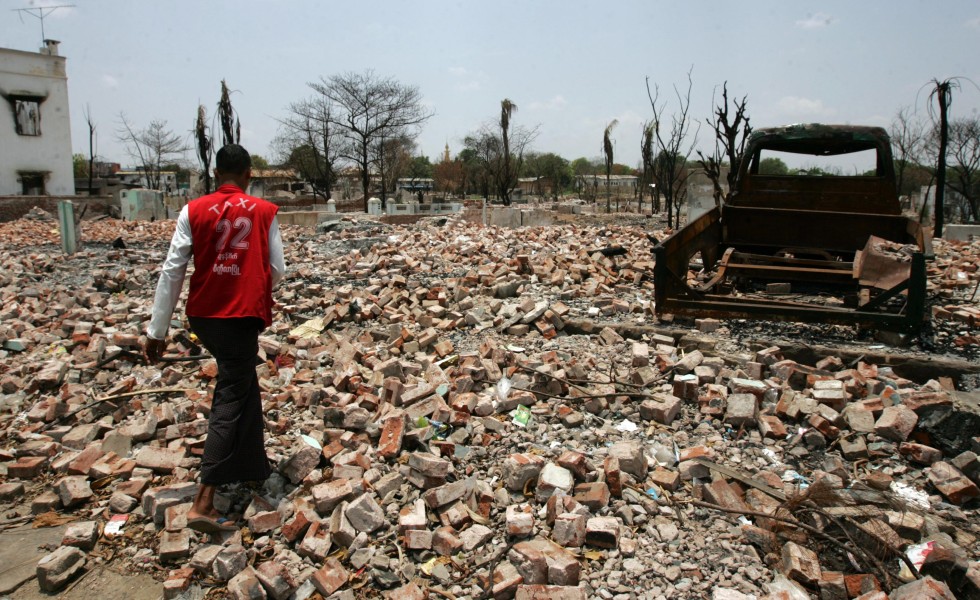
A man walks out from a destroyed mosque that was burnt down in recent violence at Thapyuchai village, outside of Thandwe, in the Rakhine state, October 3, 2013. REUTERS/Soe Zeya Tun
THANDWE, Myanmar | Fri Oct 4, 2013 3:32am EDT
(Reuters) -

 The Buddhist mob mutilated and burned Khin Naing so severely his son couldn't recognise the body, one of series of attacks that suggest a resurgence of a monk-led movement in Myanmar accused of stoking violence against Muslims.

Flies were buzzing around the bloodied patch of earth outside a ransacked mosque in Tha Phyu Chai village where police removed Khin Naing's body after he was hacked to death by ethnic Rakhine Buddhists.

"He couldn't run fast enough from the Rakhine people," said his son, Tun Tun Naing, 17, who emerged from hiding to identify his father's corpse from what remained of his charred clothing.

Khin Naing was one of five Muslims killed and four Rakhine Buddhists wounded in four days of violence in Thandwe, a township in western Rakhine State popular with foreign tourists for its nearby Ngapali Beach.

Not far from its resorts, Buddhists armed with sticks, slingshots and machetes launched repeated attacks on Muslim villagers from Sunday, burning down dozens of homes, witnesses said.

Sectarian violence in Myanmar has killed at least 240 people and displaced 140,000, most of them Muslims, since June 2012.

The latest bloodshed in Thandwe shows Myanmar's reformist government struggling to curb the spread of a Buddhist nationalist movement known as 969 and control members of an ethnic Rakhine political party implicated in violence.

The 969 movement is led by firebrand monks who preach that Islam is a threat and urge supporters to shun interfaith marriage and boycott Muslim-run businesses.

The numbers symbolise the Buddha, his teachings and the monkhood. Many anti-Muslim attacks have taken place where monks have preached the 969 creed but the violence had ebbed in recent weeks until the Thandwe attacks.

Police in Thandwe say they have arrested six people, including the local chairman of the Rakhine Nationalities Development Party (RNDP) and supporters of the 969 movement. RNDP members were implicated in anti-Muslim violence last October in which at least 89 people were killed, a Reuters investigation found.

The latest violence coincided with a three-day visit to Rakhine State by President Thein Sein. Tension was high as he arrived in Thandwe on Wednesday, with police firing shots in the air to disperse a crowd.

"ENEMY BASES"

Evidence of 969 activity is hard to miss.
Banners bearing the movement's logo flank roads to Ngapali beach. Muslims said 969 supporters had recently blasted Buddhist nationalistic songs from speakers at Thandwe town hall.

That followed a sermon in Shwe Hlay village by a prominent 969 monk called Wirathu, who once described mosques as "enemy bases".

"After that, we had to be very careful in the village and not bump into Buddhists or make them angry," said Myint Aung, one of scores of Muslim residents of Tha Phyu Chai village huddled near one of the few homes left standing.

Wirathu's admirers include Sann Sint, minister of religious affairs, who told Reuters in June the monk only promoted "love and understanding between religions".
President Thein Sein has called Wirathu "a son of Lord Buddha" and said 969 "is just a symbol of peace".

About five percent of Myanmar's 60 million people are Muslim, according to government estimates. About a million more are Rohingya Muslims, mostly stateless and living in northern Rakhine State.

Maung Myint Htay, a Buddhist resident of Tha Phyu Chai, said he played no part in Tuesday's attacks, but didn't condemn them.
"It's not wrong," he said, adding that Rakhine people had a "historical duty" to protect their homeland from Muslims.

Myint Moe of a group called the Committee for the Protection of Religion and Nationality acknowledged that he distributed 969 stickers and had the support of hundreds of Buddhist monks.

Myint Moe rejected the name "Rohingya" and instead referred to members of that community as "Bengalis", a term that implies they are illegal migrants from neighbouring Bangladesh.

An RNDP official in Thandwe said the arrest of party members could cause more unrest.
"It's the responsibility of the government because they arrested the party leader and religious leaders," said Maung Maung Phyu. "People are angry."
(Amends transliteration of name in paragraph three to Tun.)


(Additional reporting by Min Zayar Oo in Yangon; Editing by Martin Petty, Andrew R.C. Marshall and Robert Birsel)

Breakingnews > Thein Sein tours riot-torn Rakhine

credit:Bangkok Post

Published: 4 Oct 2013 

Myanmar's president on Thursday met communities in an area convulsed by deadly anti-Muslim violence, after mobs torched property and police fired warning shots to try to restore order.
A Muslim man inspects the burnt area of a vandalised building in Thabyu Chi village near Thandwe, in Myanmar's western Rakhine state on October 3, 2013

Six people have been arrested after several days of tensions spilled into bloodshed on Tuesday in the western state of Rakhine, with the death toll now standing at six -- all Muslims, police said.

Thein Sein met local residents and hoteliers in the flashpoint town of Thandwe but did not venture into outlying villages, before returning to the capital Naypyidaw.

The Myanmar leader was on his first visit to Rakhine since a wave of religious violence erupted there last year, leaving dozens dead and tens of thousands homeless.
Unrest flared again on Wednesday evening despite the nearby presence of the president, a Rakhine police official told AFP on condition of anonymity.

"The police opened fire to control the situation," the official said, adding that two houses on the outskirts of Thandwe owned by a local Muslim were torched but no one was injured.
The man was allegedly involved in a verbal argument with a Buddhist tuk tuk driver that sparked the initial unrest at the weekend. His house in Thandwe was burned by a mob and he has since been arrested by local police on unknown charges.

Muslim families fled into forests in terror after Tuesday's violence, which saw a mob of some 800 Buddhist thugs set alight dozens of homes in their village on the outskirts of Thandwe.

A 94-year-old woman was knifed to death in the rioting, which happened near the popular tourist destination of Ngapali Beach.
Rights groups have previously accused Myanmar's authorities of complicity with rioters in the Buddhist-majority nation -- a claim the government denies.
The international community has expressed growing disquiet at the fresh unrest in strife-racked Rakhine.

Both the US and UN expressed serious concern over the latest incidents and urged swift action to quell conflict and bring perpetrators to justice.
What began last year as communal fighting between Rakhine Buddhists and stateless Rohingya Muslims has since spread, with other minority Muslim groups increasingly targeted.

Around 250 people have been killed and more than 140,000 left homeless in several outbreaks of Buddhist-Muslim violence around the country since June 2012, mostly in Rakhine

Monday, 30 September 2013

Rohingya Muslims in hiding in Myanmar after outbreak of sectarian violence


Buddhist mob torched houses and surrounded mosque in latest incident of communal unrest
Monday, 30 September, 2013, 3:28pm
Terrified Muslims hid in their homes in northwest Myanmar on Monday after armed police dispersed a Buddhist mob that torched houses and surrounded a mosque in the latest outbreak of sectarian tension.

Clashes between majority Buddhists and Muslims have killed at least 237 people and left more than 150,000 homeless since June last year.

The violence threatens to undermine political and economic reforms launched in the two years since a quasi-civilian government replaced a military junta.

The situation in the town of Thandwe was precarious after police restored order by firing shots in the air to break up the mob late on Sunday, said two security sources, who sought anonymity as they were not authorised to speak to the media.

Thandwe, 260 km from the capital Yangon, is in Rakhine state, the worst-hit region. As in several previous bouts of communal unrest, a minor disagreement triggered an outpouring of anger, a local Muslim politician said.

“We’re now scared and hiding inside our homes, like the previous times,” Kyaw Zan Hla, chairman of the Kaman Muslim Party, told Reuters by telephone, adding that about 200 people had joined the mob, some wearing masks and carrying flaming torches.

He said he had himself become embroiled in a row after he objected to a Buddhist man parking a motorcycle in front of his home late on Saturday and rumours spread that he had insulted Buddhism.

Police reported no deaths or injuries from the incident in Thandwe, home to an airport used by tourists who visit resorts on the popular Ngapali beach nearby.
In April, the government said 192 people were killed in June and October last year clashes between ethnic Rakhine Buddhists and Rohingya Muslims, most of whom Myanmar regards as illegal immigrants from Bangladesh, despite roots going back generations.

The United Nations has described the Rohingya as “virtually friendless”.
Clashes between Rohingya and Rakhines in June last year led to unrest elsewhere in the country, where other groups of Muslims have been targeted, including Kamans, who are of different ethnicity from Rohingyas. An estimated five per cent of Myanmar’s population of about60 millions is Muslims.

Credit:Reuters in Yangon

More Details about Attacks in Tandwe township: 30/09 /13

More Details about Attacks in Tandwe township: 

a house belong to a Kaman muslim, U Kyaw Zan Hla, was burn down during the first attack by Rakhine people by the evening of 29 Sept that followed destruction of four other houses and the mosque. Where the military forces who are guarding the area, were quietly watching the scene and driven the muslim villagers who came out to defense into the mosque.

Other 50 houses of Aindaw village along there those were abandoned by muslim villagers from last year, were also burn down by following morning on 30 Sept.

Beside, Kyauknimaw villagers are still in fear of attacks after a military captain tried to negotiate with the top ten Rakhine leaders who asked Muslim villagers to leave from the village within two weeks.

Sunday, 29 September 2013

Tatmadaw is the biggest Dacoit of Burma

Tatmadaw is the biggest Dacoit of Burma


By Kanbawza Win

Tamadaw, as the marauding Burmese Army is known is the greatest dacoit and robber the country has ever known since it assumes power in 1962.For three quarter of a century, it has been pillaging, killing, raping, robbing, displacing, and robbing the people, encouraged by the neighbouring countries of ASEAN, China and India.

Burma's military leaders have siphoned billions of dollars into offshore accounts in Singapore over the past nine years, and Singapore’s Constructive Engagement Policy,hitherto used to accepting Narco dollars have gleefully accepted it as this is the only way to keep Burma from rising up. The money comes from the Yadana gas project in Burma.

"Some $5 billion[Dh18.3bn] from the Yadana gas pipeline has been stolen from the Burmese people," Mathew Smith, the main author of the Earth Rights International (ERI) report said in an interview. "Rather than contribute to Burma's economic development, the billion-dollar revenues from the project have gone into the pockets of the top generals." 

The money has been put in two Singapore banks, the Overseas Chinese Banking Corp. (OCBC) and the DBS.

Burma earns $150 million (Dh551m) a month from gas exports, and that is set to raise substantially in the future, according to Sean Turnell, an Australian academic at Macquarie University in Sydney and an expert on Burma's banks and economy."Foreign reserves have now just passed $5 billion. Meanwhile, the international community is being berated over its failure to stump up for the government's post-Nargis reconstruction funding proposals,"he said. While the gas revenues are the most substantial part of the regime's schemes, according to diplomats in Rangoon who monitor the economy, they are only the tip of the iceberg."Every deal done with foreign companies involves a cash-back component," a European diplomat familiar with the government's business practices.

"The industry minister, Aung Thaung, always asks foreign businesses which approach him for government approval for 25 per cent of the projects value as a kickback," according to a German entrepreneur who has been dealing with the regime for more than a decade. Most Western businesses baulk at this request, but the Constructive Engagement Policyof Asian firms are much more compliant, seeing it as an acceptable cost of doing business with the generals, as perhaps this is the core of the Asian values.

The Generals managed to keep the $4.83bn off its national budget accounts by using a 30-year-old exchange rate from dollars to the local kyat currency, which produced a sum in kyat that was a mere fraction of the real amount generated, according to ERI. But the cat was let out of the bag when Jelson Garcia, Asia Program Manager with the Banking Information Center (BIC), said World Bank, ADB and International Monetary Fund (IMF) officials informed that Burma’s government held up to $11 billion in several Singaporean bank accounts.

This angers Naypyidaw and reluctantly revealed that a total US $7.6 billion was kept offshore by Burmese state-owned and private banks. But they declined to specify in which offshore locations or clarify exactly how much of these funds were government-owned and how much was in private Generals hands. Something very fishy is going on.
Mentality of the Tatmadaw

The first pre requisite and unavoidable step to democracy and the Federal Genuine Union of Burma is that the evil Tatmadaw must go. The Burmese army must be disintegrated and in its place the Union Army what in Burmese callPyidaungsu Tat must come into being. Essentially it will be the people’s army on the lines of Switzerland and some Asian countries where national service in the army is compulsory for every able bodied men and women get the basic military training annually. There will be no standing army save the trainers and this will save the expenses but in times of emergency and war if there is an aggression on the sovereignty of the country then all the people can be called up to defend the mother land. Just like in Switzerland or even like Singapore if there is an aggression then for example if in a household there is a father, mother and children above 16 years, then all became soldiers as they have been given the military training and specific duties in specific areas. This is what we called people`s army. The unwritten philosophy of the Tatmadaw that "We alone are can do it." must be uprooted once and for all for the sake of the Genuine Union, Pyidaungsu. This, endorse the argument that only the Tatmadaw is patriotic and that that rest are parasites that does not have a pale of patriotism. What an unbelievable and paradoxical phrases as the Tatmadaw is our father and mother are posted throughout the length and breadth of the country and forcing the people to believe, when in fact it is a rapist army, committing unaccountable human rights violations with impunity. Tatmadaw has no regards except the lip service for Pyidaungsu. 

Their thinking is“We the Tatmadaw are the only one imbued with patriotism and that is why we make a supreme sacrifice for the country while the rest of the people are just parasites living on the fruits of our labor.And they don’t harbor a pale of patriotism and as such should be treated as a second citizen”. With this kind of attitude and behavior how can one expect to have the Genuine Pyidaungsu (Union) or Democracy in Burma? Why is it a state within a state? The founder of the, Tatmadaw, our beloved Bogyoke Aung San had clearly depicted in an unambiguous terms that the Tatmadaw has been founded for one man or one party but for the entire country. He clearly rejected the view of those military personnel who harbored the opinion that only they were capable of patriotism. 

The military’s view that they are the only ones capable of patriotism is made explicit, when they change the ‘Resistance Day’as their exclusive ‘Army Day’. This is the day when the rag tag Burmese army went out to battle the retreating Japanese forces. In the Japanese records there was no such thing as the Burmese resistance or the Burmese army in the 2nd World War, let alone the Army Day (Resistance Day) which falls on 27th March when the allies and the British Burma Army has already occupied Mandalay, and the whole of upper Burma. There is no such day as resistance day, not to mention Army Day. It was an outright lie because it was an excuse to justify their grip on the country. The British also have no knowledge of the Burmese resistance. But during this unstable time there were several dacoits, robbers and cut throats roaming the country and claiming themselves to belong to the Burma army and the British administration has to pacify them. This is the Tatmadaw mentality to look good either by hook or by crook. The truth is that most of the Tatmadaw men are ragamuffins, poorly educated and have no future in the globalize and digital world of civilization and as such it soldiers could not survive, as what in Burmese call A Kyan Kone Ga Lone Hsar Chet which means there is no other way or choice and so have to join the army to make both ends meet. If lucky they will be rich in exploiting the people to whatever advantage they get, either by robbery or forced labour or whatever means, at least they have a chance to rape the ethnic women. Hence no doubt they become marauding Tatmadawwhenever they met villagers especially in the ethnic areas.

Why Should Tatmadaw Go?

When General Aung San founded the Tatmadaw he had set the example by resigning from the armed forces to compete in elections and does not compete as a representative of TatmadawHence in the first place historically the Tatamadaw has no place in the making of future the Federal Genuine Union of Burma. 

The second aspect is that the majority, if not every university student starting from 1959 Ava Hall crisis (the army tank destroyed the gates of Ava hall in order to access to the students holed up in the hall) up to this day including the 8888 generation vehemently hated the Burmese army. The Tatmadaw is the ones that destroyed the educations system and the country. Every time there was a crisis they always killed off a number of students. The generations from 1959 up to the 8888 and the upcoming generations of students up to this day vehemently hated the Tatmadaw. This explicitly means that as long as the Tatmadaw is there the animosity and the antagonism will goes on and on between the generations of students and the Tatamadaw. 

And since the future of the country depends on young people and students there is no place for the Tatmadawin the making of future Genuine Union of Burma.

The third aspect is that there must be no single entity that can wield the power of the gun, to eliminate the threat of a military coup. If it is a genuine federal union there must be the province armed forces just like in the old days when we have Karen Rifles, 1st to 4th Chin, 1st to 4th Kachin, 1st Shan, Kayah Yae and so on to protect their own State and Divisions. There must be a Pyidaungsu Tat (Union army) conscripted from all the ethnic and Myanmar forces, to defend the country from outside encroachment.

So, if any particular army be they Myanmar or Non Myanmar make an attempt to seize power by force, then the rest can come and defend the Union (Pyidaungsu), as it had done in the late 40s and early 50s. So viewing from every angle there is absolutely no place for the Tatmadaw in building a better world the future of the Union of Burma.

The fourt aspect is the fact that they want to have 25% of the administrative power in the new administrative structure reveals that Tatmadaw is a power maniacs. The evil Tatmadaw, with the connotations of the Burmese word, Taw (such asNaing Gan Taw depicting a Myanmar empire, if not a chauvinist tone over the ethnic nationalities treating them these ethnic nationalities as if they were the second citizen will have to be eliminated once and for all to get real peace and genuine Pyidaungsu.

The fifth and most crucial aspect is that the Burmese army is not sincere and has no love and good will cetena(apwem) to the people of Burma. The classic example is the Nargis Cyclone when it prevents the international help from reaching the people.

The sixth aspect is that. Tatmadaw is sorely afraid that the people of Burma will be happy and prosperous e.g. when it came to power in 1988 after killing thousands of peaceful demonstrators they opened up the country economically and of course the investors rush in thinking that it was a genuine market economy and the middle class prosper for a couple of years. Tatmadaw knows that with the rise of the middle class the country will be inching towards democracy because it is a matter of time that this middle class will have a say in politics and so it at once reverse the trend, chasing the investors out of the country and destroying the middle class with the result that the country has now became poor at the bottom of the world's ladder. What more Tatmadaw, is still not satisfied and is hindering the works of the NGOs who has come into the country with a sincere heart to help the down trodden and marginalized people and to help the victims of cyclone Nargis.

The seventh aspect is that their inhuman atrocities which they committed to the people of Burma are well recorded not only in the annals of the history of Burma but also by the UN and the international NGOs. They cannot be forgotten and in time even though the people may forgive them of what they have done to them it will be taken as a lesson for any defense organization not to repeat this kind of atrocities which the Tatmadaw has committed to its own people.

The eight and the final aspect of the Tatmadaw is that it is against Buddhism, the hate the genuine monks who sympathize with the peop
On the wholeTatmadawhas a cruel heart, to look on the suffering of the people but not the world community and when these well meaning NGOs came in they prevent them. They even indirectly forced out the Global Fund and only off and on will let the International Red Cross in. the question we can ask ourselves is that are we going to give this Tatmadaw a role, which continues to harbor such mentality? In short if one were to solve the Burmese problem from its root this pugnacious Tatmadawhas no place and must be substitute with a more suitable force.

Achievements of Tatmadaw
Analyzing the achievement of the Tatmadaw we can see that the first achievement of the Tatmadawis that it was able to alienate all the ethnic nationalities, so much so that there is not a single ethnic nationality group that does not rebel against the Tatmadaw. Not to mention the seven major ethnic nationalities of Shan Chin, Kachin, Karen Mon, Karenni, Arakanese and Mon, even the smaller groups as the Pa Oh, Palaung and the proto Burman groups such as Mergui and Tavonian rebelled. This gives the much needed pretext for the Military administration to expand the Tatmadaw Since then the defense budget is more than half of the annual national budget.
The second achievement was that it was able to take down the level of education especially that of the tertiary level. Previously Rangoon University ranks with Oxford and Cambridge University level now the Tatmadaw has brought it down to the lowest level because it construe that once the Burmese youths were properly educated, then they would be in a position to questions the doings of the Tatmadaw. Under the new educational system, English was discarded as the medium of teaching in the high school and subjects like moral and civic were eliminated with the sole purpose of perpetuation of the rule of Tatmadaw, for only then with the uneducated population they would be in a position to manipulate things..
But the third and the most successful aspects of the Tatmadaw was wrecking of the economy of the country knowing full well that it can control the masses, once it controls their stomach and this led to the rice crisis as early as 1965. Restrictions or rather the popular word Sanctions were imposed on the population of Burma to carry the consumer goods from one place to another or to engage in big business. Hence to fuel price hike was done deliberately to control the belly of the people. Now with the quasi military government it grabs the farmers land and all major economic enterprises under cover of cronies.
The fourth achievementwas that it was able to downgrade the moral of the people of Burma, the Burmese Buddhist concept of Anadaw Anada Nga Par better translated as the five jewels of respecting the Lord, the teachings, the monks, the parents and the teachers were discarded. Traditionally these Buddhist teachings had control the moral and the civic lives of the people and the Burmese were considered to be one of the most civilized and hospitable people of the world. In a traditional Buddhist country even some of the teachings and the predictions of Lord Buddha that were too obvious and not compatible with the regime’s policy were prohibited. For example the Kawthala Ein Met Hset Chaut Chet translated as the sixteen predictions of King Kawsala, where the idiots and murderers will become rulers and the educated and respected people will have no place, where abundance will flow only to those who are already rich by foul means but the truthful and the mass of the people will remain desperately poor that coincide with the current situation, were banned. The people watch sadly as these thing began to unfold in front of the eyes.
The fifth achievement is that it had succeeded of making the untruth to be the truth. Of course all the government lies bu “lie-ing the very concept of truth” has become the norm of the Burmese Generals and its Tatmadaw By the 80s with the successive demonetizing of bank notes the people realized that the Burmese army was all the time lying to them. This was proven more when the Burmese army promised to hand over power to the winning party of its own election was never honored up to this day. Hence nobody believes in the Tatmadaw.
TheTatmadaw must go in Burma because the decades-long experience of human rights abuses is deeply rooted in the militarization which has characterized the country since 1962. This militarization has exasperated ethnic tensions, which has, in turn, created a civil war in which human rights abuses will never abate unless the war itself is finally brought to an end. The primary task in Burma, therefore, is the dismantling of the military system and the Tatmadaw and its total control over the economic, social and political life of the country.
Once this military system is removed then the civil war will really come to an end, national reconciliation begun and human rights abuses addressed in a constructive and decisive way. The Defense of the country must be the people`s army like in Singapore or Switzerland and its leader must be in a professional hand just as Bogyoke Aung Sa has chosen General Smith Dun a Karen. To implement this internal administration smoothly there must be a system of check and balance. This explicitly means that a provincial peacekeeping force (call it a police or whatsoever) must be set up in every ethnic State and Divisions to balance the Federal Forces (which must be confined to barracks and come out only when there is an external threat). Only then the country would be in a position to prevent another coup d' tat by another strongman be a Myanmar or a non-Myanmar. The people should enjoy their own natural resources within their own state and must not be exploited by the Central government. Presently the electricity generated atLawpita in Karenni (Kayah) State is used only for Burma proper while the Karenni has to stay in the dark. So also the ruby mines and forest of Shan and Kachin states are exploited by the Generals while all the mines and minerals of Mon and Tennaserim/Tavoy states are geared for the central government leaving the local people poor and desperate and so on. There must be an equitable distribution of the fruits of the natural resources with each state and divisions enjoying its own products. Then and only then there will be peace in Burma.

Now it has been revealed that the Tatmadaw Generals have put billions of dollars in foreign country while the country remains poor and uneducated. Through their crony system it will continue to exploit the country and the people of Burma. This biggest dacoit and robber of the country Tatmadaw will continue to rob the country and commit all sorts of atrocities and moreover it will try to prevent democracy and obstruct genuine union if it is allowed to survive, hence must be ousted once and for all.

End Notes
Please refer to Singapore Sling video
Jagan, Larry; Junta has 'stolen billions' in gas revenue 13-9-2013
http://www.thenational.ae/news/world/asia-pacific/junta-has-stolen-billi...
Yan Naing; Saw, Burma Govt Denies Reports That It Holds $11B in Singaporean Banks Irrawaddy 13-11-2013
Naing Zaw;Htet Central Bank Confirms $7.6B in Burmese Funds Held in Overseas Accounts, Irrawaddy 20-9- 2013
See the speeches of Bogyoke Aung San
Aung; Tetoe From the People’s Army to the Enemy of the People” Mizzima News 29th-3-09
Win, Kanbawza; Policy Paper : Blue Print for Burma Sun, 2006-09-24 02:21 Internet publication
Win, Kanbawza; Policy Paper Blue Print for Burma Sun, 2006-09-24 02:21 Internet publication
There are seven types of sanctions placed on the entire population of Burma
Burma Issues: Human Abuse in Burma and Possible Solutions April, 1993
Currently Burma has 15 billionaires and in the next 10 years will increase to 40 billionaires while the mass of the people will remain poor.
Source- Asian Tribune -

"ANTI-MUSLIM VIOLENCE BREWING IN SANDOWAY OR THANDWE URGENT URGENT URGENT URGENT

Credit:Maung Zarni 

ACTION NEEDED: ban 969 and the RNDP (Rakhine Nationality Development Party).

Plans are underway to burn Muslim neighborhoods in Sandoway or Than-dwe, with families inside after 9 pm local time - any day.

There has been a 9pm - 4 am curfew known as "Muslim Curfew" because non-Muslims are largely unaffected by the curew. Authorities only enforce the curfew against the Muslim, with 6-month prison sentence.

here is a sequence of events since yesterday:

28 Sept: a 969-follower and a member of the Rakhine Nationality Development Party chaired by Vet Aung Maung (MP from Ramree based in Naypyidaw) who works as a motorcycle taxi-driver parked his motorcycle in front of a shop owned by a Karman Muslim named Haji U Kyaw San Hla.

The shop-owner told off the taxi-driver as the cycle was blocking the shop's loading area for the disel engines for motorboats.

the 969 and RNDP member taxi-driver threatened to destroy the shop, mobilizing his network, and came around with 10+bikers and threw stones at the shop and repeated the threats of violence against the Karman muslim shopkepper U Kyaw San Hla.

The Sandwe police summoned the Muslim shopowner and asked him to sign a paper pledging not to behave 'rudely' again and was released him on the signed pledge.

Already about 200-strong mob came to to the police station, where Muslim shop owner was being questioned and lectured by the police.

Nothing happened yesterday.

29 Sept - Sunday:

at 2 pm, several thousand-strong 969 and RNDP crowd went to the 2-story wooden house/residence of Chairman of the local Karman Muslim Organization, named Haji U Khin Maung Latt. His house was located right across from Sandoway/Thandwe City Hall.

they threw petrol bombs and burned the house down completely.

Lon-htein, a hybrid of military and riot police came, and so did the Army troops to the city hall area where Haji U Khin Maung Latt's house was still on fire.

They fired warning shots into the air, but didn't stop the mob from their arson attacks.

The troops also blocked any road leading to the burning house and the City Hall so that no Muslim residents from other parts of the town could enter the area to offer any assistance or help put out the fire.
The family escaped the attack.

Sandoway's sole fire engine couldn't do anything to extinguish the fire, which burned the wooden house to the ground.

============================
Here is demographic and political info:

Sandoway's population is made up of Burmanized Rakhine, mixed Rakhine-Bama familes, Karman muslims, etc. there have been no religious conflicts or communal conflicts among these residents. in terms of Muslim-Buddhist make-up, it's about half and half.
Karman Muslims are, even by 1982 Citizenship Act and other associated laws, recognized as 'Taiyin-thar' or ethnic natives of Burma. Many maintain close ties with the authorities.

However, at the time of this crisis, the authorities show no interest in or signs of protecting the Karman muslims from the 969 and the ultra-nationalists/neo-Nazi Rakhine Nationalities Development Party (RNDP), the second largest party in Rakhine representing the Rakhines, after the ruling USDP.

=============================

the surrounding areas are small settlements and coastal villages where many Rakhine, Bama and other laborers work in the fishing industry.

=============================

Many of these laborers from places as far as GWA and other migrant labor settlements are said to be paid and bused into Sandoway by the 969 and RNDP.

==============================

Key anti-Muslim leaders (969 and RNDP are very close and there are overlapping personalities who are connected to both Nazi campaigns):

1) a key leader of the 969 - is a Karman convert to Buddhism named Mr Tun Thant Kyaw

2) several Bama or Burmese Buddhists who are very active leaders and funders of the anti-Muslim campaign

a) Mr Win Ko Lay - a diesel oil seller (for the fishing and other boats)
b) Mr Thein Win,the owner of a pharmacy named U Waziya
c) Mr Tu Tu, owner of Aung Myan Mar bus/taxi station

they are funding and managing the campaign.

They are very active in the ultra-nationalist campaign of the Rakhine party (RNDP Aye Maung's party).

MONKS:

there are 969 monk leaders:

1) Nyaung Bin Thar Monastery Abbot
2) Pearl Monastery abbot

The muslims, karmans and others, feel the State and its organizations are NOT going to protect them in the likely event of a 969/RNDP attacks, arson and loot.

They want the truths out to the world.

The least you can do is spread the word, in hopes that truth may wake the conscience of some in this world who might be in a position to pressurize the Burmese regime into banning both the RNDP and 969 and to pressure Thein Sein Government to protect the Muslims."

Like · Comment · Share
You are receiving this email because you've listed Maung Zarni as a close friend. Change Close Friend Notifications.

Attempts and Atrocities by Myanmar’s Military to Conceal a Rape Crime against a Rohingya Girl

Credit: Reports by Aung Aung (@aungaungsittwe) and Saman Leesanee
Compiled by M.S. Anwar
RvisionTV.com | September 29, 2013
Ming-Byaa Township, Arakan State:
27th September, 2013
1) Around 2PM on 27th Septemeber 2013, two Myanmar military raped a 18-year-old Rohingya girl named Zaitun Bahar @Gulubi daughter of Habibullah at the village of Sangyi Pyin in Min-Byaa Township, Arakan state.
2) Around 3PM of the day, the same Myanmar military personnel arrested innocent Rohingya named Ba Kyaw @Ahmed Sayed S/o Mohammed Amin (Age 27) from the same village.
3) At 3:30PM, Military called up the girl’s parents to their camp and forced them to say that Ba Kyaw had raped their daughter. The military officer tortured Ba Kyaw and forced his family to pay a ramsom amount, Kyat 800,000, to let him be released. However, despite the extortion of humungous amount of money, the military have not freed Ba Kyaw yet.
Then, the military paid Kyat 500,000 to the girl’s parents and treatened not to tell anyone who the actual rapists were. They threatened the girl’s parents “if you tell the truth, your family will be in danger.”
4) Some Rohingyas in the village reported the incident to their friends in other parts of the country. At 5PM of the day, some military personnel raided the village and attempted to arrest 7 Rohingya men suspected for reporting the case. When the men fled, the military beat up their family members and threatened to punish anyone who would try to report the case to anyone.
——————————————————————————
Ming-Byaa Township, Arakan State:
28th September, 2013
1) At 3PM on 28th September 2013, the above-mentioned military arrested two more Rohingyas, Abdullah (Age 22) and Ali Ahmed (Age 35), from the village. They started torturing the two Rohingyas to reveal the names of the people who had reported on the rape case.
2) And Ali Ahmed (Age 35) mentioned above DIED at around 7PM on 28th Septemebr 2013 due to the tortures by the military.
3) Military started raiding house by house in the said village to find out the people who reported the rape case. Therefore, the lives of the few people who have mobile phones are facing life-threatening danger.
————————————————————————
Ming-Byaa Township, Arakan State:
29th September, 2013
1) At 1AM today (i.e. on 29th September 2013), the military and Rakhine Security Force broke down the bridge to the village of Sangyi Pyin, Min-Byaa to prevent anyone from going to the village. They blocked the village. It looks like they are going to commit massacres of innocent Rohingya villagers.
2) At 2PM of the day, a Rakhine Terror Network in the township robbed Kyat 400,000 from Rohingyas’ houses at the village of Paikthay, Min-Byaa Township. Then, the robbed money was said to have been donated to the monastery of Dhamma-Yun in the township. Similar things have been happening in the township since June 2012.
3)At 3:30PM today, two from the village of Paikthay, one from Rohingyas from the village of Sandali Fara and another from the village of Thaddar (Sic) were on their way to the neighboring villages in order to buy some food rations. Meanwhile, the Rakhine Terror Network attacked them and robbed their money. They are critically injured now. Two of them are: 1) Hussain (Age 28) from the village of Paikthay and 2) Azizurrahman (age 25) from the village of Thaddar (sic). The other two are from the village of Sandali and Paikthay respectively.
————————————-
Epilogue
Min-Bya, Mrauk-U, Mye-Bun, Thandwe, Rambre are a few
ships where Rohingya and Kaman people are minorities and persecuted like nowhere else. Yet, the atrocities against Muslims in these township have largely unknown to the world. Hardly any international observer or reporter is given access to these regions. On top of that, Rohingya and Kaman community in the townnships have been systematically blocked and being starved to death. These are some of the modern-day silent-killing fields.
Min Bya Township (Photo: Google Map)